The short version
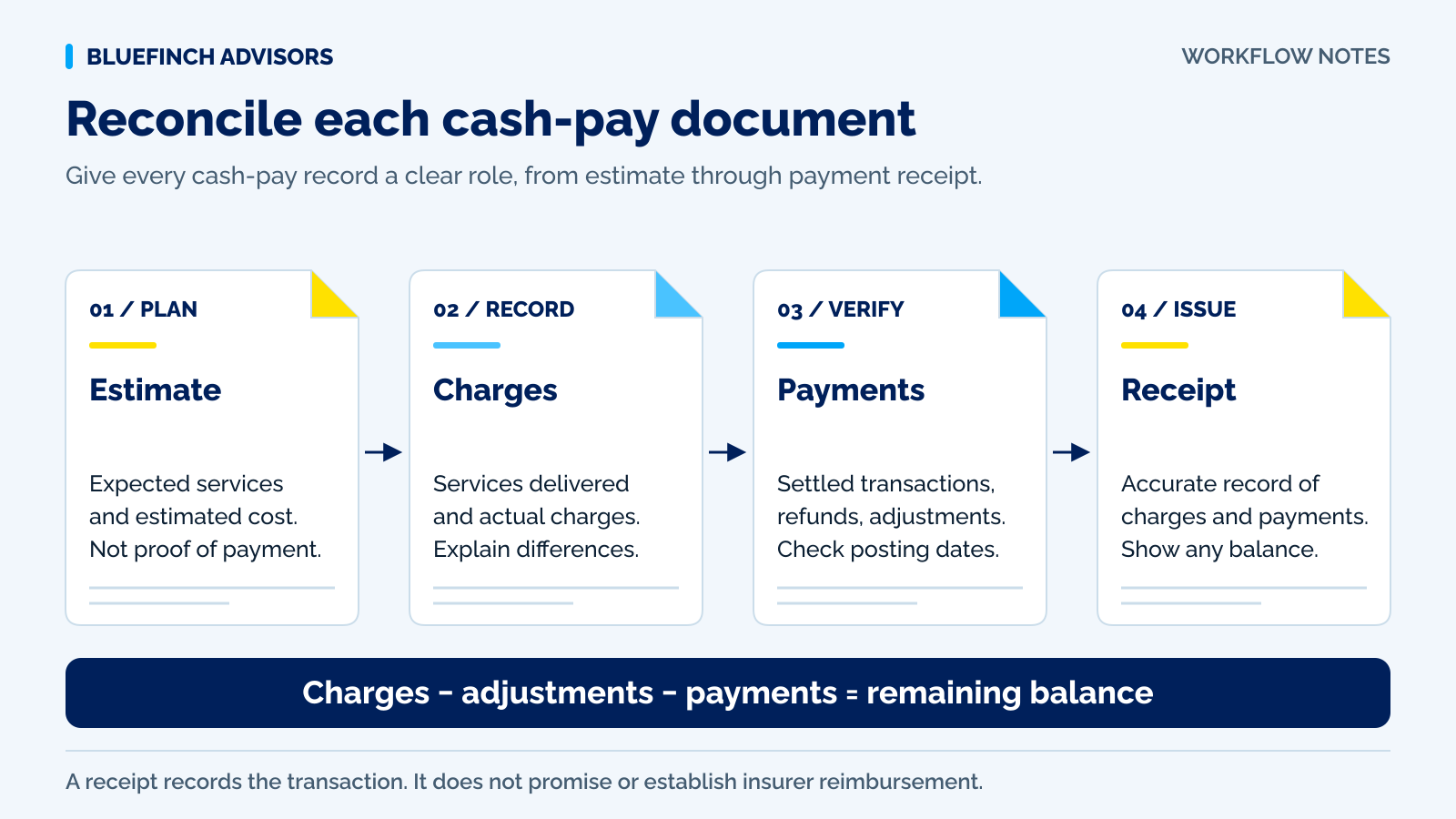
- Record expected charges, visits delivered and payments received separately.
- Revise the estimate and payment schedule when the planned visit series changes.
- A superbill helps a patient request reimbursement; it doesn't guarantee the insurer will pay.
A patient prepays for several physical therapy visits, then the schedule changes after the evaluation. To explain the balance, your front desk needs to distinguish the expected charges, visits already delivered, payments received and unused package value.
This guide covers practices that collect directly from patients. Here, cash-pay describes that arrangement, not a requirement to use paper currency. Keep payment and settlement records for cards, checks and any other methods you accept.
Use with this guide
Wellness processing-cost calculator
Use actual card volume and fees to work out the cost of collecting patient payments.
Pilates class calculator: find the paid-seat break-even point
An occupied reformer doesn't always earn the drop-in price. Use actual allocated revenue per paid attendance to check which classes cover their costs.
Browse the complete wellness center guides and worksheets.
Know which question each document answers
Use the estimate for expected charges, the service record for delivered visits, the invoice for billed charges and the receipt for money paid. The package ledger connects a prepayment with the services it covers. Staff can then explain a changed plan without rewriting earlier payments.
APTA provides resources for cash-based practices, and WebPT's cash-based physical therapy guide explains superbills for reimbursement requests. A superbill includes more than a basic payment receipt. Prepare it through your practice's billing process without promising what an insurer will reimburse.
Sources for this section: American Physical Therapy Association: cash-based practice · WebPT: superbills for cash-based physical therapy
Keep the required estimate in the payment process
CMS publishes good-faith-estimate requirements and model resources for uninsured or self-pay patients. Its recurring-service FAQ includes physical therapy. Under that guidance, one estimate for recurring care should specify the expected scope, frequency and number of services and cover no more than 12 months.
Follow current CMS resources and your practice's compliance process for when to provide an estimate, what it includes, updates and retention. The worksheet below helps reconcile financial records. It doesn't replace the required estimate or decide which rules apply to a patient.
Sources for this section: CMS: recurring-service good faith estimates for uninsured or self-pay patients · CMS: provider requirements and resources
Example: an evaluation and six follow-up visits
In this fictional practice, an evaluation costs $200 and six follow-up visits cost $150 each, for an expected $1,100 total. The patient pays the $200 evaluation fee and prepays $900 for follow-ups. Once the evaluation and two follow-ups are delivered, $500 of service is complete and $600 remains allocated to four unused visits.
Suppose the practice agrees to remove one unused visit and issues a $150 refund under the applicable terms. Net payments are then $950: $500 for delivered service and $450 allocated to three remaining visits. The example uses equal per-visit values, an approved refund and no other adjustments. It neither sets a required refund policy nor recommends a treatment schedule.
| Fictional account | Calculation | Amount |
|---|---|---|
| Expected evaluation plus follow-ups | $200 + (6 × $150) | $1,100 |
| Delivered evaluation plus two visits | $200 + (2 × $150) | $500 |
| Unused allocation before adjustment | 4 × $150 | $600 |
| Net collected after approved refund | $1,100 − $150 | $950 |
| Remaining allocation after adjustment | 3 × $150 | $450 |
Give the front desk the current plan
When the clinician changes the expected visit series, update it through your estimate and billing process. Give staff the current version, charges and payment arrangement. Rescheduling an appointment shouldn't silently change the visits a package covers or create another charge.
Retain the earlier estimate and identify its replacement. Distinguish added visits, rescheduled visits, unused package visits and reversed payments. Similar-looking calendar changes can affect the account differently.
Use the printable estimate-to-payment worksheet
Try the worksheet with a practice account reference rather than patient details. Store completed patient records in your approved system, and check actual receipts before explaining a balance.
| Account record | Count / amount | Date / reference |
|---|---|---|
| Current estimate version | ________________ | ________________ |
| Expected services and charges | $_______________ | ________________ |
| Package visits purchased | ________________ | ________________ |
| Visits delivered | ________________ | ________________ |
| Payments received | $_______________ | ________________ |
| Approved change or credit | $_______________ | ________________ |
| Refund issued | $_______________ | ________________ |
| Unused visits / prepaid allocation | ________________ | ________________ |
| Receipt or superbill provided | ________________ | ________________ |
Download it free, with no email signup. Add business or customer details only to your own copy.
Record merchant fees separately from patient payments
If the processor deposits less than the gross card payment, that difference isn't a new patient balance. Match the receipt to the gross payment and record merchant fees separately. This also keeps partial refunds distinct from processor adjustments.
Before changing prices patients see, review relevant payer agreements, applicable requirements and the processor-approved program. Use consistent disclosed prices on the estimate, booking page, payment request and receipt. Patients should be able to understand their account without reading your merchant statement.
Questions business owners ask
Can a prepaid package take the place of a good faith estimate?
The package records services purchased and payments received. Meet the applicable good-faith-estimate requirements separately, following current CMS guidance and your practice's process.
Can a payment receipt serve as a superbill?
No. A receipt confirms payment, while a superbill includes additional billing information for requesting reimbursement. Prepare each through your practice's approved process.
Primary sources
BlueFinch last reviewed these sources on September 7, 2026. Payment rules and state requirements can change.
- American Physical Therapy Association: cash-based practice
- WebPT: superbills for cash-based physical therapy
- CMS: recurring-service good faith estimates for uninsured or self-pay patients
- CMS: provider requirements and resources
Use this page for general business information. It is not legal, tax, or accounting advice.