Calculate the paid seats needed to cover costs
Test one class using realized revenue per seat and whole paid attendance counts.
Use the interactive tool without signing up. It runs in your browser: enter your numbers, save a comparison, download results or print a working copy. Your numbers are not sent to BlueFinch.
Illustrative example inputs
These starting values show how the math works. They are not industry averages, customer results or a quote.
| Input | Example value |
|---|---|
Available class seats Count whole usable reformers or seats permitted for this class. | 12 |
Paid attendance seats Count whole paid attendances; don't include complimentary spots as revenue. | 8 |
Allocated revenue per paid seat Use average revenue after discounts and package allocation. Enter zero fees if the amount is already net of them. | $25.00 |
Other variable cost per paid seat Count per-attendee costs without repeating payment fees or instructor pay entered elsewhere. | $1.00 |
Loaded instructor cost for the class Use flat class compensation including prep, applicable employment costs and owner teaching time. | $65.00 |
Other fixed cost allocated to the class Allocate room, equipment or other class costs consistently without counting instructor pay again. | $25.00 |
Allocated payment rate Apply this percentage to entered revenue. Use a blended rate for mixed payments, or zero if fees are already deducted. | 3% |
Allocated fixed payment fee per seat Allocate part of the original payment fee to each visit; fractional cents are allowed. Redemption doesn't create a new charge. | $0.10 |
Example results
| Measure | Result |
|---|---|
Paid seats to break even | 4 |
Class contribution after entered costs | $95.20 |
Break-even occupancy | 33.33% |
Calculation detail
| Measure | Result |
|---|---|
| Allocated revenue from paid seats | $200.00 |
| Allocated payment fee per seat | $0.85 |
| Contribution per paid seat | $23.15 |
| Fixed class costs | $90.00 |
| Contribution at full capacity | $187.80 |
| Seats beyond capacity needed to break even | 0 |
Model assumptions
- Use one average allocated revenue and variable cost for each paid attendance.
- Instructor cost is a flat class amount. Revise the cost scenario for attendance bonuses or percentage-based pay.
- Allocate payment costs from the original sale; redemption isn't another charge.
- Capacity sets an attendance limit, not a sales prediction. Defaults are fictional examples.
Read alongside these results
- For member and package visits, use actual allocated revenue per paid attendance instead of the drop-in price. Redemption isn't another card transaction.
- Allocate percentage and fixed payment costs per paid seat, or enter zero if seat revenue already deducts them.
- Include flat instructor cost for this class even if the owner teaches. Adjust the scenario for tiered attendance bonuses.
- Studio overhead not allocated to other class costs is excluded. Capacity limits don't predict paid attendance.
Download this worked example (CSV). Use the interactive version to export your own inputs and results.
Download infographic (PNG) · Download vector (SVG) · Link to the source and methodology


The short version
- Use collected or allocated value for each paid attendance instead of the menu's drop-in price.
- Include flat instructor compensation as a class cost, even when the owner teaches.
- Check the whole-seat break-even count against usable reformers or class capacity.
Eight people attend using a mix of class packs, memberships and one drop-in payment. Pricing all eight seats at the drop-in rate would credit the studio with revenue it didn't collect.
Enter average allocated revenue per paid attendance, flat instructor cost and class capacity to compare one class with its costs. The sample is fictional; it doesn't predict attendance or whole-studio profit.
Use with this guide
Wellness processing fee calculator
Check monthly processing costs separately from the operating result of a single class.
Yoga guest workshops: define the revenue-share base before tickets go on sale
Before agreeing to a percentage split, define which revenue it covers and when payment is due.
Browse the complete wellness center guides and worksheets.
Allocate revenue to the attendance it covers
A ten-visit pack sold for $220 allocates $22 per visit under a simple equal-value method, before other adjustments. For memberships with varying attendance, document an allocation basis and use it consistently across classes. Don't assign the entire membership sale to each class attended.
Square separates package purchases from later redemptions in its workflow. Keep the original sale and fee allocation in your records; redemption isn't a second payment transaction. If allocated seat revenue is already net of processing costs, enter zero in both fee fields.
Sources for this section: Square: package purchases and service redemptions
Include instructor cost before judging the class result
Record flat instructor pay separately from per-seat expenses. Include prep or closing work and applicable employment costs in the loaded amount. An owner also supplies labor when teaching, so leaving instructor cost at zero would overstate the economic result.
Mindbody recommends attendance and capacity reports for evaluating classes and staffing. Compare those records with actual paid-seat value. A crowded class sold at discounts can contribute less than a smaller one with a different price mix.
Sources for this section: Mindbody: class capacity, attendance, and staffing reports
Example: $90 in class costs needs four paid seats
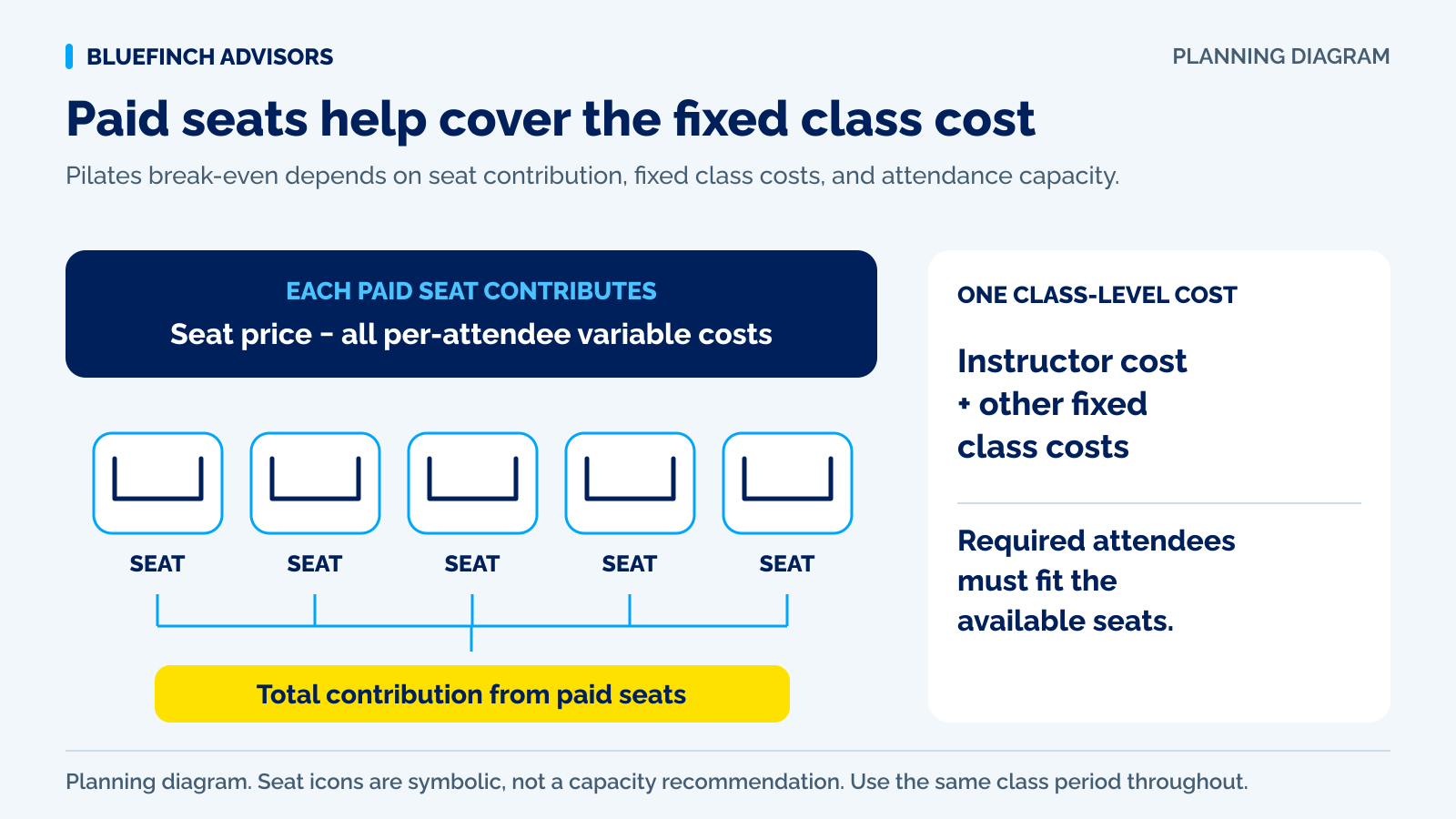
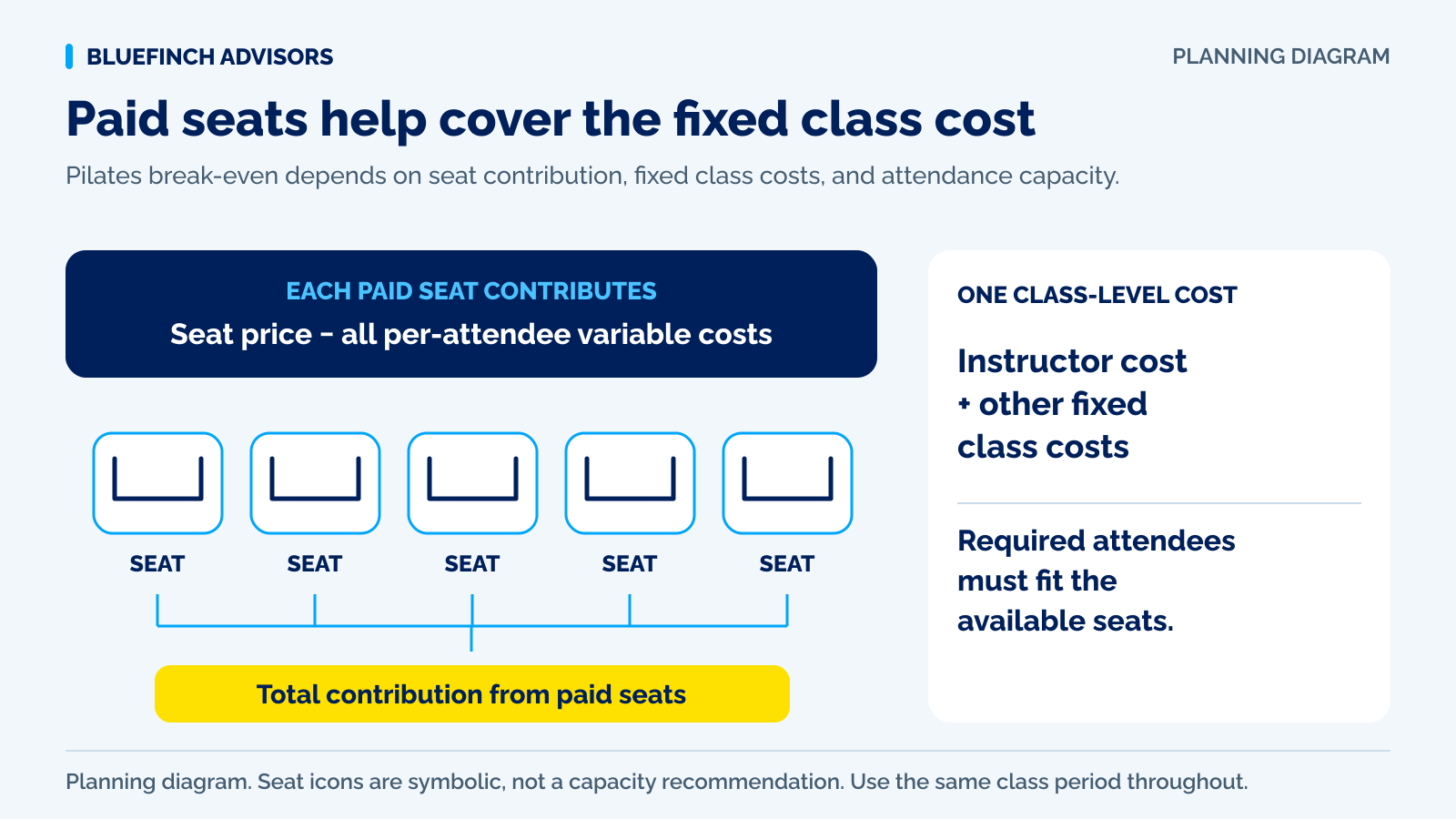
The fictional class has 12 seats and eight paid attendees, each with $25 of allocated revenue. Payment cost per seat is $0.85 from 3% plus $0.10 allocated fixed cost. Deduct another $1 of variable cost to leave $23.15 contribution. Instructor pay of $65 and other class costs of $25 total $90.
Using the SBA's fixed-cost divided by unit-contribution approach, $90 ÷ $23.15 rounds up to four paid seats. Eight seats leave $95.20 after entered costs. Break-even fills one-third of the 12-seat capacity, but any studio expenses omitted still need coverage.
| Fictional class | Amount |
|---|---|
| Revenue from eight paid seats | $200.00 |
| Allocated payment costs | $6.80 |
| Other variable attendee costs | $8.00 |
| Instructor and other fixed class costs | $90.00 |
| Class contribution after entered costs | $95.20 |
Sources for this section: U.S. Small Business Administration: break-even calculation
Test changes before deciding what a weak class needs
Compare the same day and time over several weeks, using actual paid attendance and price mix. Change one assumption at a time: lower allocated seat revenue, the next instructor pay tier or fewer usable reformers. If break-even needs more seats than capacity, filling the class still won't cover modeled costs.
The class result is withheld if paid seats exceed capacity. Complimentary attendees also use seats, so reserve them before assessing paid attendance. Include meaningful variable costs of free attendees in the class allocation. Before changing the schedule based on one result, check effects on member access, retention and nearby classes.
Questions business owners ask
Can I value a class-pack visit at the drop-in price?
Use actual allocated pack revenue, not a price the member didn't pay. Follow one documented method consistently for the classes compared.
How can a full class still miss break-even?
Its available seats may not leave enough contribution for instructor pay and other entered costs. The calculator identifies required paid attendance above capacity.
Where do prepaid-pack payment fees go?
Allocate the original payment cost across visits using your chosen method. Don't add a new transaction fee whenever a prepaid visit is redeemed.
Primary sources
BlueFinch last reviewed these sources on September 7, 2026. Payment rules and state requirements can change.
- Square: package purchases and service redemptions
- Mindbody: class capacity, attendance, and staffing reports
- U.S. Small Business Administration: break-even calculation
Use this page for general business information. It is not legal, tax, or accounting advice.