Check one restoration project's balances
Use cumulative totals for one project at one cutoff date. Include deposits in receipts, then identify the amount already applied to invoices.
Use the interactive tool without signing up. It runs in your browser: enter your numbers, save a comparison, download results or print a working copy. Your numbers are not sent to BlueFinch.
Illustrative example inputs
These starting values show how the math works. They are not industry averages, customer results or a quote.
| Input | Example value |
|---|---|
Original approved scope Enter the original approved amount before tax, using the same basis throughout. | $40,000.00 |
Authorized additions Include approved additions only. To model a scope reduction, revise this snapshot's approved base amount. | $5,000.00 |
Completed-work value at this review Use the documented value of completed milestones, not an amount inferred from receipts or the percentage billed. | $18,000.00 |
Total invoiced to date Count issued progress invoices once. Leave out drafts not issued and deposit requests not invoiced. | $15,000.00 |
Total cash received to date Count payments and advances once before payment fees, whether or not applied to an invoice. | $12,000.00 |
Received cash applied to invoices Enter the portion of receipts applied to invoices. It isn't another payment; exclude unallocated deposits. | $10,000.00 |
Direct job costs paid to date Count direct expenses actually paid, including payment fees if desired. Unpaid purchase orders aren't cash outlays. | $9,000.00 |
Example results
| Measure | Result |
|---|---|
Invoiced balance after applied payments | $5,000.00 |
Completed work minus invoiced amount | $3,000.00 |
Cash received but not applied | $2,000.00 |
Cash received less paid direct costs | $3,000.00 |
Calculation detail
| Measure | Result |
|---|---|
| Original approved scope | $40,000.00 |
| Authorized additions | $5,000.00 |
| Current approved scope | $45,000.00 |
| Completed-work value entered | $18,000.00 |
| Invoiced to date | $15,000.00 |
| Cash received to date | $12,000.00 |
| Cash applied to invoices | $10,000.00 |
| Approved scope not yet invoiced | $30,000.00 |
| Direct job costs paid | $9,000.00 |
Model assumptions
- The default project is fictional, not a customer case or a recommended billing schedule.
- Use one cutoff date and before-tax figures consistently. Refunds, credit notes and retainage aren't modeled separately.
- Management enters its assessment of completed-work value. Earned revenue depends on the agreement and accounting treatment.
- Negative differences stay visible for review. The calculator doesn't supply authorization, apply deposits automatically or issue invoices.
Read alongside these results
- You supply the completed-milestone value. It isn't a calculation of recognized accounting revenue.
- Applied cash is already included in receipts. Applying it to invoices doesn't mean receiving it again.
- If completed work exceeds billing, review that work against the billing agreement. A negative difference means billing is ahead of completed work entered.
- Receipts minus paid direct costs show cash at this cutoff, not profit. Unpaid costs, overhead and tax are excluded.
Download this worked example (CSV). Use the interactive version to export your own inputs and results.
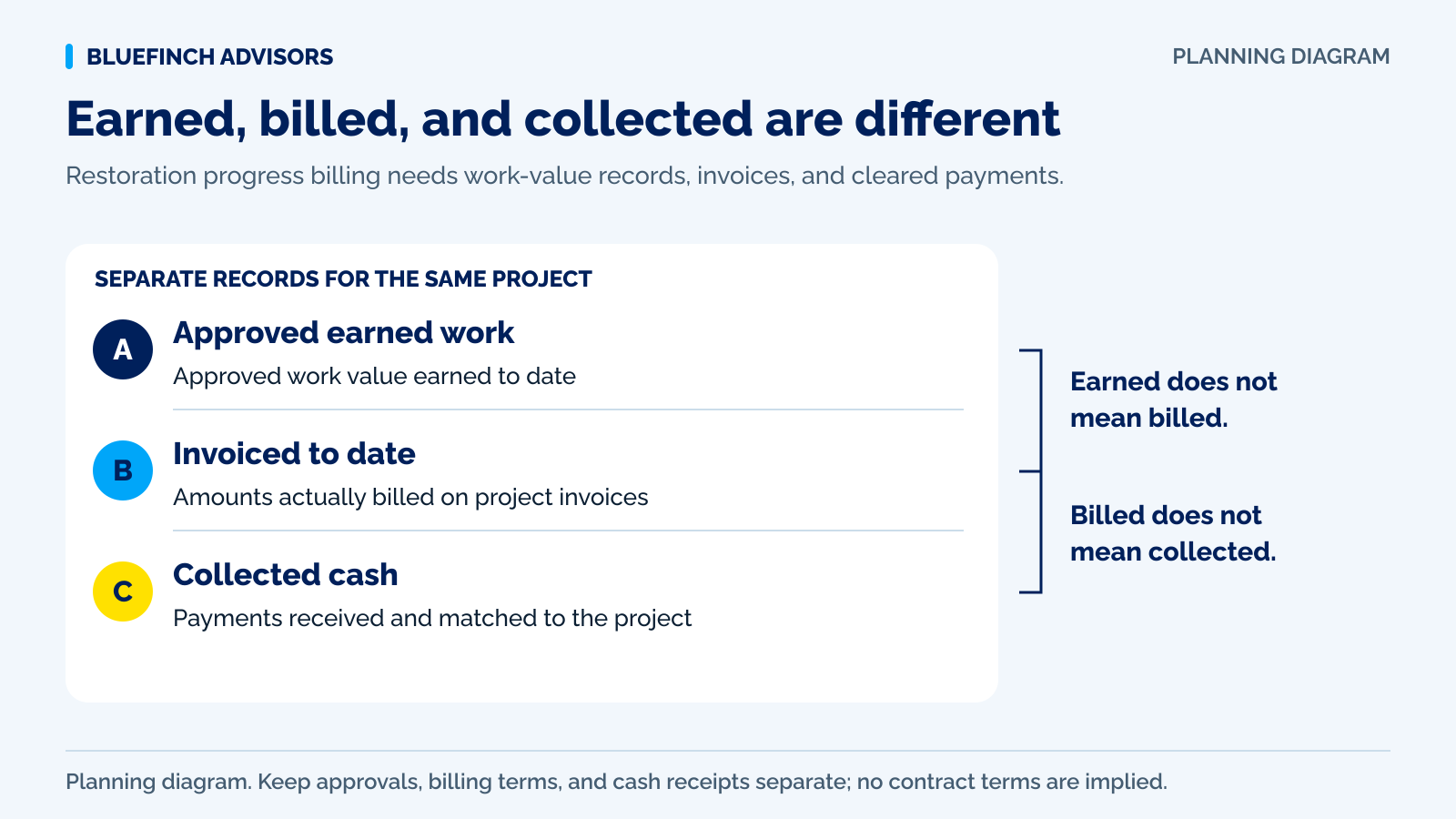
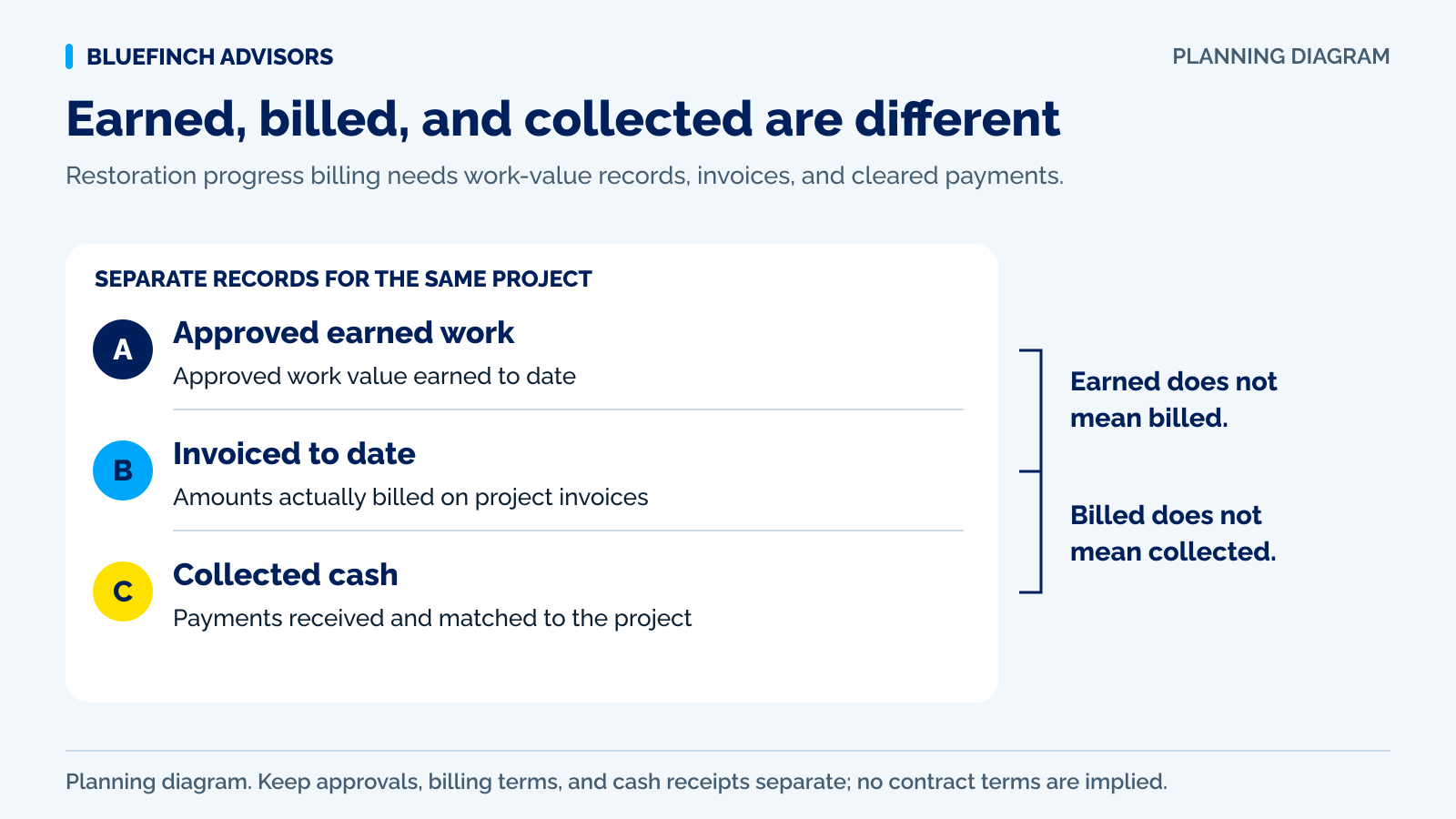
Download infographic (PNG) · Download vector (SVG) · Link to the source and methodology

The short version
- Track approved scope, completed-work value, invoices and receipts independently.
- Applying cash to an invoice doesn't create another receipt.
- Review unbilled work against the agreement before charging for it.
A restoration moves through approved stages, but the paperwork may lag behind. Body preparation might be finished while the invoice still covers only teardown. Meanwhile, a customer advance may remain unapplied to either stage's invoice.
Keep those records separate with this worksheet. It shows invoice balances, completed work to review for billing, unapplied cash and receipts left after paid direct costs. The example is fictional and doesn't choose a revenue-recognition method for your business.
Use with this guide
Job cash flow planner
Track when payments become available and when job expenses leave the bank.
Browse the complete auto repair guides and worksheets.
Trace each invoice to the approved scope
Intuit links multiple partial invoices to one estimate in its progress-invoicing workflow, with the estimate and invoices available for review. Use that approach to keep one current scope record and trace each progress invoice to it.
Here, approved scope adds authorized additions to the original amount. Use milestone records for completed-work value, issued invoices for billed value and collections for cash received. Don't substitute one total for another. Save a dated snapshot so a later scope change doesn't overwrite what the office knew at this review.
Sources for this section: Intuit: set up and send progress invoices
Example: applying a deposit without counting another receipt
The fictional project starts with $40,000 of scope and $5,000 in authorized additions. Completed work is valued at $18,000; issued invoices total $15,000 and receipts total $12,000. Of the receipts, $10,000 is applied to invoices and $2,000 remains unapplied.
That leaves $5,000 on the issued invoices. The $3,000 by which completed work exceeds billing needs review against the billing agreement. Receipts less $9,000 of paid direct costs leave $3,000 in cash, including the unapplied advance. That cash balance isn't profit or a measure of completed work.
| Separate reconciliation | Calculation | Result |
|---|---|---|
| Outstanding invoice balance | $15,000 - $10,000 | $5,000 |
| Completed work minus billed amount | $18,000 - $15,000 | $3,000 |
| Cash not yet applied | $12,000 - $10,000 | $2,000 |
| Cash less paid direct costs | $12,000 - $9,000 | $3,000 |
| Approved scope not yet invoiced | $45,000 - $15,000 | $30,000 |
Reconcile differences before issuing the next invoice
When invoices exceed completed-work value, check the agreed stage or advance billing terms. A positive or negative difference shows the gap's direction, not whether the invoice is wrong. If applied cash exceeds receipts, reconcile payments before using the balances.
If billed or completed value exceeds approved scope, check the latest authorization and scope version. California BAR's Write It Right guide requires recorded authorization for additional repairs. That guidance is specific to California; document changes under the requirements that apply to your shop.
Sources for this section: California Bureau of Automotive Repair: Write It Right
Give the customer a traceable account statement
Show approved scope, issued invoices, received payments, how those payments were applied and any unapplied cash. Let the customer follow the earlier deposit through to today's invoice balance. Applying a deposit to an invoice doesn't mean it was received again.
Use a dated cash plan too if you need to know whether the next parts order is funded. This calculator captures one cutoff date; it doesn't forecast supplier due dates, payroll, late collections or the cost of finishing the remaining work.
Questions business owners ask
Is completed-work value the same as earned accounting revenue?
It is your value for documented completed milestones at this review. The calculator neither chooses an accounting method nor determines recognized revenue.
Why can the invoice balance exceed the project's total cash gap?
Invoice balances deduct payments applied to those invoices. An unapplied advance is still part of total receipts until you apply it in your records. Both amounts are shown separately.
Can I charge automatically for completed work that isn't billed?
No. Check completed scope against the agreed billing milestone before issuing the next progress invoice.
Primary sources
BlueFinch last reviewed these sources on September 7, 2026. Payment rules and state requirements can change.
Use this page for general business information. It is not legal, tax, or accounting advice.