Plan repeated panel cuts
Separate finished area, full-width cut strips, and new-roll purchasing cash.
No signup. The interactive tool runs in your browser tab. Change the inputs, save a comparison, download the results, or print a working copy. Your entered numbers are not sent to BlueFinch.
Illustrative example inputs
Starting values demonstrate the math. These are not industry averages, a customer result, or a quote.
| Input | Example value |
|---|---|
| Roll width, inches | 60 |
| Length per roll, feet | 150 |
| Finished panel width, inches | 20 |
| Finished panel length, inches | 30 |
| Total allowance per dimension, inches | 0.5 |
| Identical panels required | 18 |
| Price per full roll | $950.00 |
Example results
| Measure | Result |
|---|---|
| New whole rolls required | 1 |
| Cut-strip material cost | $144.88 |
| New-roll purchase cost | $950.00 |
Calculation detail
| Measure | Result |
|---|---|
| Panels across the roll | 2 |
| Rows per full roll | 59 |
| Rows needed | 9 |
| Total cut-strip length (feet) | 22.88 |
| Full-width cut-strip area (sq ft) | 114.38 |
| Finished rectangular panel area (sq ft) | 75 |
| Trim and unfilled cut-strip area (sq ft) | 39.38 |
| Panels per full roll | 118 |
Model assumptions
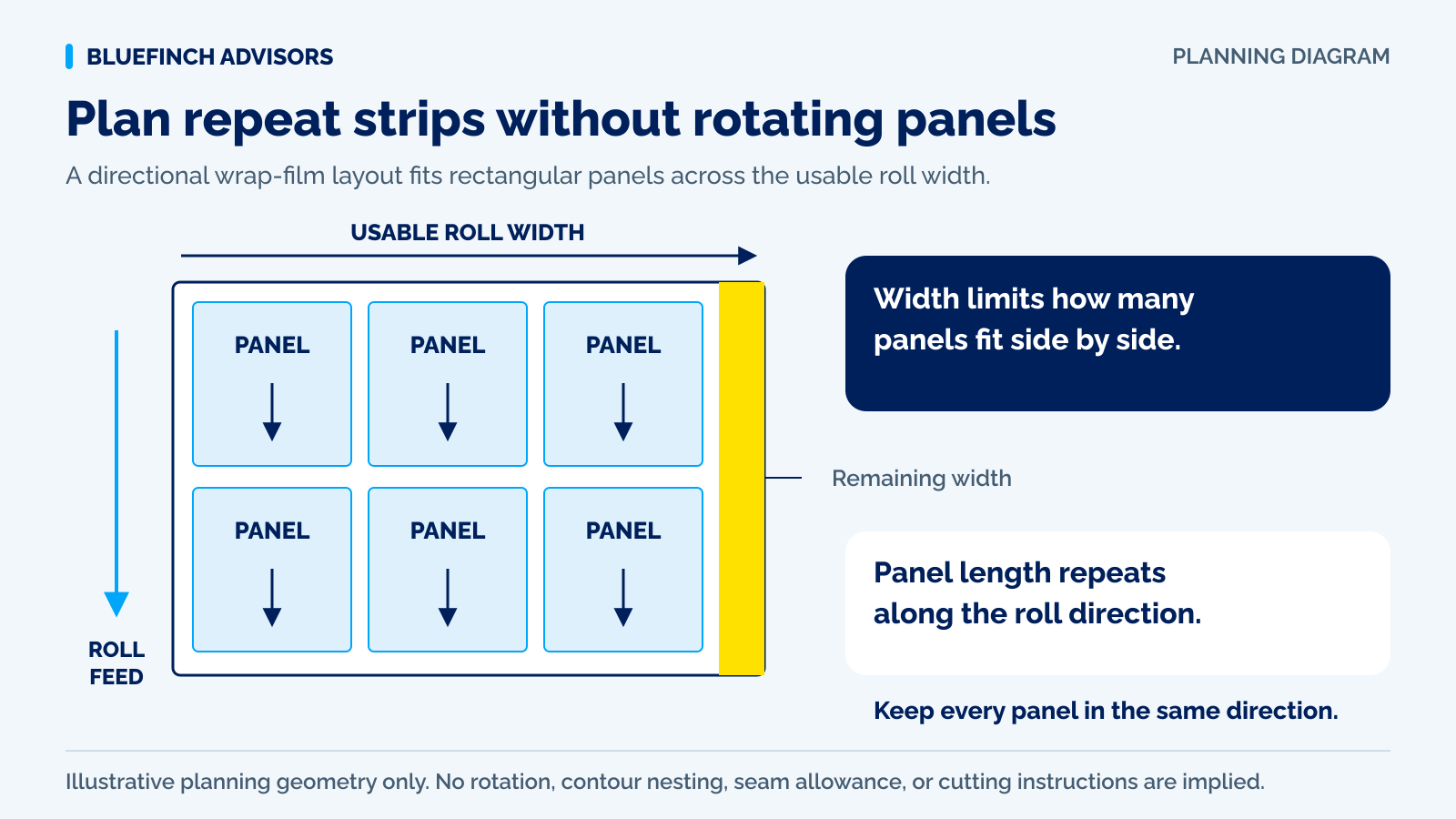
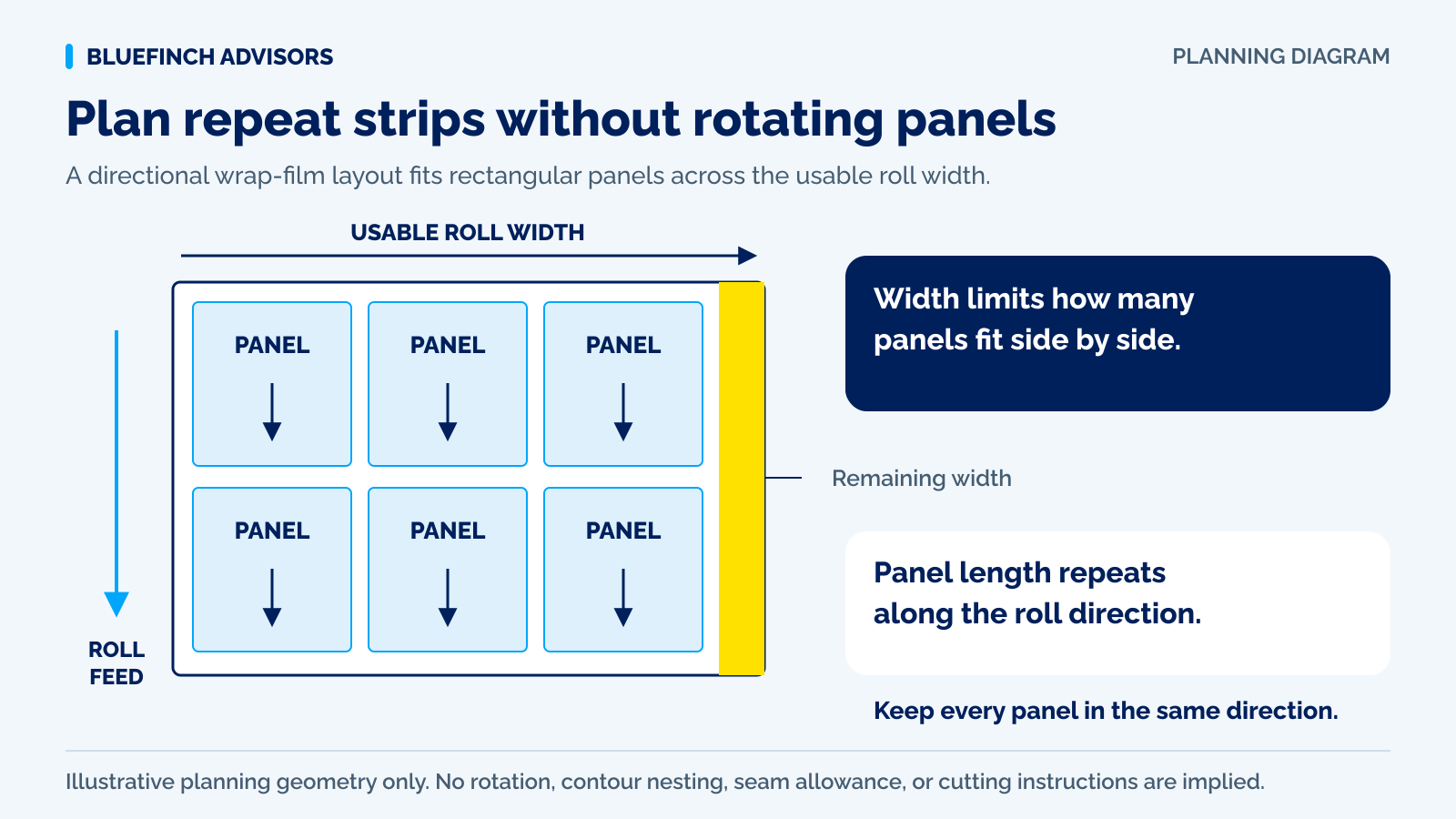
- All panels share one size and direction. No nesting, rotation, seams, stretching, or vehicle-pattern fitting.
- New-roll purchasing starts with no usable stock on hand.
- The total cut-strip length combines the rows cut from all rolls. Unusable tails between rolls are excluded from cut-strip cost but remain part of whole-roll purchasing cash.
- Every starting value is an illustrative input, not a supplier specification or waste benchmark.
Read alongside these results
- Identical rectangular cuts, fixed orientation, no rotation or nesting optimization. Allowance adds once to each panel dimension, not to each edge.
- Roll purchase assumes no existing stock. Cut-strip cost excludes unused roll tails, reprints, vehicle fit, and installation waste.
Download this worked example (CSV). The interactive version also exports your own inputs and results.
Download infographic (PNG) · Download vector (SVG) · Link to the source and methodology


The short version
- Enter finished panel dimensions plus one total allowance for each dimension.
- Compare material used with the cash needed to buy whole rolls.
- Keep film orientation fixed and verify the actual vehicle pattern separately.
Eighteen identical door graphics are ready for production. You need the cut length, the number of rolls to order, and the material cost assigned to the job. The unused part of a purchased roll should not quietly become waste in the quote.
This planner handles repeated rectangles in one orientation. Enter your dimensions and supplier price. The sample is fictional. This is not a full-vehicle wrap estimator, a panel-fitting system, or an optimized nesting engine.
Use with this guide
Job cash-flow planner
Place material purchases, labor payments, deposits, and final collections on a project timeline.
Keep film direction out of the cutting shortcut
Rotating a rectangle might appear to save material. For some wrap products, changing orientation also changes the installed appearance. 3M's Series 2080 FAQ identifies directional characteristics in certain films and calls for consistent orientation between panels. Check the specific product before production.
This planner holds the entered direction fixed. Width runs across the roll. Length runs along the roll. If the panel plus allowance exceeds either usable roll dimension, the purchasing result stays blank instead of pretending the job requires zero film.
Sources for this section: 3M: Wrap Film Series 2080 installation FAQ and film direction
Count full rows before comparing costs
Divide usable roll width by panel width plus allowance, then round down for panels across. Divide required panels by panels across, then round up for rows needed. A partially filled final row still consumes a full-width strip.
The planner checks how many complete rows fit on one roll. New-roll count follows from those complete rows, not from total square footage alone. A long panel might leave an unusable tail on every roll even when the overall area looks sufficient.
| Measure | What the number means |
|---|---|
| Finished panel area | Rectangles delivered, before cutting allowance |
| Full-width cut-strip area | Roll width multiplied by all occupied row lengths |
| Cut-strip material cost | Share of roll price assigned to those strips |
| Whole-roll purchase cost | Cash for new full rolls, including remaining stock |
Example: 18 panels from a 60-inch roll
The fictional sample uses 20-by-30-inch panels, a 0.5-inch total allowance per dimension, and a 60-inch-wide, 150-foot roll priced at $950. Two panels fit across. Eighteen panels need nine rows, each 30.5 inches long. The total cut length is 274.5 inches, or 22.875 feet.
Those strips occupy 114.375 square feet. Finished panels occupy 75 square feet. The difference is 39.375 square feet of allowance, trim, and unfilled strip area. The consumed strip share costs $144.875, displayed as $144.88. Buying one new roll still requires $950. The difference is not a second job expense. Much of the roll remains in inventory.
Turn the estimate into a production check
Before ordering, verify usable stock, lot requirements, artwork scale, contour-cut margins, lamination, edge handling, and the actual vehicle layout. 3M's vehicle application bulletin provides manufacturer-specific preparation and installation guidance. This rectangle calculation does not replace those checks.
Record reprints, damage, and unusable stock separately after the job. That gives your next quote actual production evidence. Use the job cash-flow planner when a deposit must fund a roll purchase before the customer pays the balance.
Sources for this section: 3M: vehicle graphics application bulletin, July 2026 revision
Questions business owners ask
Does this calculate film for a complete vehicle wrap?
No. It calculates identical rectangular panels from the entered roll dimensions. Vehicle geometry, seams, overlap, and installation requirements need a separate production layout.
Why is new-roll cost higher than cut-strip cost?
New-roll cost purchases all the stock. Cut-strip cost assigns only the occupied strips to this production run. Remaining usable film stays available for later work.
Does the allowance apply to every edge?
No. The entered allowance adds once to each dimension. Add both edge requirements together before entering the total.
Primary sources
BlueFinch reviewed these sources on September 7, 2026. Payment rules and state requirements change.
- 3M: Wrap Film Series 2080 installation FAQ and film direction
- 3M: vehicle graphics application bulletin, July 2026 revision
This page provides general business information, not legal, tax, or accounting advice.