The short version
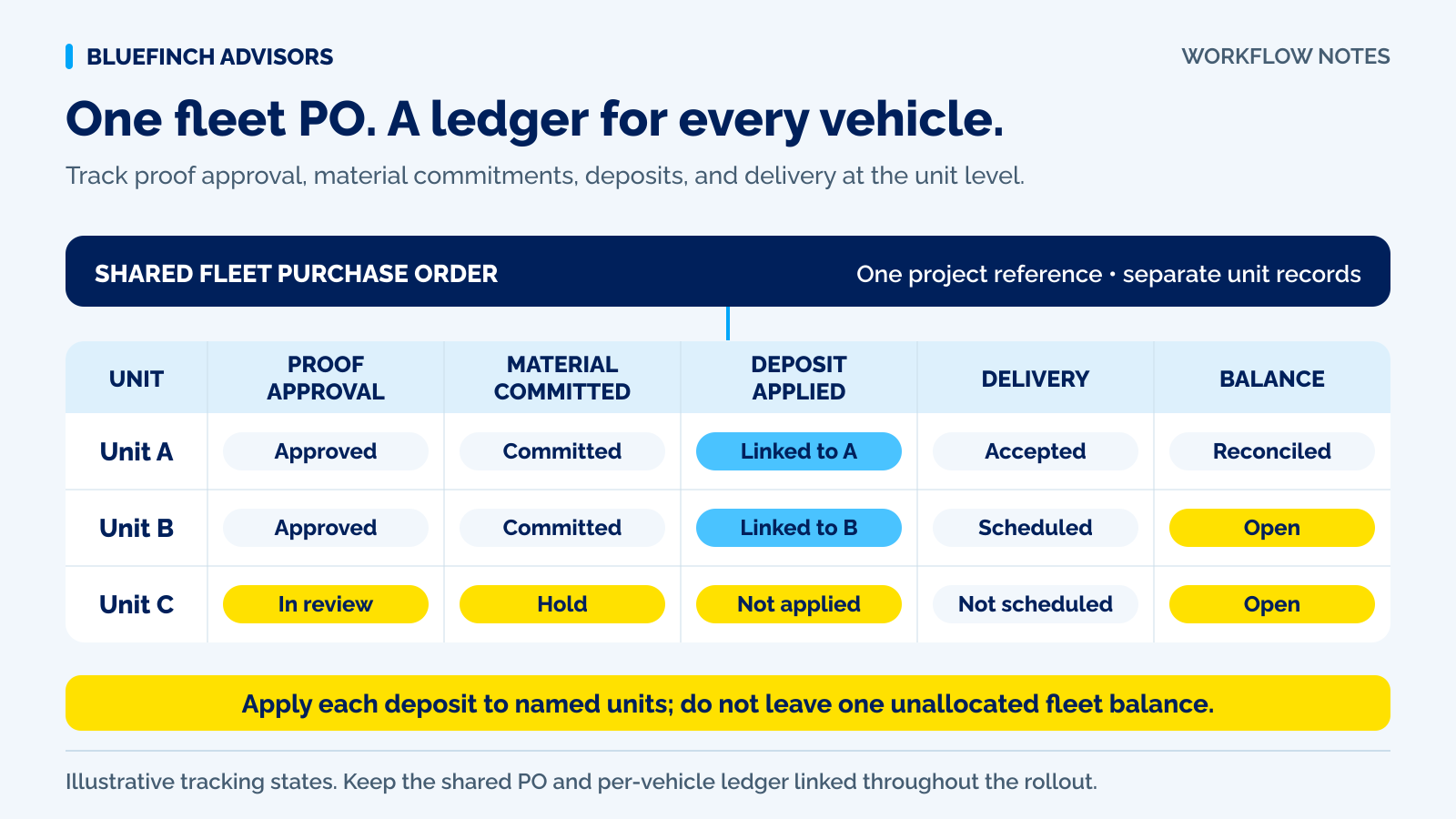
- Assign each vehicle a scope, proof version and share of the payments.
- A corporate PO or approved credit terms are not money in the bank.
- Reconcile payments by phase and apply the project deposit only once.
A fleet approves four vans, but just two arrive this week. The third has a different roof height and the fourth needs a repair first. The project total hasn't changed, but material orders, installation slots and payments now follow different dates.
Keep a vehicle-by-vehicle ledger under the fleet account. You can coordinate the rollout for the buyer while tracking each unit's approved proof, committed film and balance at delivery.
Use with this guide
Job cash-flow planner
Track committed cash and collected payments at each project milestone.
Fleet invoice checklist
Gather approvals, vehicle details, purchase-order references and billing records before sending the invoice to accounts payable.
Vehicle wrap film roll planner: calculate repeated rectangular cuts
Separate film consumed on a job from the cost of buying a roll. Plan repeated rectangular cuts while keeping directional film in the same orientation.
Fleet wrap remittances: find the short payment without rewriting the job
One transfer may cover several vehicles without settling every balance. Match its allocation before marking the rollout paid.
Delayed fleet vehicles: track install slots and paid work
Track delayed fleet vehicles separately from deposits and install capacity. Use the slot register to keep readiness, approved changes and payment milestones visible.
Browse the complete vehicle wrap guides and worksheets.
Confirm the rollout and the scope for each vehicle
Record the fleet's billing name, project reference, vehicles, quantities and authorized buyer. Note whether one purchase order covers the whole rollout or each phase has its own. Match every vehicle identifier to its body style, coverage and proof version.
SigmaGrafix describes starting with a quote and deposit, or a PO for pre-approved clients, then moving to artwork approval and production. That's one shop's workflow, not a deposit rule for everyone. State which approvals start design, printing, material orders and installation scheduling in your rollout.
Sources for this section: SigmaGrafix: deposit, artwork proof, and production workflow
Document each vehicle's condition
Approving the fleet logo says nothing about an individual van's condition. Keep its inspection, agreed removal or prep work and approved price changes with its order. When a replacement vehicle joins the rollout, confirm its scope before using an earlier proof or payment request.
3M recommends a signed pre-installation inspection record for each vehicle in its July 2026 vehicle-application bulletin. The installer should follow applicable manufacturer instructions. Use the record to match the agreed job and changes to the final invoice; a deposit doesn't authorize an undocumented substitution.
Sources for this section: 3M: Application: Vehicles instruction bulletin, July 2026 revision
Specify where the project deposit applies
Define how to allocate the project deposit. Your agreement may assign a portion to each vehicle or reserve an amount for a specific stage. Track what you received, what you've applied and what remains allocated to unfinished work.
A PO is a purchasing reference in the buyer's process, not a bank receipt. If you offer account terms, plan for material and labor payments due before you collect. An approved rollout can still leave you funding work as the vehicles are finished.
Example: collecting payment as four vans are delivered
This fictional rollout covers four vans at $3,500 each, totaling $14,000. The agreed $600 deposit per vehicle brings in $2,400 upfront. Paying $3,600 for all four vans' materials leaves an initial $1,200 cash gap, before labor and other expenses.
After two vans are finished and their $2,900 balances are collected, receipts total $8,200: the original $2,400 plus $5,800. Each unfinished van still has $600 of the original deposit allocated and $2,900 left to collect. Applying the full $2,400 again to the final invoice would count the deposit twice.
| Unit | Agreed price | Deposit applied | Balance status |
|---|---|---|---|
| Van 1 | $3,500 | $600 | $2,900 collected |
| Van 2 | $3,500 | $600 | $2,900 collected |
| Van 3 | $3,500 | $600 | $2,900 remaining |
| Van 4 | $3,500 | $600 | $2,900 remaining |
Give accounts payable the records needed for each delivery
Before the first delivery, confirm the buyer's required completion records. Visual Marking Systems asks installers for installation photos, vehicle-identification photos, a PO number and an invoice before processing payment. Its form illustrates why finishing the graphics and having an invoice ready for payment are different milestones.
Agree with your buyer which records each vehicle needs and who accepts them. Send the phase invoice with the correct PO and deposit applied, then track submission, acceptance and collection dates. Where your agreement permits phased billing, show completed units separately so a delayed vehicle doesn't hide their status.
Sources for this section: Visual Marking Systems: fleet graphics installer payment documentation
Use the printable fleet rollout ledger
Keep one sheet for each fleet project, with a row for every vehicle and references to its proof and acceptance. Add rows for substitutions and approved changes so earlier entries remain traceable.
| Vehicle / proof / PO reference | Price / deposit allocated | Delivery / remaining collection |
|---|---|---|
| Unit 1: ___________________ | $________ / $________ | ________________ |
| Unit 2: ___________________ | $________ / $________ | ________________ |
| Unit 3: ___________________ | $________ / $________ | ________________ |
| Unit 4: ___________________ | $________ / $________ | ________________ |
| Change: ___________________ | $________ / $________ | ________________ |
| Project totals: ___________ | $________ / $________ | ________________ |
Download it free, with no email signup. Add business or customer details only to your own copy.
Confirm corporate payment methods before production
Agree on accepted payment methods and prices with the authorized buyer before committing to the job. Don't spring a new price on the driver at pickup because accounts payable uses a corporate card. Check any dual-pricing arrangement against your contract and approved processing setup.
When the project closes, reconcile approved charges, deposits received, payments collected by phase, credits and the amount left to collect. Make the final statement concise, with each line tied to a vehicle.
Questions business owners ask
Is a fleet wrap deposit better set per vehicle or per project?
Either approach needs agreed terms and a written allocation method. Show where the deposit applies and what is still due after delivering only part of the fleet.
Can one approved design be used for every fleet vehicle?
Check each vehicle variant against its proof reference. Review the scope before production if body style, coverage, removal work or condition differs.
Primary sources
BlueFinch last reviewed these sources on September 7, 2026. Payment rules and state requirements can change.
- SigmaGrafix: deposit, artwork proof, and production workflow
- 3M: Application: Vehicles instruction bulletin, July 2026 revision
- Visual Marking Systems: fleet graphics installer payment documentation
Use this page for general business information. It is not legal, tax, or accounting advice.