Compare session contribution with available slots
Find how many whole sessions cover the operating costs entered.
Use the interactive tool without signing up. It runs in your browser: enter your numbers, save a comparison, download results or print a working copy. Your numbers are not sent to BlueFinch.
Illustrative example inputs
These starting values show how the math works. They are not industry averages, customer results or a quote.
| Input | Example value |
|---|---|
Monthly equipment operating allocation Use monthly rental or a consistent monthly operating allocation, not the full purchase price alongside monthly expenses. | $1,800.00 |
Monthly service and maintenance allocation Enter the month's fixed service costs without adding consumables already counted per session. | $300.00 |
Other fixed monthly service cost Add room or other service-specific costs only if not allocated elsewhere. | $400.00 |
Realized revenue per session Use actual allocated revenue after discounts and before the payment fees below. | $180.00 |
Consumables per session Count supplies, tips, disposables and other items consumed per delivered session. | $25.00 |
Paid provider minutes per session Total paid provider person-minutes for the session, including relevant work outside its device slot. | 30 |
Loaded provider cost per hour Count applicable employment costs and labor delivered by the owner once. | $60.00 |
Full device slot, minutes Include setup and turnover in device time. Follow actual clinical and manufacturer requirements when scheduling. | 45 |
Usable device hours this month Enter the usable time for one device after downtime and other work already committed. | 40 hours |
Planned completed sessions Count whole sessions expected to be delivered, with payment received or revenue properly allocated. | 35 |
Allocated payment rate Apply this percentage to entered revenue. Use a blended rate for mixed payments, or zero if fees are already deducted. | 3% |
Allocated fixed payment fee per session Spread package purchase fees across sessions, or enter zero if session revenue already deducts them. | $0.30 |
Example results
| Measure | Result |
|---|---|
Sessions to operating break-even | 21 |
Available whole session slots | 53 |
Planned operating result | $1,675.50 |
Calculation detail
| Measure | Result |
|---|---|
| Monthly fixed costs | $2,500.00 |
| Provider labor per session | $30.00 |
| Payment fee per session | $5.70 |
| Variable cost per session | $60.70 |
| Contribution per session | $119.30 |
| Break-even share of available slots | 39.62% |
| Session shortfall at break-even | 0 |
| Operating result at device-time capacity | $3,822.90 |
Model assumptions
- Use one average price, duration and variable cost per session. Model different procedures separately.
- Enter fixed costs on the same monthly operating basis. Purchase payback, depreciation and loan underwriting aren't assessed.
- Capacity reflects available device time, not guaranteed staffing or bookings.
- Allocate fees per delivered session. Default prices and costs are fictional examples.
Read alongside these results
- Operating break-even covers entered fixed and session costs only. It doesn't assess investment return, compare financing, recommend treatment or predict demand.
- Capacity uses device time after downtime and a full cycle with setup and turnover. Check staff and rooms separately when scheduling.
- This assumes one payment per session. Allocate package prices and fees, or enter zero fees if session revenue is already net.
Download this worked example (CSV). Use the interactive version to export your own inputs and results.
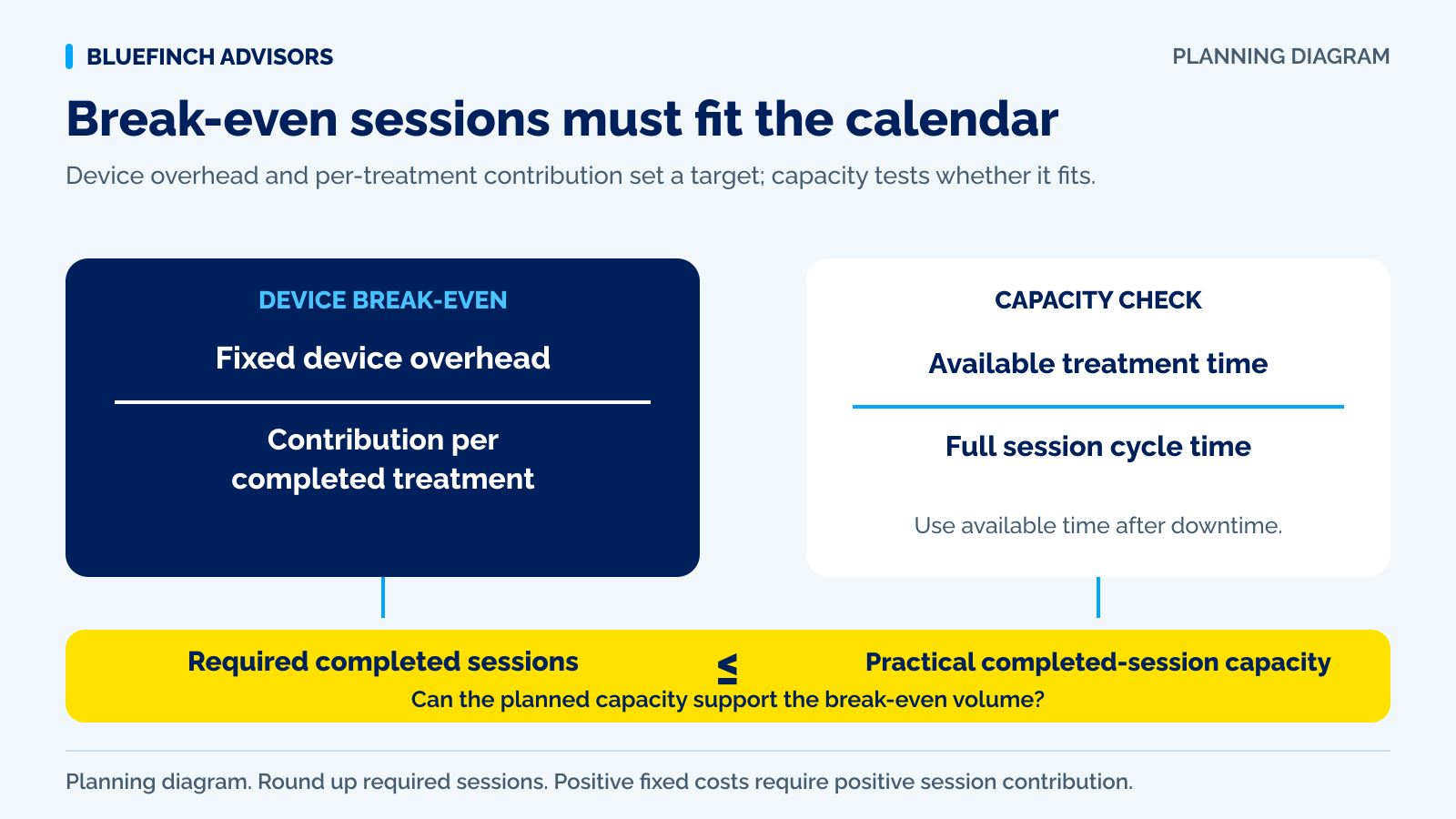
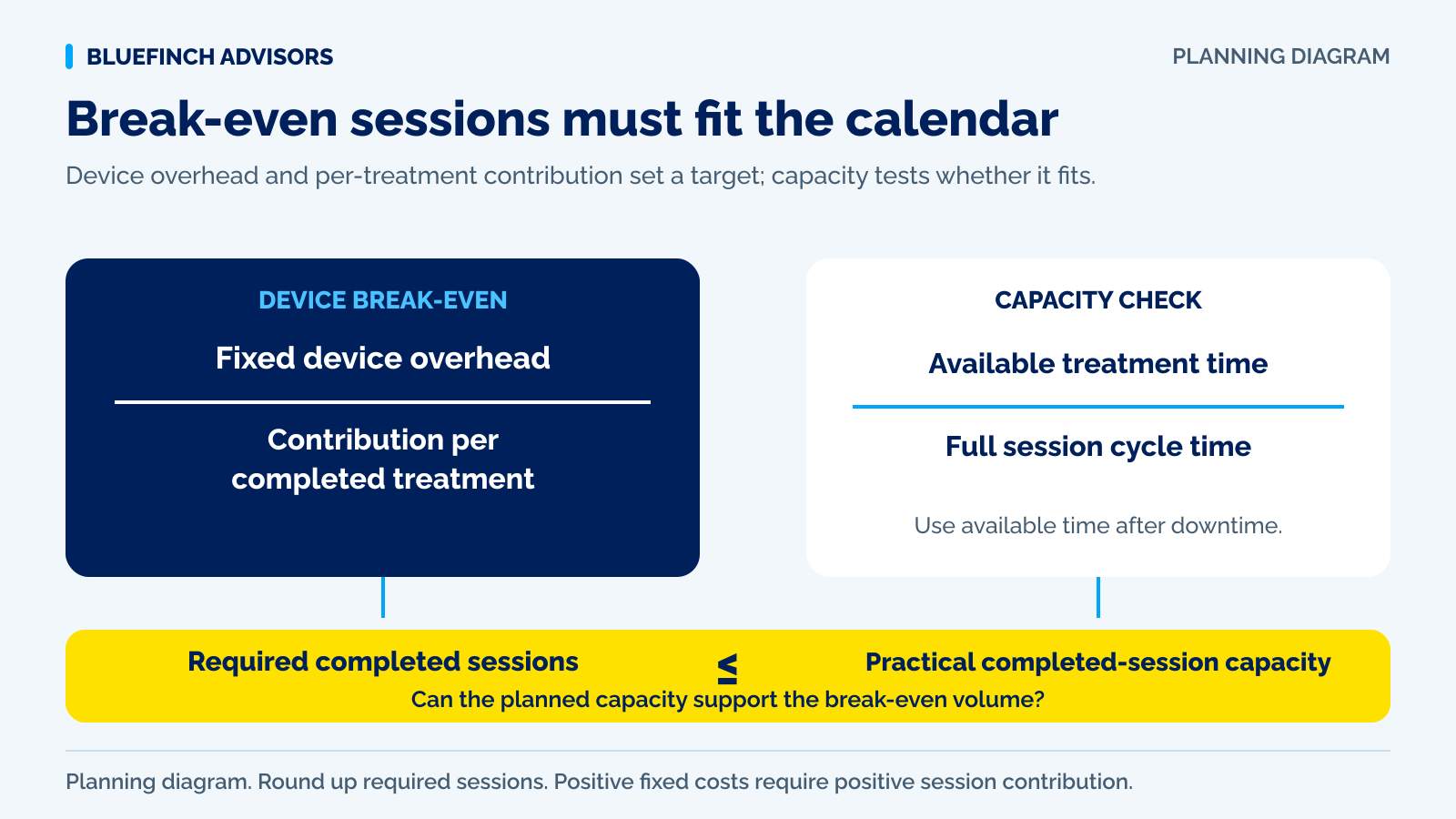
Download infographic (PNG) · Download vector (SVG) · Link to the source and methodology


The short version
- Deduct session delivery costs before calculating fixed-cost break-even.
- Round up to the next whole session needed to cover costs.
- Check the break-even count against usable device time, then verify staffing separately.
You can find the monthly device bill easily. Work out what a completed session leaves after supplies, provider time and payment fees before dividing that bill by a treatment price.
Estimate one month's operating break-even for one service mix, replacing the fictional sample figures. This doesn't value a device investment, compare financing, forecast patient demand or recommend treatment.
Use with this guide
Membership capacity calculator
Check redeemed member visits against usable provider hours and monthly service costs.
Browse the complete medical spa guides and worksheets.
Calculate session costs before covering the device bill
Start with actual revenue after discounts or a package allocation, not a rarely collected menu price. Deduct consumables, loaded provider labor and allocated payment fees. What remains contributes toward monthly operating costs.
AmSpa's device-buying guidance discusses consumables, treatment time, staffing and maintenance. The tool includes those costs, but a favorable result doesn't establish treatment effectiveness, suitability or whether it falls within a provider's scope.
Sources for this section: American Med Spa Association: evaluating device consumables, staffing, and maintenance
Round break-even up to a complete session
The SBA divides fixed costs by price less variable cost to find unit break-even. Here, each unit is a completed session. Round up because a fraction of a booking can't cover the remaining cost.
With positive fixed costs and zero or negative session contribution, no finite number of sessions reaches break-even. The tool leaves the threshold blank with an explanation. Adding bookings won't fix negative contribution per booking.
Sources for this section: U.S. Small Business Administration: break-even calculation
Example: needing 21 sessions with 53 slots available
The fictional service has $2,500 in fixed monthly costs. A $180 session uses $25 in consumables and $30 of provider labor. At 3% plus $0.30, payment fees are $5.70. Total variable cost is $60.70, leaving $119.30 per session.
Dividing $2,500 by $119.30 gives just under 21, so break-even needs 21 whole sessions. Forty usable hours with a 45-minute cycle allow 53 complete device slots. At 35 completed sessions, the modeled operating result is $1,675.50. The 53-slot limit is neither a sales forecast nor an instruction for scheduling clinical work.
| Fictional monthly scenario | Result |
|---|---|
| Fixed operating costs | $2,500.00 |
| Contribution per completed session | $119.30 |
| Whole sessions to cover entered costs | 21 |
| Complete slots from device hours | 53 |
| Operating result at 35 sessions | $1,675.50 |
Check that the target fits the available schedule
Remove maintenance and unavailable time from device hours and include setup and turnover in each cycle. If planned sessions exceed that capacity, the tool withholds the operating result. A target requiring slots you don't have isn't workable.
Provider and device minutes describe different resources. Parallel staffing or work outside the slot can make provider time longer than device time; the tool flags it for review. Check staff, rooms, supervision and service requirements separately. Test lower realized prices, longer cycles and higher consumable costs before relying on a favorable scenario.
Questions business owners ask
Will this tell me when the device purchase pays for itself?
No. It covers entered monthly operating costs. Model purchase payback separately using upfront cash, financing, time, taxes, residual value and risk.
How should I price a session sold in a package?
Allocate actual package revenue and purchase fees consistently to delivered sessions. Don't count the whole package sale again at every visit.
Why isn't there a planned operating result?
It's withheld when planned sessions exceed the device-time capacity entered. Check volume, usable hours and cycle time before relying on the monthly calculation.
Primary sources
BlueFinch last reviewed these sources on September 7, 2026. Payment rules and state requirements can change.
- American Med Spa Association: evaluating device consumables, staffing, and maintenance
- U.S. Small Business Administration: break-even calculation
Use this page for general business information. It is not legal, tax, or accounting advice.