Compare membership demand with provider hours
Estimate this month's redemption costs and the provider time needed for the benefits modeled.
Use the interactive tool without signing up. It runs in your browser: enter your numbers, save a comparison, download results or print a working copy. Your numbers are not sent to BlueFinch.
Illustrative example inputs
These starting values show how the math works. They are not industry averages, customer results or a quote.
| Input | Example value |
|---|---|
Members paying this month Count whole members whose dues are collected this month, excluding failed or paused payments. | 120 |
Monthly dues per member Enter average collected dues before the fees below, treating tax consistently. | $149.00 |
Expected visits per member this month Use average visits redeemed now, including older credits. Don't use the count of credits sold. | 1.2 |
Provider minutes per redeemed visit Average full provider time across the service mix, including relevant setup and cleanup. | 45 |
Loaded cost per redeemed visit Count provider labor and consumables once, without duplicating that labor in another field. | $40.00 |
Other monthly cost per member Add member-specific expenses not counted in service costs or fixed program costs. | $5.00 |
Total usable provider hours this month Total usable hours after leave, breaks, administration and known downtime. | 140 hours |
Hours committed to other services Count provider time already committed to work outside this membership group. | 20 hours |
Allocated payment rate Apply this percentage to entered revenue. Use a blended rate for mixed payments, or zero if fees are already deducted. | 3% |
Allocated fixed fee per monthly payment This assumes one dues payment per member. Enter zero if the dues amount already accounts for this fee. | $0.30 |
Monthly fixed program cost Include program expenses not already allocated per member or visit. | $500.00 |
Example results
| Measure | Result |
|---|---|
Monthly cash after modeled costs | $10,447.60 |
Provider-hour capacity used | 90% |
Members supported by entered hours | 133 |
Calculation detail
| Measure | Result |
|---|---|
| Monthly dues collected | $17,880.00 |
| Expected redeemed visits | 144 |
| Provider hours needed | 108 hours |
| Provider hours left for members | 120 hours |
| Provider-hour headroom | 12 hours |
| Provider-hour shortfall | 0 hours |
| Redeemed service cost | $5,760.00 |
| Other member costs | $600.00 |
| Monthly payment fees | $572.40 |
| Fixed program cost | $500.00 |
Model assumptions
- Model one paying cohort. Set aside other booked hours for former or paused members' redemptions and budget those costs separately.
- Each entered member pays the entered dues this month. Revise inputs for failed payments, refunds and new-member timing.
- Use one average redemption duration and cost. Weight mixed services appropriately or model them separately.
- Provider hours alone don't establish availability of rooms, equipment, clinical services or requested appointment times.
- Low usage this month doesn't remove future redemption obligations. Defaults are fictional, not usage benchmarks.
Read alongside these results
- This cash scenario covers the paying cohort and redemptions entered. Collected dues aren't all earned profit.
- Reserve other booked hours for former or paused members' redemptions and budget their service costs separately. Stopped dues don't remove remaining benefits.
- Include loaded provider labor and supplies once per redeemed visit. Broader overhead and future unused benefits aren't covered by this result.
- Apply fees once per monthly dues payment, or use zero when entered dues already deduct them.
- The provider-hour limit is for aggregate planning. Rooms, qualified staff, appointment times and clinical decisions still limit bookings.
Download this worked example (CSV). Use the interactive version to export your own inputs and results.
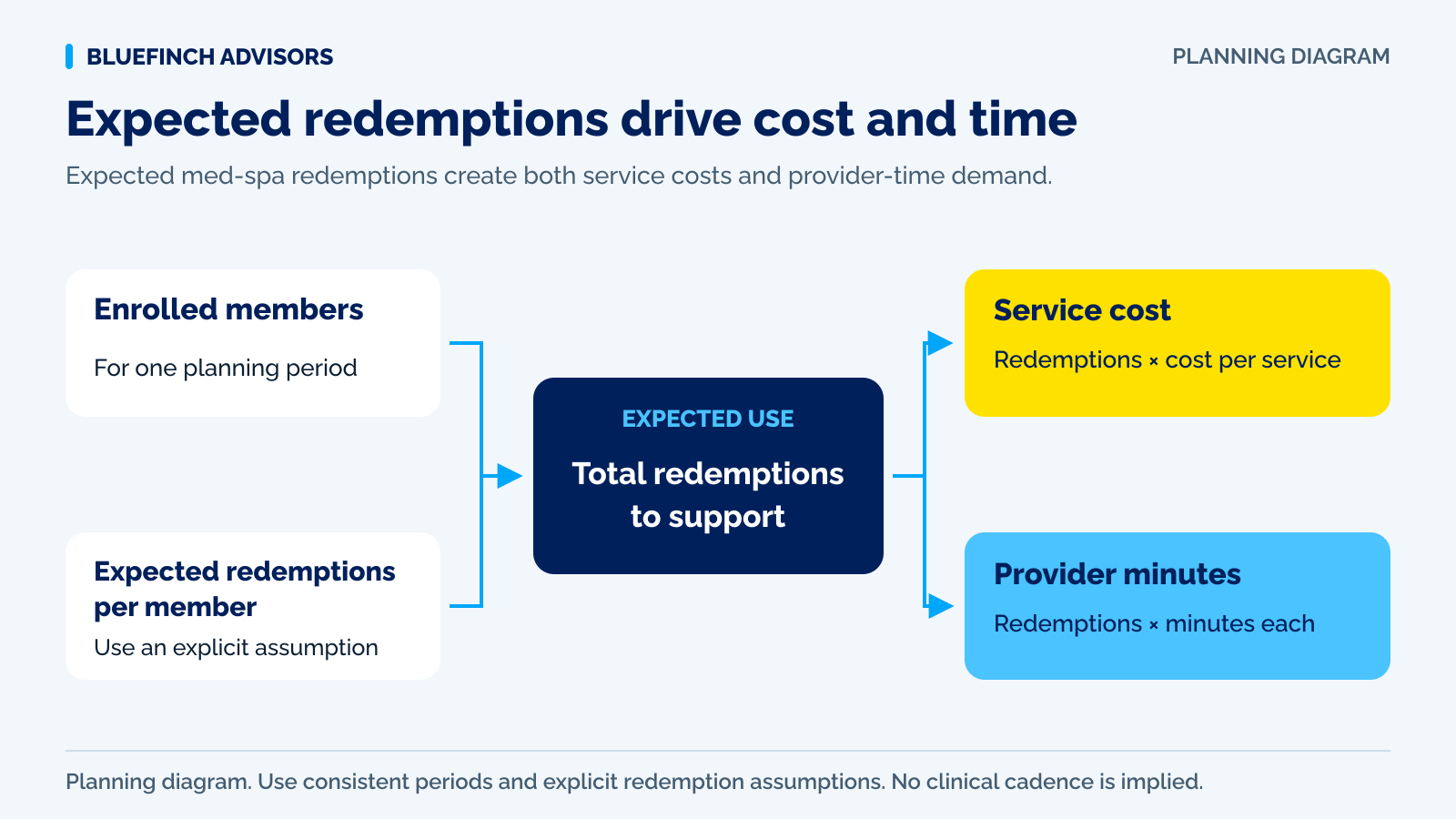
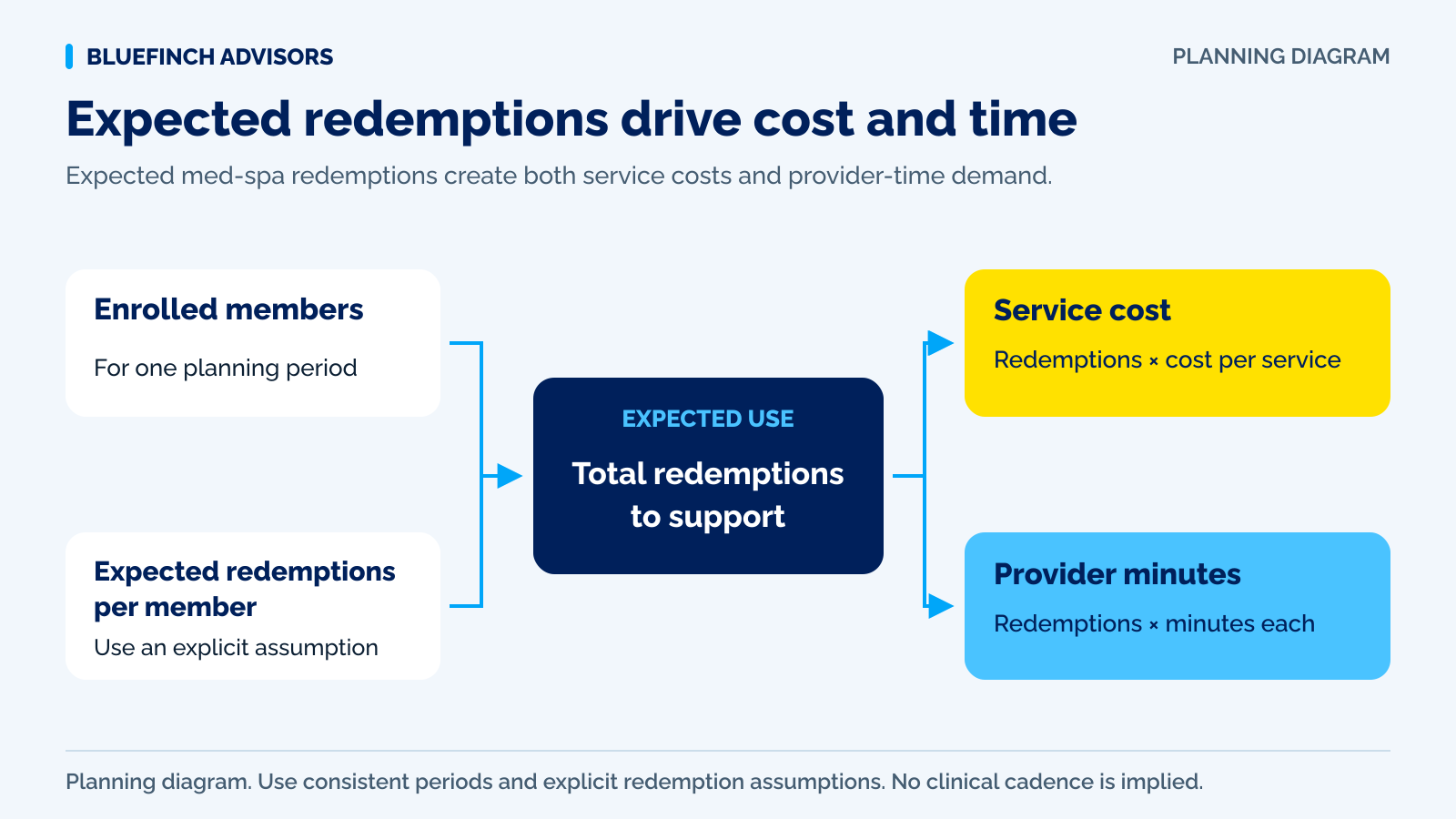
Download infographic (PNG) · Download vector (SVG) · Link to the source and methodology


The short version
- Count visits redeemed by the paying cohort, including carried-over benefits used now.
- Reserve time for former members' redemptions and other bookings before adding this cohort's hours.
- Keep cash left after expected costs distinct from earned accounting profit.
Your membership dashboard shows $17,880 collected, but the appointment book tells you how much provider time those members need. Check both before opening another membership tier.
Enter paying members, actual usage and available provider hours. The fictional sample isn't a picture of a typical med spa. This models operating capacity and cash, without recommending treatment or deciding revenue recognition.
Use with this guide
Med spa device break-even calculator
Compare entered device-service operating costs with the time available to deliver sessions.
Browse the complete medical spa guides and worksheets.
Count redeemed visits separately from benefits issued
Divide visits redeemed by this paying cohort by the same member count, including older credits used this month. Reserve time for former, paused and nonpaying members' remaining benefits under other booked work and budget their costs separately. Stopped dues don't erase those benefits.
Zenoti reports benefits issued, redeemed, expired and still available separately. Keep those distinctions even in another system. A receipt confirms collected cash, not completion of every service that payment covers.
Sources for this section: Zenoti: membership benefits, redemptions, and remaining liability reporting
Set aside hours needed elsewhere in the practice
Start with usable provider hours after leave, breaks and administration, then subtract time committed to other services. What remains is available for this membership scenario.
Use average full provider time per redeemed visit. Plan separate groups for services needing different staff qualifications, rooms or durations. AmSpa's measurement guidance emphasizes treatment and provider economics. This tool brings usage and time records together; it doesn't judge medical suitability or choose who should receive a procedure.
Sources for this section: American Med Spa Association: measuring practice costs and provider performance
Example: 120 members need 108 provider hours
In the fictional month, 120 members pay $149 each, bringing in $17,880. At 1.2 visits each, they redeem 144 visits requiring 108 hours at forty-five minutes per visit. From 140 usable hours, 20 are reserved for other work, leaving 120. Memberships use 90% of that time, with 12 hours remaining.
At $40 per visit, service costs total $5,760. Add $600 in other member costs, $500 in fixed program expenses and $572.40 in sample payment fees to leave $10,447.60 of modeled cash. That isn't accounting profit. At the same average usage, 133 whole members fit the aggregate hour limit, before checking timing and other constraints.
Test a month with higher redemptions
Raise visits per member before raising member count. In the fictional sample, moving from 1.2 to 1.5 visits requires 135 hours, or 15 more than the available 120. The cash calculation still includes all assumed visit costs; it doesn't postpone bookings silently or provide free extra staffing.
Check carried-over credits, pending cancellations, appointment availability and failed collections alongside the figures. Strong collections can coexist with undelivered benefits. Review service obligations and approved practice policies before adding hours, changing future enrollment or revising the offering.
Questions business owners ask
Does cash left after monthly costs show membership profit?
No. It covers collections and expected service costs for the paying cohort entered. Future benefits, accounting treatment, taxes and costs not entered still need separate consideration.
How do I account for credits carried over from earlier months?
Include the paying cohort's older credits redeemed now in its visit average. Reserve other booked hours for former or paused members' redemptions and budget those costs separately.
Will the calculated member limit guarantee available appointments?
No. It limits aggregate provider hours only. Check qualified staff, rooms, equipment and the times members want separately.
Primary sources
BlueFinch last reviewed these sources on September 7, 2026. Payment rules and state requirements can change.
- Zenoti: membership benefits, redemptions, and remaining liability reporting
- American Med Spa Association: measuring practice costs and provider performance
Use this page for general business information. It is not legal, tax, or accounting advice.