Calculate the full route's contribution
Include paid travel time to compare the cash contribution remaining from the route.
Use the interactive tool without signing up. It runs in your browser: enter your numbers, save a comparison, download results or print a working copy. Your numbers are not sent to BlueFinch.
Illustrative example inputs
These starting values show how the math works. They are not industry averages, customer results or a quote.
| Input | Example value |
|---|---|
Paid jobs on the route Count whole paid jobs using the same average price and time assumptions. | 4 |
Average collected job price Use revenue per completed job before the payment costs below, excluding sales tax passed through. | $240.00 |
Installer hours per job Count paid prep, installation and cleanup person-hours. Two people working one hour use two hours. | 1.25 hours |
Total paid travel hours Total the crew's paid travel hours, including paid waiting if it isn't counted elsewhere. | 1.5 hours |
Loaded hourly labor cost Use hourly compensation or replacement cost with applicable employment costs, including owner labor. | $35.00 |
Materials per job Allocate film and consumables to each completed job. | $25.00 |
Total route miles Count vehicle miles for the whole route, including the return when applicable. | 80 |
Vehicle cost per mile Use your operating cost per mile, without duplicating fuel or vehicle expenses. The sample isn't an IRS deduction rate. | $0.70 |
Allocated payment rate Apply this percentage to entered revenue. Use a blended rate for mixed payments, or zero if fees are already deducted. | 3% |
Allocated fixed fee per job This assumes one transaction per job. Blend the allocation for mixed payment methods, or enter zero if fees are already deducted. | $0.10 |
Other route-specific cost Add parking, tolls or other daily costs that aren't included elsewhere. | $15.00 |
Example results
| Measure | Result |
|---|---|
Route contribution | $532.30 |
Contribution per working hour | $81.89 |
Contribution per job | $133.08 |
Calculation detail
| Measure | Result |
|---|---|
| Route revenue | $960.00 |
| Service hours | 5 hours |
| Service plus travel hours | 6.5 hours |
| Loaded labor cost | $227.50 |
| Materials | $100.00 |
| Vehicle operating cost | $56.00 |
| Allocated payment fees | $29.20 |
| Other route cost | $15.00 |
| Total modeled route cost | $427.70 |
Model assumptions
- The route uses one average job price, material cost and installation time.
- Count paid person-hours for labor and miles for the vehicle, not separate miles for each worker.
- The rate applies to all entered revenue. Use weighted allocated fees for mixed payments or separate scenarios.
- Debit, wallet and transfer costs aren't assumed to be free. Defaults are examples.
Read alongside these results
- Route contribution deducts entered costs but isn't company net profit. Include owner labor at loaded compensation or replacement cost.
- Fees apply to all entered revenue, assuming one transaction per job. Blend allocated fees for mixed payments or use zero for fees already deducted.
- Use your vehicle's operating-cost estimate rather than an IRS mileage rate, and don't add fuel again if the rate includes it.
Download this worked example (CSV). Use the interactive version to export your own inputs and results.
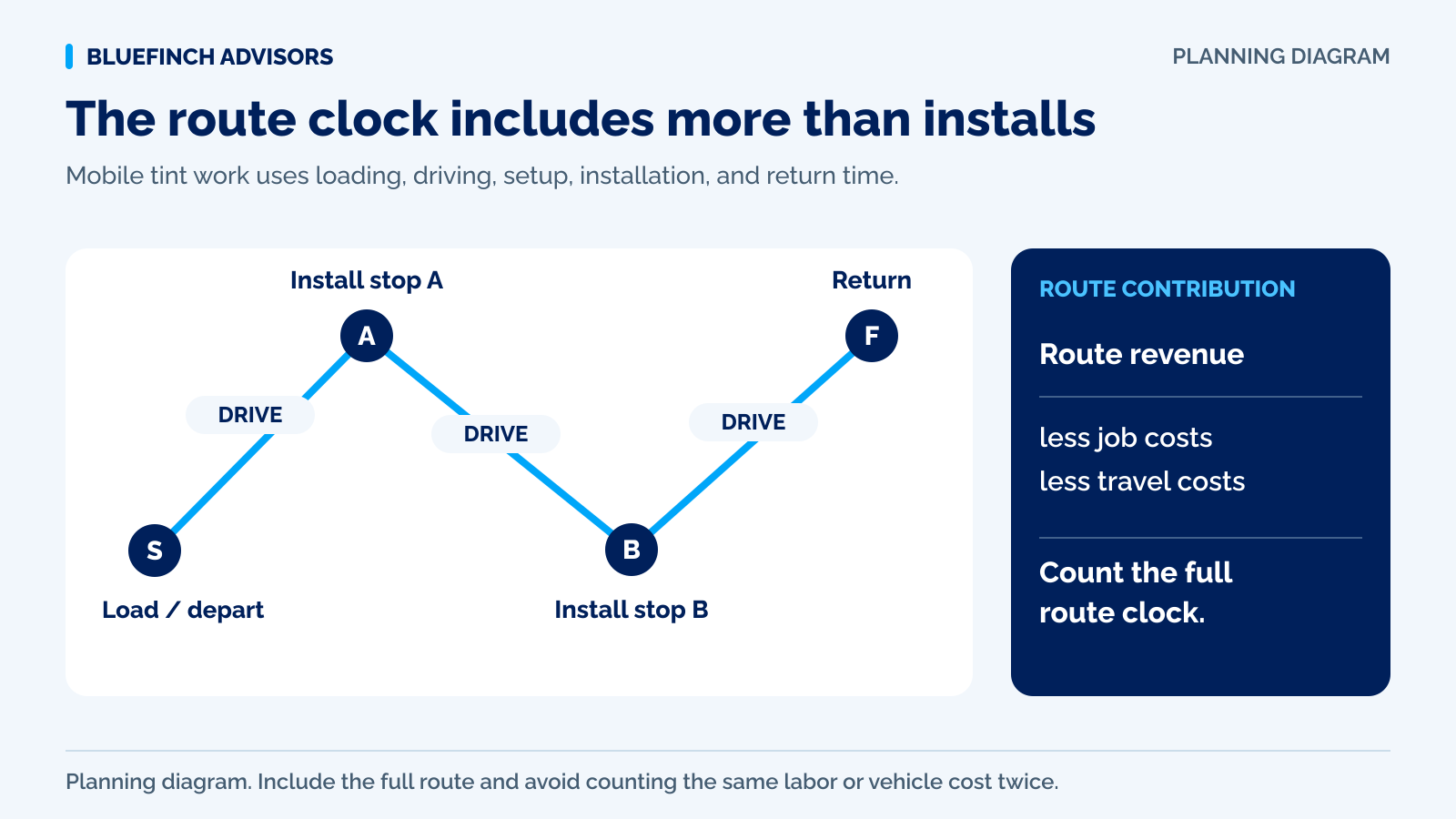
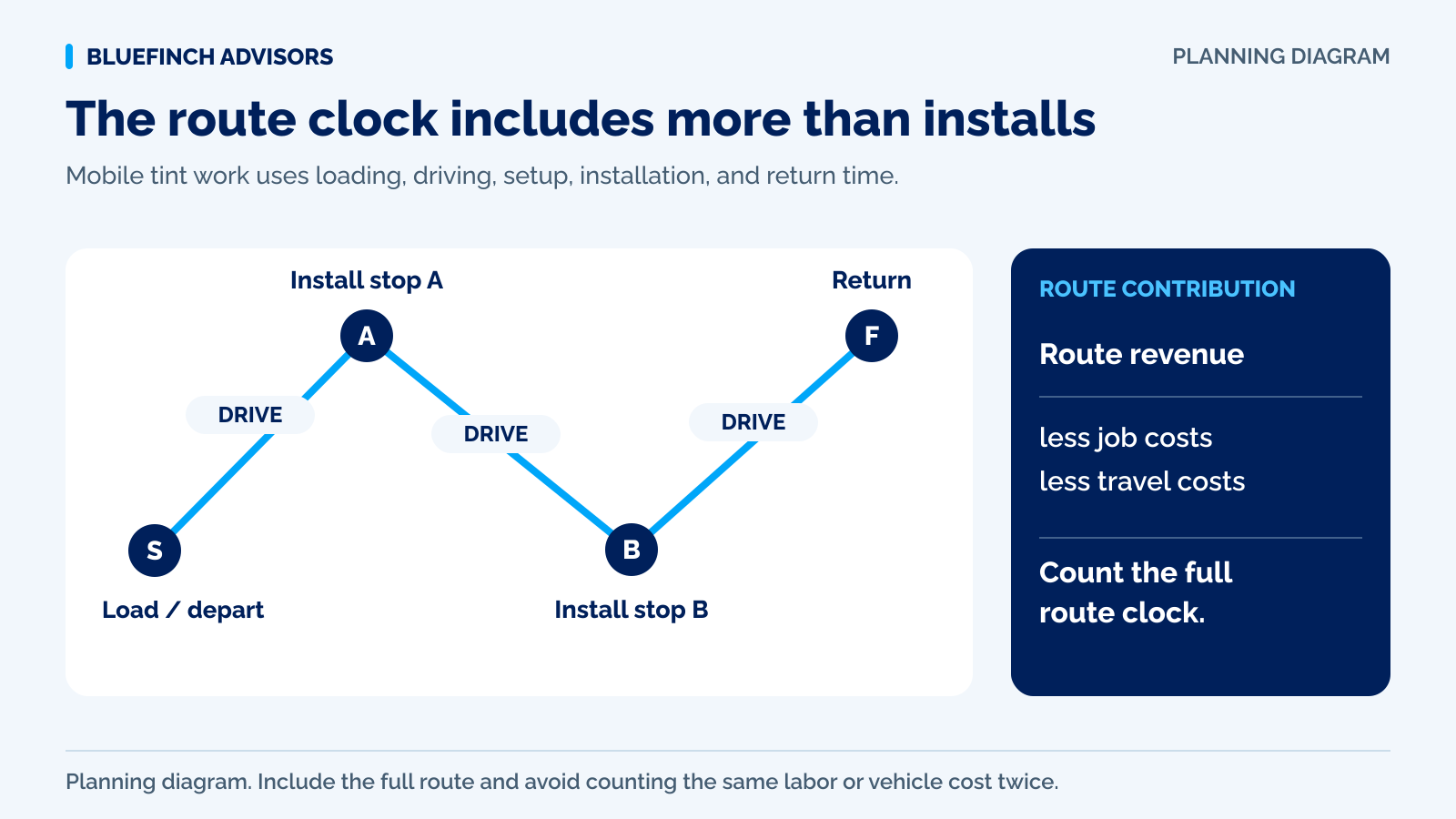
Download infographic (PNG) · Download vector (SVG) · Link to the source and methodology


The short version
- Include paid installation and travel hours in the calculation.
- Use your vehicle's costs and avoid duplicating fuel expenses.
- Compare contribution per working hour rather than judging the route by ticket size.
A $240 mobile booking might look attractive until you add the drive. Travel takes paid time, the vehicle has operating costs, and gaps between distant jobs consume the day. Film cost alone won't tell you whether to add it to tomorrow's route.
Use this as an operating estimate for a route, with fictional starting figures you can replace. It shows contribution after entered costs, not whole-business profit or a forecast of an optimized route.
Use with this guide
Job cash-flow planner
Track material purchases, labor payments, deposits and final collections by date.
Browse the complete window tint guides and worksheets.
Include the drive in the job costs
Count installation, prep, cleanup and paid travel. Two people driving for an hour use two labor hours even though the van travels for one. Enter crew-hours for labor and vehicle miles for transport.
The hourly result divides contribution by total service and travel person-hours entered. It doesn't schedule appointments. Check access, customer readiness, weather and installation conditions separately; a route you cannot complete isn't useful, however good its calculated hourly result.
Use a consistent vehicle-cost basis
For tax purposes, the IRS distinguishes actual vehicle expenses from standard mileage. Its actual-expense categories include fuel, repairs, insurance and depreciation or lease costs. Use those categories to spot omissions, but don't assume a tax deduction rate equals your van's operating cost.
Build the per-mile estimate from your vehicle records. If it includes fuel and wear, don't add them again as other costs. Record parking and tolls separately if excluded from the rate, and use the same basis for both routes you compare.
Sources for this section: IRS: business vehicle expense categories and mileage methods
Example: $960 in receipts leaves $532.30 of contribution
In the fictional route, four jobs at $240 bring in $960. Five installation person-hours plus 1.5 travel hours cost $227.50 at a loaded $35 rate. Materials cost $100, eighty miles cost $56 at the sample $0.70 per mile, and other route expenses are $15.
An assumed 3% payment fee plus $0.10 per job costs $29.20. Entered route costs total $427.70, leaving $532.30: $133.08 per job or about $81.89 per working hour. That contribution still needs to cover office overhead, marketing, callbacks and taxes unless you've included them.
| Fictional route | Amount |
|---|---|
| Collected job revenue | $960.00 |
| Loaded service and travel labor | $227.50 |
| Materials, vehicle, and other route costs | $171.00 |
| Allocated payment costs | $29.20 |
| Contribution after entered costs | $532.30 |
Check what the extra stop adds to costs and hours
Save the route without the distant job, then include its price, labor, miles and parking in a second scenario. Compare the additional contribution and hours. More daily revenue may require low-return hours that could serve a closer booking.
For uneven jobs, use revenue-weighted payment fees and actual average material and labor costs, or assess segments separately. Like the SBA's break-even framework, this model distinguishes costs that vary with sales from fixed costs. It doesn't claim to include every business expense.
Sources for this section: U.S. Small Business Administration: break-even calculation
Questions business owners ask
Should I count installation and driving time when I do the work myself?
Yes. Enter the owner's loaded compensation or replacement cost. Zero labor cost would treat unpaid owner work as free.
Does the default mileage cost come from a tax rate?
No. The $0.70 default is a fictional operating estimate, not a tax deduction calculation. Use your vehicle's actual cost basis.
Why are there costs when the route has no jobs?
Travel hours, miles and other route costs entered still use money without completed jobs. Contribution per job stays blank when job count is zero.
Primary sources
BlueFinch last reviewed these sources on September 7, 2026. Payment rules and state requirements can change.
- IRS: business vehicle expense categories and mileage methods
- U.S. Small Business Administration: break-even calculation
Use this page for general business information. It is not legal, tax, or accounting advice.