The short version
- Identify the installation milestone behind each invoice.
- Record invoice dates separately from the dates you expect payment.
- Include approved changes and agreed retainage in the final-payment forecast.
Commercial film work may involve separate people approving access, authorizing the scope and paying the bill. The building contact, authorized buyer and accounts-payable team can each have a different deadline.
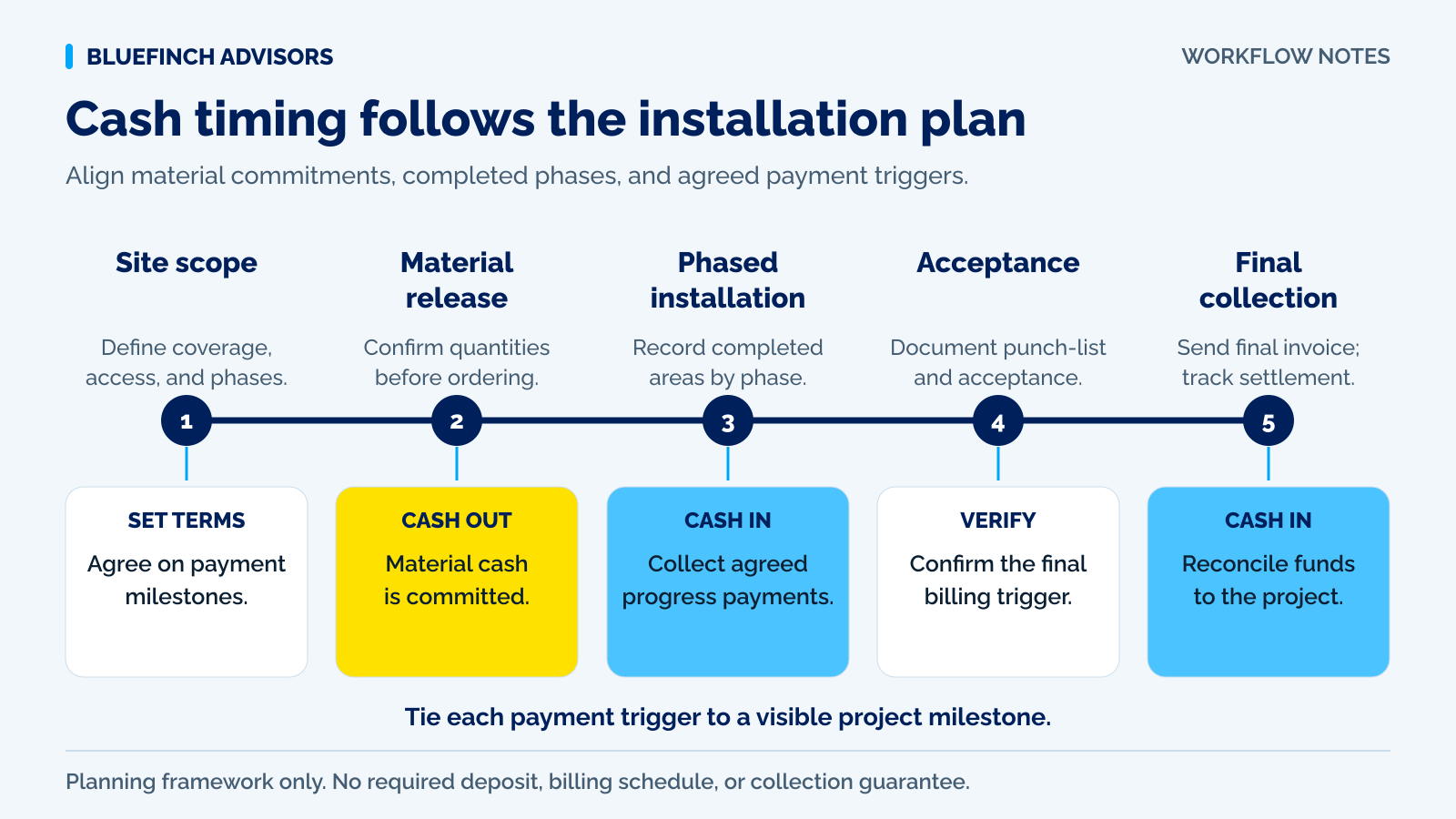
Before you order materials, list installation stages with the dates you expect payment. A deposit doesn't fund the job until it arrives. An invoice issued Friday won't cover Friday's payroll if the buyer has another month to pay.
Use with this guide
Job cash-flow planner
Track committed cash and collected payments at each project milestone.
Fleet invoice checklist
Gather approvals, vehicle details, purchase-order references and billing records before sending the invoice to accounts payable.
Vehicle wrap film roll planner: calculate repeated rectangular cuts
Separate film consumed on a job from the cost of buying a roll. Plan repeated rectangular cuts while keeping directional film in the same orientation.
Mobile tint calculator: check a route's contribution
Four booked jobs don't establish route profit. Include paid driving, vehicle costs and installation time before comparing the day's contribution.
Commercial window film: price a measured scope change before collection
Explain the measured area and access changes in an approved revision. A scope change isn't itself a progress invoice.
Browse the complete window tint guides and worksheets.
Record the glass and work approved
List the site, film product, measured areas, removal work, access and installation phases. Name the person who approves the scope and any added area. Document exclusions so a site conversation about another doorway doesn't become unpriced work.
Express Window Films' proposal form and example include residential/commercial selections, film details and deposit fields. Keep similarly detailed scope records beside your payment schedule. A project total alone doesn't tell billing which area is complete when you request a progress payment.
Sources for this section: Express Window Films: installation proposal form · Express Window Films: example installation proposal
Define the milestone behind each payment
Choose milestones both parties can verify, such as signing the agreement, ordering specified materials, accepting first-floor installation or closing the final punch list. Put the schedule in the contract. A percentage alone is hard to apply when access or material deliveries change.
If the agreement includes retainage, list the amount withheld and its release condition separately. Don't assume a standard percentage; some projects have no retainage. Record required PO references, acceptance signatures and other submission requirements before calling a milestone invoice ready for collection.
| Stage | Evidence for invoice | Collection question |
|---|---|---|
| Deposit | Signed scope and agreed schedule | Must funds arrive before ordering? |
| Material commitment | Specified order or delivery record | Is this a billable milestone? |
| Installation phase | Completed area and required approval | Who accepts the phase? |
| Final balance | Completion and agreed closeout records | When is payment due? |
| Retainage, if agreed | Contract release condition satisfied | Who authorizes release? |
Cash-flow example for a $12,000 installation
In a fictional project, you receive a $3,600 deposit, collect $4,800 after an installation phase and receive $3,600 at completion. Paying $4,500 for materials before the second collection leaves a temporary $900 cash gap.
Suppose you've paid another $2,000 in job costs when the second payment arrives. Receipts now total $8,400 and cash costs total $6,500, leaving $1,900 ahead on these flows. Pay another $1,000 before final collection and the closing difference is $4,500. This isn't net profit: overhead, tax, financing and transaction fees are excluded.
| Point in schedule | Receipts to date | Cash costs to date | Receipts less cash costs |
|---|---|---|---|
| Deposit received | $3,600 | $0 | $3,600 |
| Material purchased | $3,600 | $4,500 | −$900 |
| Phase payment collected | $8,400 | $6,500 | $1,900 |
| Final payment collected | $12,000 | $7,500 | $4,500 |
Revise payment dates and balances after changes
Extra glass, a different film, delayed access or added removal can change the schedule in different ways. Record the request, added price, approval and resulting collection dates. Revise the forecast once agreed rather than adding an unexplained amount to the final invoice.
Record credit notes too. Removing an area from scope means reducing the appropriate balance and reconciling deposits already applied. Don't keep a second spreadsheet with a total that differs from the approved proposal.
Complete and print the project payment worksheet
Give each agreed milestone a row, with its expected collection date beside the invoice date. The time between them shows how long your business funds the work.
| Milestone / approved amount | Cash costs due first | Invoice / expected collection |
|---|---|---|
| Deposit: __________________ | $_______________ | ________________ |
| Material stage: ___________ | $_______________ | ________________ |
| Installation phase: _______ | $_______________ | ________________ |
| Approved change: __________ | $_______________ | ________________ |
| Final balance: ____________ | $_______________ | ________________ |
| Agreed retainage: _________ | $_______________ | ________________ |
Download it free, with no email signup. Add business or customer details only to your own copy.
Agree the final payment method before signing
A buyer may expect to pay by corporate card after procurement approves the project total. Discuss methods before signing and use the same agreed prices on proposals and invoices. Before offering dual pricing, review the contract and processor-approved setup.
At closeout, reconcile the original price, approved changes, credits, earlier payments and balance. Supply the supporting records the buyer requested. Explain the agreed final amount rather than introducing a new price in the payment request.
Questions business owners ask
Should every commercial film job have a 50% deposit?
No deposit amount fits every project. Agree a schedule based on material terms, access, project size, buyer requirements and applicable law.
Does sending a progress invoice count as collecting payment?
No. Record the invoice, acceptance, due and receipt dates separately. Actual cash flow uses the date money arrives.
Primary sources
BlueFinch last reviewed these sources on September 7, 2026. Payment rules and state requirements can change.
Use this page for general business information. It is not legal, tax, or accounting advice.