The short version
- Identify the fleet's approver and billing requirements before starting work.
- Record invoice acceptance separately from the day payment arrives.
- Use your own assumptions to compare collection delays with processing fees.
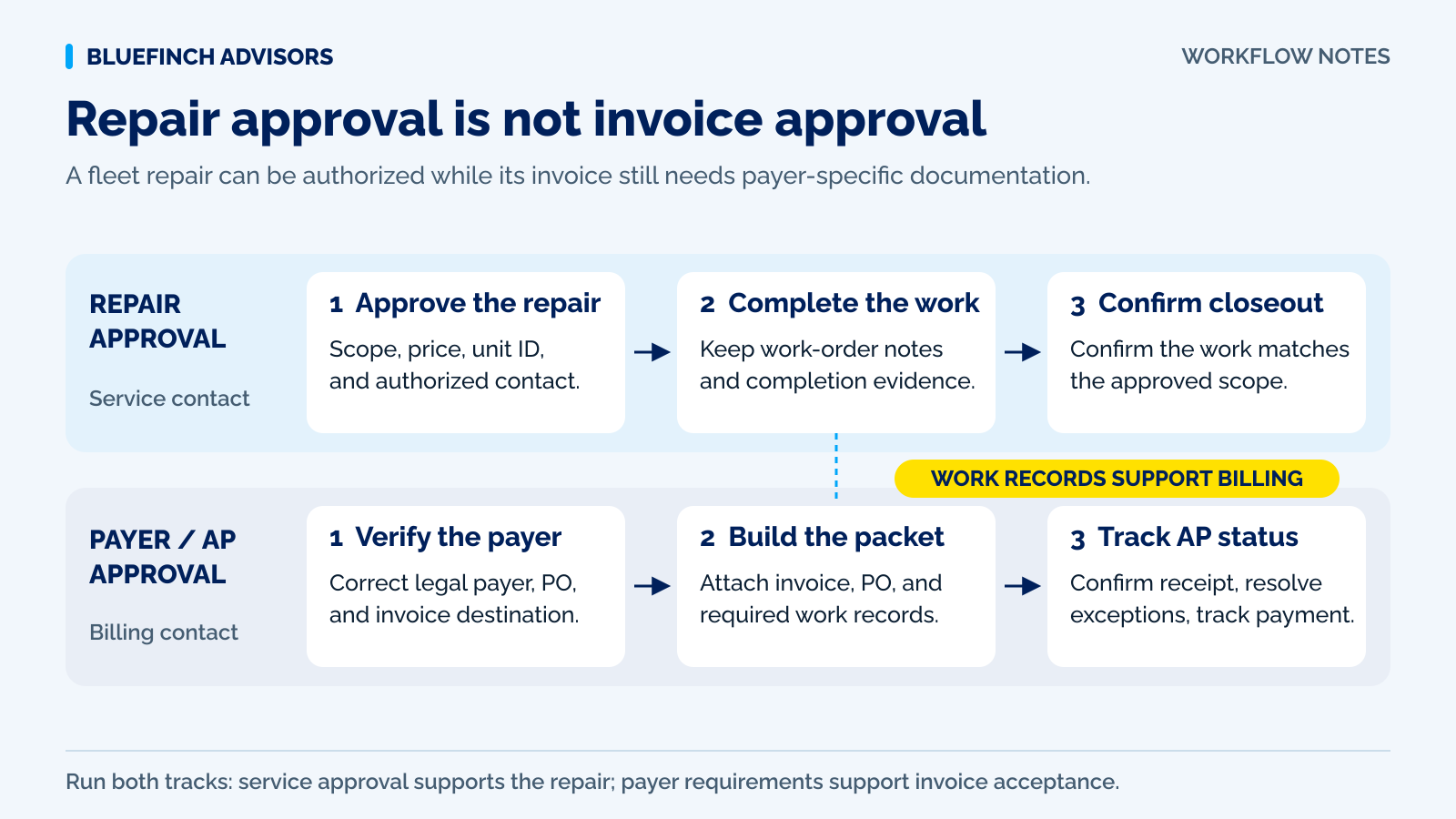
The truck is working again, but the invoice is held up by a missing purchase-order number. Another call to the driver may not reach the person who can approve the expense.
Gather the payment records while the repair is underway. Match the fleet account, unit, spending limit, repair order and billing instructions before submitting the invoice. Then track the time from acceptance to collection.
Use with this guide
Fleet invoice checklist
Gather approvals, vehicle details, purchase-order references and billing records before sending the invoice to accounts payable.
Job cash-flow planner
Track committed cash and collected payments at each project milestone.
Diesel core charges: reconcile supplier credits and customer refunds
Returning the core doesn't confirm a posted supplier credit or a paid customer refund. Check each side of the transaction separately.
Browse the complete auto repair guides and worksheets.
Identify who approves spending before reaching the limit
Record the fleet's legal billing name and unit ID. Find out who authorizes repairs, whether you need a purchase order and who approves work above the initial limit. The driver, dispatcher and accounts-payable contact may be three different people.
Fullbay's invoicing documentation covers fleet spending limits and the further approval needed to exceed them. Record the limit and authorization reference even if your shop uses other software. Don't confuse the customer's purchase-order reference with the order you send your parts supplier.
Sources for this section: Fullbay: service-order approval and invoicing workflow
Give accounts payable the invoice details it requires
Send the invoice to the specified billing address or vendor portal. Include the required customer PO, unit and repair-order numbers, work dates, itemized charges, approved additions, terms and requested attachments. Confirm which email or portal submission serves as the official invoice record.
Stripe's business-agreement guide explains the role of purchase-order references in larger buyers' accounting controls. That reference matches your invoice to an authorized purchase. A clear repair description can't replace a required PO number.
Sources for this section: Stripe: purchase-order references and invoice payment terms
Compare costs using measured collection time
Net-30 describes the agreed terms, not the number of days collection actually takes. Record submission, acceptance, the due date and payment received. Follow up differently on an invoice rejected for a wrong unit number and one that's accepted but not yet due.
Fullbay's cash-flow guidance discusses paying for parts and labor before fleet invoices are collected. Include the cost of funding that gap and any collection expense in your comparison. For ACH, include actual charges, returns and timing. A corporate card may pay faster but costs money to accept.
Sources for this section: Fullbay: managing cash flow in a diesel repair shop
Cost example: $8,000 outstanding for 30 extra days
Take a fictional $8,000 invoice and assume a 12% annual cost of funding. An extra 30 days outstanding costs about $78.90: $8,000 × 12% × 30 ÷ 365. This estimates financing cost; it isn't necessarily a charge the customer owes.
Processing a card payment at an example 3% costs $240. An assumed $5 ACH fee brings the delayed-payment case to $83.90. That $156.10 difference isn't the whole decision: the model excludes collection labor, nonpayment risk, existing cash reserves and actual arrival dates. Replace the assumptions before choosing a method.
Complete and print the fleet invoice checklist
The person closing the repair order completes the first six lines; the billing owner adds submission and payment dates. Identify who will handle the next follow-up.
| Required record | Value / reference | Confirmed by |
|---|---|---|
| Fleet billing name and account | ________________ | ________________ |
| Unit ID and repair order | ________________ | ________________ |
| Authorized person and spending limit | ________________ | ________________ |
| Customer PO / required billing reference | ________________ | ________________ |
| Added work approval | ________________ | ________________ |
| Invoice total and attached records | ________________ | ________________ |
| Submission / acceptance / due dates | ________________ | ________________ |
| Follow-up owner and contact | ________________ | ________________ |
| Payment received and method | ________________ | ________________ |
Download it free, with no email signup. Add business or customer details only to your own copy.
Set payment terms during account setup
Give the fleet your accepted methods and written payment terms when opening the account. Check contract restrictions before offering cash/card pricing. Don't introduce an unexpected card charge when collecting an invoice under terms already agreed.
Review rejected invoices each month and group the reasons: missing approval, wrong unit, omitted attachment, disputed work or ordinary late payment. Fix recurring handoff errors so staff don't keep chasing the same corrections.
Questions business owners ask
Am I guaranteed payment if the fleet supplies a PO?
No. The PO links the invoice to authorized work. The repair, amount, documentation, contract and customer's ability to pay still affect collection.
Should I ask all fleet customers to pay by card?
Compare real acceptance fees with collection time, funding costs, agreed account terms and administration. The lowest transaction fee doesn't always give the lowest total collection cost.
Primary sources
BlueFinch last reviewed these sources on September 7, 2026. Payment rules and state requirements can change.
- Fullbay: service-order approval and invoicing workflow
- Stripe: purchase-order references and invoice payment terms
- Fullbay: managing cash flow in a diesel repair shop
Use this page for general business information. It is not legal, tax, or accounting advice.