Check the balances on a paid core charge
Enter one core transaction or a reconciled group, separating supplier account credits, supplier cash refunds and customer cash movements.
Use the interactive tool without signing up. It runs in your browser: enter your numbers, save a comparison, download results or print a working copy. Your numbers are not sent to BlueFinch.
Illustrative example inputs
These starting values show how the math works. They are not industry averages, customer results or a quote.
| Input | Example value |
|---|---|
Supplier core charge actually paid Count the supplier core charge paid, excluding the replacement part and unpaid charges. | $1,500.00 |
Supplier core credit approved Enter all approved recovery for this paid charge, including credit already posted. | $1,200.00 |
Supplier core credit posted Use cumulative credit showing on the supplier account; it may not be a cash refund. | $900.00 |
Supplier cash refund received Count money actually returned to your bank or payment method. It's part of posted credit, not another recovery. | $0.00 |
Separate return freight paid Count separately paid freight once. Don't add it here if already deducted from the net credit entered. | $75.00 |
Customer core cash collected Include core cash only, excluding repair payments and the part's selling price. | $1,500.00 |
Customer refund approved Enter the documented customer refund obligation independently of supplier approval. | $1,500.00 |
Customer refund actually paid Count cumulative refunds paid for this customer core amount, not refunds promised or queued. | $500.00 |
Example results
| Measure | Result |
|---|---|
Approved supplier credit still pending | $300.00 |
Approved customer refund still unpaid | $1,000.00 |
Actual core cash position | -$575.00 |
Supplier core charge less posted credit | $600.00 |
Calculation detail
| Measure | Result |
|---|---|
| Supplier core charge paid | $1,500.00 |
| Supplier credit approved | $1,200.00 |
| Supplier credit posted | $900.00 |
| Supplier cash refund received | $0.00 |
| Posted credit not refunded as cash | $900.00 |
| Core charge without approved recovery | $300.00 |
| Separate return freight paid | $75.00 |
| Customer core cash collected | $1,500.00 |
| Customer refund approved | $1,500.00 |
| Customer refund paid | $500.00 |
| Customer cash still held | $1,000.00 |
Model assumptions
- Defaults are examples, not actual supplier results or a BlueFinch customer case.
- This starts with paid supplier core charges. Reconcile unpaid purchases separately as payables.
- Cash refunded by the supplier is part of posted credits, not a second recovery. Count freight once.
- Use the documented customer agreement and applicable requirements for refund obligations. Supplier approval doesn't establish customer rights.
- The core-only cash balance excludes replacement parts, labor, tax and all other repair revenue and costs. It isn't profit.
Read alongside these results
- Track supplier approval, credit posting and cash refunded separately. Only actual cash refunded enters the cash balance.
- Supplier credit may settle another invoice rather than return money to the bank. It is still economic recovery, but enter only cash actually returned as a cash refund.
- Enter the approved customer refund from your documented obligation. A supplier decision doesn't establish or replace the customer's rights.
- Only core-related amounts are reconciled here. Parts sales and purchases, labor, tax and the rest of the repair are excluded, so no result shows repair profit.
Download this worked example (CSV). Use the interactive version to export your own inputs and results.
Download infographic (PNG) · Download vector (SVG) · Link to the source and methodology

The short version
- Distinguish a supplier credit from cash returned to your bank.
- Record the approved customer refund independently of supplier recovery.
- Separate core-related cash from parts revenue and repair profit.
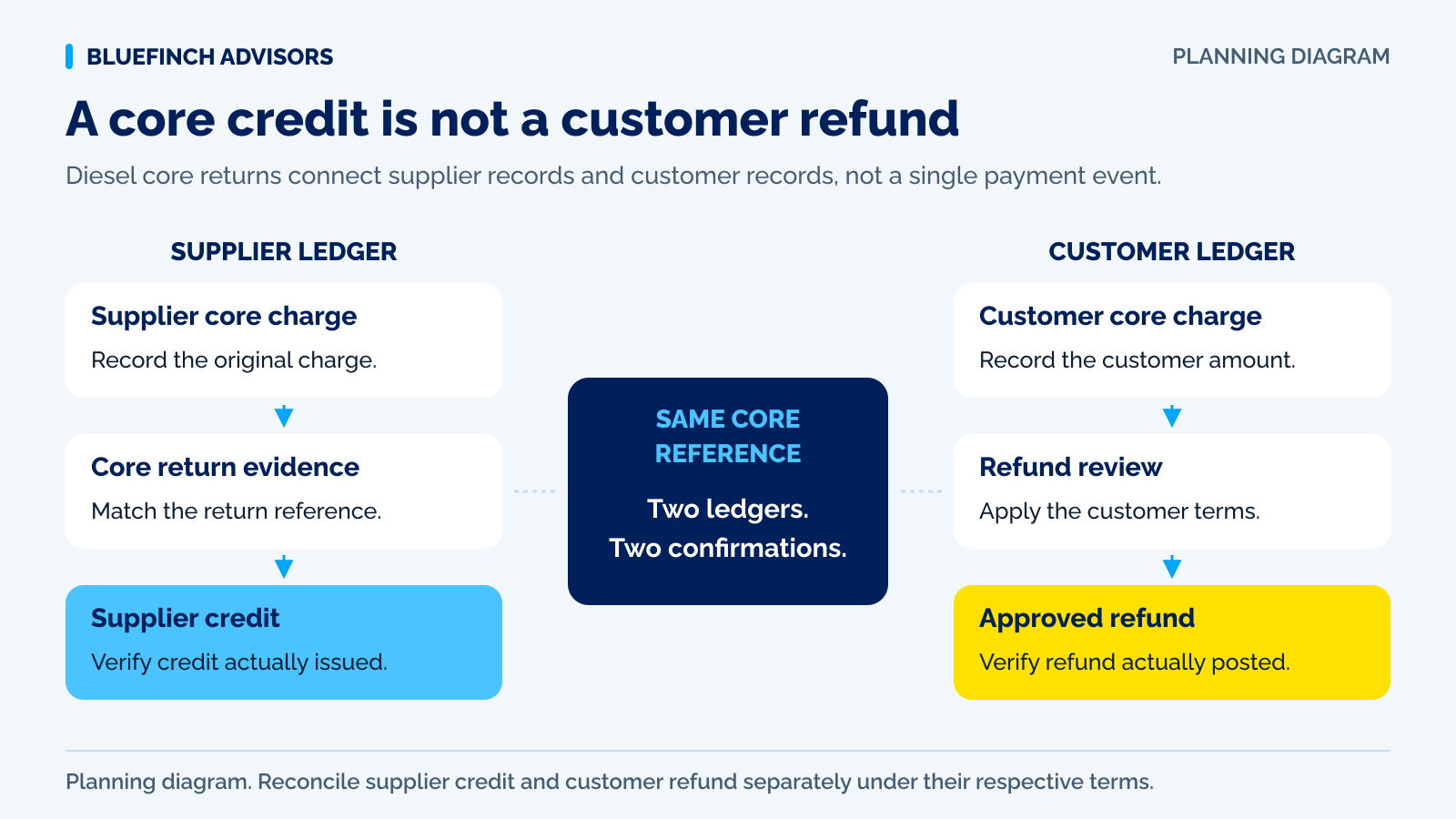
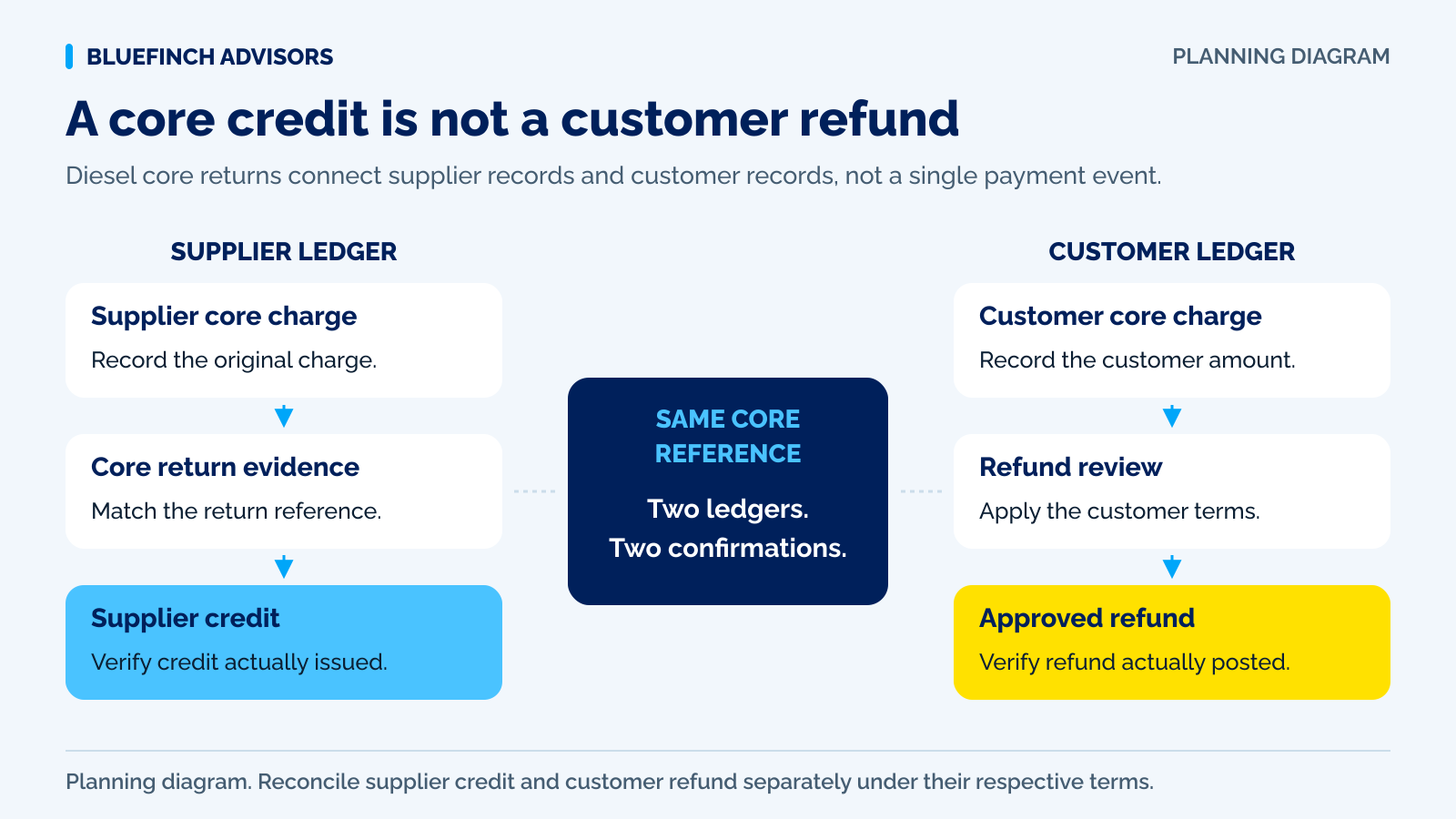
A replacement arrives with a core charge. You return the old unit, receive an approval and wait for the supplier credit to post. Your customer may also be waiting for a refund. Settling the supplier record doesn't settle the customer's account.
Track a paid supplier core charge through approval, posting and cash actually refunded. Separate inputs track the customer payment and approved refund. Enter confirmed amounts; the worksheet doesn't decide whether either party owes a refund.
Use with this guide
Fleet invoice checklist
Check payer details, the PO, approvals and the invoice handoff before billing.
Job cash flow planner
Track when payments become available and when job expenses leave the bank.
Browse the complete auto repair guides and worksheets.
Check the credit memo against the supplier record
Diesel USA Group separates core eligibility, return documentation and applying credits to supplier invoices in its published policy. Those supplier-specific terms may change. Check the terms for your purchase rather than assuming a shipped core guarantees recovery.
Record the original paid charge, approved recovery and posted credit separately. Follow up on approved credit that hasn't posted. A credit applied to the supplier account can provide economic recovery without returning that amount to your bank.
Sources for this section: Diesel USA Group: published core return policy
Example: pending supplier and customer balances versus cash
The fictional shop pays a $1,500 core charge. Its supplier approves $1,200 and posts $900 to the account, with no cash refund. That leaves $300 of approved credit pending and $600 of the paid charge not covered by posted credit. Separate return freight costs $75.
The shop collects $1,500 from the customer and approves a $1,500 refund, paying $500 so far and leaving $1,000 unpaid. Core cash stands at negative $575: $1,500 collected less $1,500 paid to the supplier, $75 freight and $500 refunded. The posted $900 credit doesn't enter that cash calculation because it wasn't returned as cash.
| Separate balance | Calculation | Result |
|---|---|---|
| Approved supplier credit still pending | $1,200 - $900 | $300 |
| Paid supplier charge less posted credit | $1,500 - $900 | $600 |
| Approved customer refund still unpaid | $1,500 - $500 | $1,000 |
| Core cash position | $1,500 + $0 - $1,500 - $75 - $500 | -$575 |
Document the customer refund independently
Cummins describes ReCon acceptance as a process of core inspection and replacement credit. It doesn't establish this worksheet's customer refund. Use the customer's documented arrangement to enter that obligation.
Keep a partial supplier approval in the supplier record without automatically reducing the customer's approved refund. Resolve the difference under the actual terms and circumstances. Likewise, paying the customer back doesn't confirm that supplier credit has posted.
Sources for this section: Cummins: ReCon core acceptance and replacement credit
Connect the returned core with its financial records
Keep the purchase reference, core ID, return authorization, shipping evidence, supplier decision, credit memo and refund record together in your approved system. That file should show what remains unresolved. Leave private identifiers out of the public calculator.
Count freight once. If shipping was deducted from the credit and you entered the net credit, don't also count that deduction as separately paid freight. The tool flags posted credit above approved credit, or refunded cash above posted credit, for review instead of silently changing it.
Questions business owners ask
Why doesn't posted supplier credit count as cash?
It may reduce an account balance without returning money to your bank. This cash calculation includes only actual supplier cash refunds.
Should the customer refund match the supplier credit?
Enter the customer's documented refund obligation separately. The calculator keeps the two decisions distinct and doesn't interpret refund rights.
Does a negative core cash balance mean the repair made a loss?
No. Only core cash movements are included here. Replacement parts, labor, other revenue, expenses and tax aren't in this calculation.
Primary sources
BlueFinch last reviewed these sources on September 7, 2026. Payment rules and state requirements can change.
Use this page for general business information. It is not legal, tax, or accounting advice.