Compare material billing with consumed cost
Select one repair order or a matched group. Use their consumed material costs and charges actually approved and billed.
Use the interactive tool without signing up. It runs in your browser: enter your numbers, save a comparison, download results or print a working copy. Your numbers are not sent to BlueFinch.
Illustrative example inputs
These starting values show how the math works. They are not industry averages, customer results or a quote.
| Input | Example value |
|---|---|
Approved material amount billed Enter the before-tax material line, not payments collected. | $600.00 |
Color material consumed Count color cost attributable to these jobs, including their waste once. Leave out unopened stock for other work. | $210.00 |
Clear material consumed Count clear and associated components used on these jobs, without duplicating another category. | $120.00 |
Primer and sealer consumed Enter recorded costs for the repair orders you're reviewing. | $70.00 |
Non-paint sundries consumed Count masking, abrasives and similar items consumed on these repairs once. | $60.00 |
Matching consumed-cost credits Use verified credits against the consumed costs above. Exclude unrelated unused-stock returns. | $20.00 |
Refinish hours for these repair orders Keep the agreed hour basis consistent across periods. Don't use total shop labor hours. | 10 hours |
Example results
| Measure | Result |
|---|---|
Billed material recovery At 100%, material billing equals net material cost entered. | 136.36% |
Billed material surplus / shortfall | $160.00 |
Consumed material cost per refinish hour | $44.00 |
Calculation detail
| Measure | Result |
|---|---|
| Approved material amount billed | $600.00 |
| Color material consumed | $210.00 |
| Clear material consumed | $120.00 |
| Primer and sealer consumed | $70.00 |
| Non-paint sundries consumed | $60.00 |
| Consumed cost before credits | $460.00 |
| Matching material cost credits | $20.00 |
| Net consumed material cost | $440.00 |
| Refinish hours | 10 hours |
| Billed material amount per refinish hour | $60.00 |
| Material surplus as share of billed amount | 26.67% |
Model assumptions
- Starting figures are examples, not industry reimbursement benchmarks.
- Match material charges and costs to the same repair orders, excluding sales tax.
- This measures billed recovery, not what a customer or insurer is required to pay.
- Material surplus excludes labor, overhead, payment fees and tax. It isn't net profit.
Read alongside these results
- Recovery compares approved material billing with consumed costs entered, not cash received or insurer acceptance.
- Use consumption for these repair orders rather than all stock purchased. Count each job's waste once in the relevant material category.
- Apply credits only to consumed costs entered here. Returning unused stock doesn't reduce these jobs' costs unless that stock was wrongly included.
- Material surplus still has to cover labor, overhead, payment fees and tax. It isn't net shop profit.
Download this worked example (CSV). Use the interactive version to export your own inputs and results.
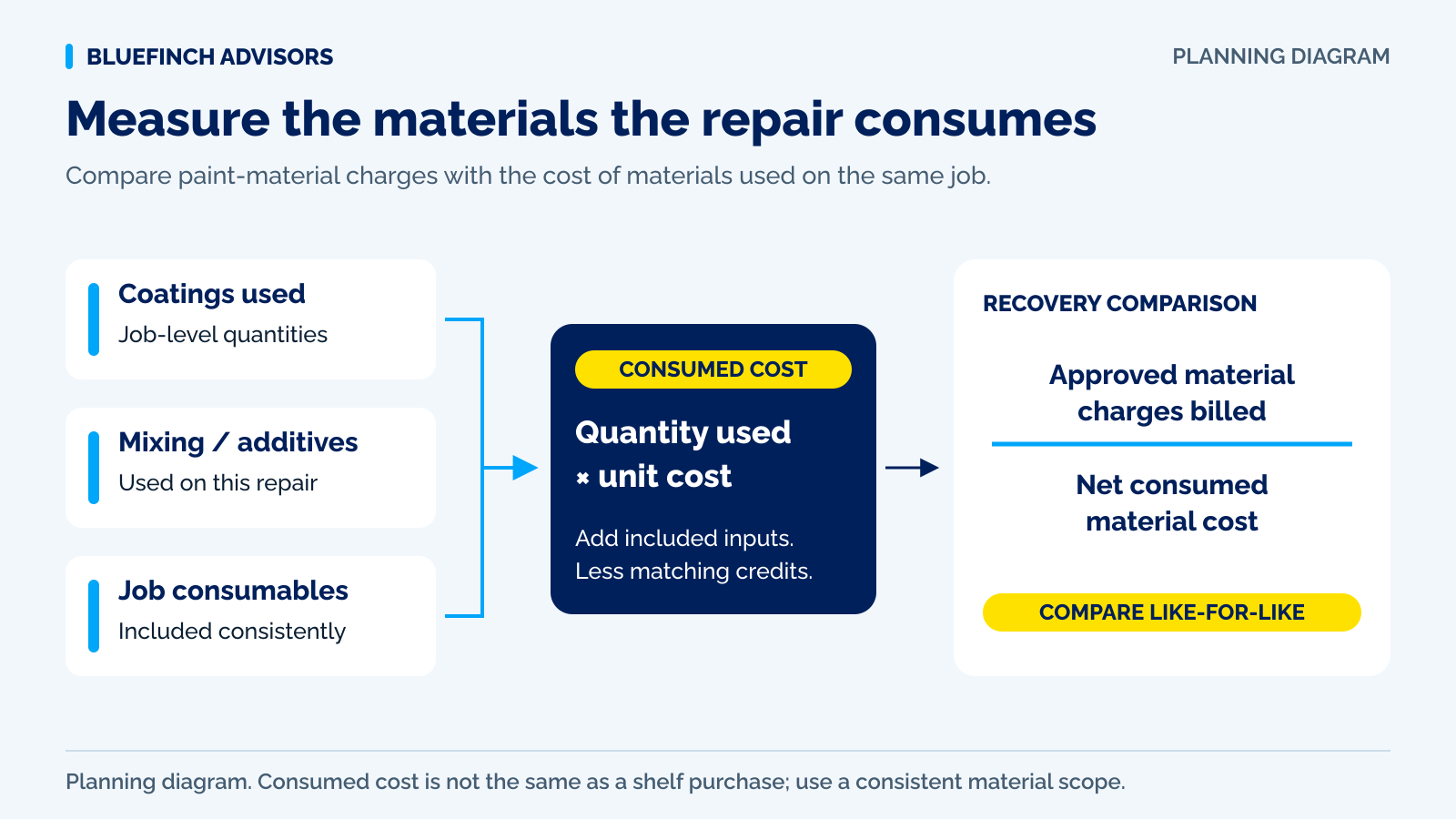
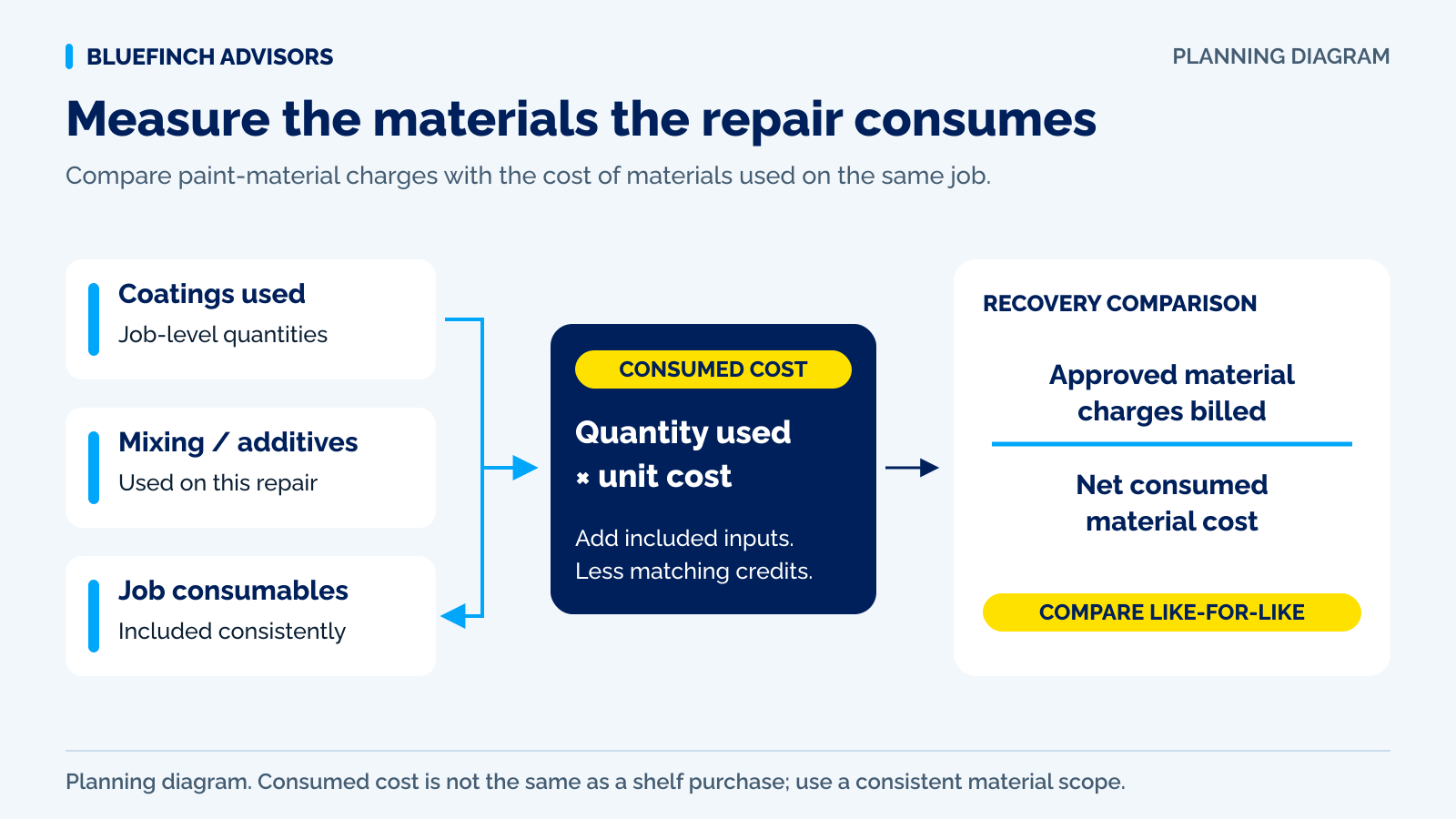
Download infographic (PNG) · Download vector (SVG) · Link to the source and methodology

The short version
- Match material billing and consumption to the same repair orders.
- Don't treat every stock purchase or supplier return as job consumption.
- Use consumed cost for recovery percentage and billed value for the surplus share.
This week's paint delivery may cover both jobs leaving the shop and stock staying on the shelf. Using that purchase invoice as the denominator for material recovery mixes inventory purchases with the cost of completed repairs.
Choose one repair order or a matched group, then enter their material billing and consumed costs. The fictional $600 charge below demonstrates the calculation. It doesn't recommend an allowance or reimbursement rate or describe a carrier agreement.
Use with this guide
Job cash flow planner
Track when payments become available and when job expenses leave the bank.
Browse the complete auto body guides and worksheets.
Use consumption recorded for each repair
PPG documents how Paint Shop Interface tracks paint and material consumption against repair orders. Its volume-estimator workflow estimates usage for selected vehicle panels. One plans usage; the other records what a job consumed. Keep those figures distinct.
Take consumed costs from closed job records. Separate color, clear, primer and non-paint sundries without overlap. Don't add waste again if the mixing report already includes discarded material. Stock bought for future repairs belongs in inventory planning, not this job's cost denominator.
Sources for this section: PPG: tracking consumed paint and materials against repair orders · PPG: paint volume estimation for individual repair panels
Example: $600 billed for $440 in consumed materials
The fictional job uses $210 of color, $120 of clear, $70 of primer and sealer, and $60 of sundries, totaling $460. A verified $20 credit against those consumed costs leaves $440 net cost. The approved material charge billed is $600.
Recovery is $600 ÷ $440, or 136.36%, with a $160 billed surplus. That surplus is 26.67% of the $600 billed value. Across 10 refinish hours, billing is $60 per hour and consumed cost is $44 per hour. These figures measure material billing before collections, labor and overhead.
| Illustrative measure | Result |
|---|---|
| Consumed material cost before matching credit | $460 |
| Net consumed material cost | $440 |
| Billed material recovery | 136.36% |
| Billed surplus before other expenses | $160 |
| Consumed material cost per refinish hour | $44 |
Check the records before changing material charges
Below 100%, the approved material billing doesn't cover the net consumed cost entered. First check the job set, mixing records, product prices, credits and billed scope. Low recovery doesn't prove insurer underpayment, and high recovery doesn't establish shop profit.
California BAR accepts hourly-rate and actual-cost approaches to estimating paint and materials under its guidance. That is a California example, not an instruction to change invoice terms nationwide. Any revised method must fit customer authorization, the actual agreement and applicable requirements.
Sources for this section: California Bureau of Automotive Repair: Write It Right
Compare the same jobs on the same basis
For last month's closed repair orders, use billing, consumption and refinish hours from those exact jobs. Combining materials issued to an open job with an invoice from a closed one creates a false gap. Keep the cutoff and cost basis consistent at the next review.
A negative net consumed cost needs investigation, usually of credits and consumption records. The calculator shows the signed amount but withholds the cost-based recovery ratio. Excess credits aren't treated as better performance.
Questions business owners ask
Does 136% recovery mean a 136% margin?
No. Recovery divides material billing by consumed cost. The surplus share divides surplus by billed value instead. This example has 136.36% recovery and a 26.67% material surplus share.
Can I use the monthly paint supplier invoice?
Only if it represents consumption on the same repairs. Inventory purchases usually cover different timing or jobs. Match the calculation to job consumption records.
Will this calculate what insurance owes for materials?
No. It compares the approved billing and consumed costs you enter. Coverage, reimbursement and authorized charges need separate supporting records.
Primary sources
BlueFinch last reviewed these sources on September 7, 2026. Payment rules and state requirements can change.
- PPG: tracking consumed paint and materials against repair orders
- PPG: paint volume estimation for individual repair panels
- California Bureau of Automotive Repair: Write It Right
Use this page for general business information. It is not legal, tax, or accounting advice.
Related resources
- 2026 Credit Card Processing Cost Report
- Auto Body Shop Payment Guide
- Auto Body Shop Credit Card Processing Calculator
- ADAS calibration sublets: match the work, invoice and payments
- Auto glass split payments: check customer and insurer balances
- Insurer virtual cards: what a body shop should check before processing one