The short version
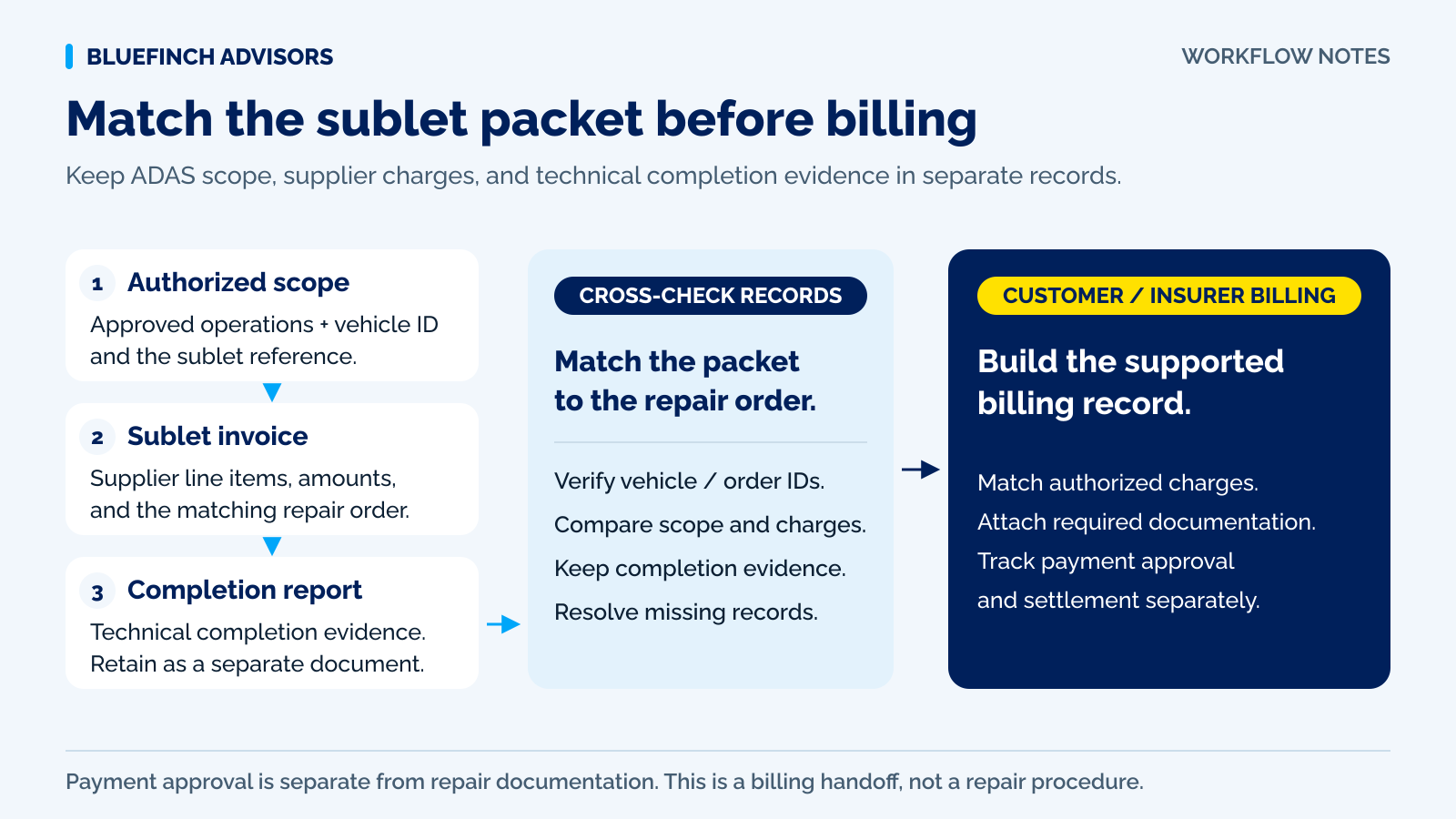
- Check that every document identifies the same sublet scope, vehicle and repair order.
- Track technical completion, the vendor bill and insurer payments separately.
- Use actual collections and vendor cash due to estimate what the shop needs to fund.
The vehicle is back from the calibration provider and the invoice has arrived. Your file also contains a quote, customer authorization, technical reports and a supplement still awaiting the payer's response. The vendor's invoice doesn't tell you whether those other items are resolved.
This guide covers the financial handoff for advanced driver assistance systems, or ADAS. Your qualified repair team uses current, vehicle-specific OEM information to determine the work needed. The worksheet connects that work with the office's cost, documentation and collection records.
Use with this guide
Job cash-flow planner
Track committed cash and collected payments at each project milestone.
Auto glass split payments: check customer and insurer balances
The deductible doesn't explain the whole payment file. Reconcile confirmed payer amounts with the final invoice and distinguish balances from receipts.
Body shop paint material recovery: match billing to consumed cost
A supplier invoice shows stock purchased. The repair order needs materials consumed on that job. Match those costs before calculating recovery.
Browse the complete auto body guides and worksheets.
Identify the vehicle, repair order and authorized work
Record the vehicle ID, repair order, requested work, customer authorization reference and provider quote. Let the qualified repair team define the technical scope. If the provider finds more work, send the revised request through your approval process; the original quote may no longer describe the final cost.
I-CAR's diagnostics process covers customer authorization, documentation and OEM repair information. Keep references to those records in the office file. When several sublet bills arrive, a line that says only 'calibration' is hard to match without the vehicle, operation or repair-order reference.
Sources for this section: I-CAR: ADAS collision repair diagnostics process, validated 2025
Distinguish completed work from billing and collection
The quote describes proposed work and cost; the final invoice lists the vendor's charges. Completion records show the work and reported results for technical review. Your customer estimate and payer correspondence identify amounts requested or agreed. Use bank receipts to confirm what you actually collected.
Before closing the job, reconcile these records. Assign each scope or amount difference to someone who can resolve it. Bookkeeping staff shouldn't have to judge technical completion from an invoice, and finished work doesn't mean the insurer has accepted the charge.
| Record | What to match | Separate question |
|---|---|---|
| Sublet authorization and quote | Vehicle, requested scope, approved cost | Was added work authorized? |
| Vendor invoice | Billed operations, amount, due date | Does the bill match the agreement? |
| Completion documentation | Vehicle, operation, date, reported outcome | Has the repair team reviewed the record? |
| Customer / insurer account | Agreed charges and current payer status | What amount is still unresolved? |
| Receipts and vendor payment | Actual amount, date, and reference | What cash has moved? |
Have the repair team review completion records
I-CAR covers calibration and test-drive documentation in its ADAS preparation training. Honda's July 2025 position statement distinguishes diagnostic scanning from calibration and directs repairers to applicable service information. Keep the technical records available to the people qualified to review them.
Request the documentation agreed for this job, then have your repair team resolve missing or unclear results. Completing a financial checklist doesn't establish vehicle safety or insurer coverage. Retain revised reports with their version history rather than silently replacing failed or incomplete records.
Sources for this section: I-CAR: ADAS preparation and calibration documentation · American Honda: post-collision scanning and calibration statement, July 2025
Example: paying the vendor before collecting the full amount
In this fictional job, the vendor quotes $650 and a separately approved $90 addition brings the final bill to $740. The shop has a documented $900 receivable for the related work. When it pays the vendor $740, it has collected only $600 of that receivable.
For these cash flows, the shop funds a $140 gap and still has $300 to collect. If that remainder arrives, receipts total $900, or $160 above vendor cost. This isn't net profit: shop labor, transport, overhead, taxes and processing costs are excluded. The example makes no claim about a real insurer's coverage decision.
Use the printable calibration sublet worksheet
Fill in the administrative records and send technical documents to the repair reviewer. Leave unresolved payer amounts clearly marked; don't transfer them to the customer balance without an established basis.
| Record | Amount / status | Reference / owner |
|---|---|---|
| Vehicle and repair order | ________________ | ________________ |
| Authorized scope and sublet quote | $_______________ | ________________ |
| Approved change | $_______________ | ________________ |
| Final vendor invoice / due date | $_______________ | ________________ |
| Completion report / technical review | ________________ | ________________ |
| Current billed amount / payer status | $_______________ | ________________ |
| Receipts actually collected | $_______________ | ________________ |
| Vendor payment actually sent | $_______________ | ________________ |
| Unresolved difference / next action | ________________ | ________________ |
Download it free, with no email signup. Add business or customer details only to your own copy.
Check unresolved sublets before month-end
Sort open items into missing reports, vendor billing differences, pending payer responses and overdue collections. Assign repair documentation to the repair team and payment questions to the estimator or billing contact so each reaches the right person.
Don't include vendor costs in card volume. When analyzing processing, count only receipts that ran through the merchant account. An insurer check, an unpaid supplement and a customer's credit-card payment don't affect the statement in the same way.
Questions business owners ask
Can the calibration invoice confirm the work was done correctly?
It confirms the charge. Your qualified repair team needs the relevant completion records and OEM information to review the repair.
Will an insurer pay the full amount for authorized calibration work?
Not necessarily. Track repair authorization, technical completion, payer agreement and receipts separately. Determine coverage and payment responsibility through the applicable claim and customer agreement.
Primary sources
BlueFinch last reviewed these sources on September 7, 2026. Payment rules and state requirements can change.
- I-CAR: ADAS collision repair diagnostics process, validated 2025
- I-CAR: ADAS preparation and calibration documentation
- American Honda: post-collision scanning and calibration statement, July 2025
Use this page for general business information. It is not legal, tax, or accounting advice.