Compare the contribution left per coating bay-hour
Enter one job in place of the sample. The calculation assumes you collect its full price and deducts only the direct costs listed here.
Use the interactive tool without signing up. It runs in your browser: enter your numbers, save a comparison, download results or print a working copy. Your numbers are not sent to BlueFinch.
Illustrative example inputs
These starting values show how the math works. They are not industry averages, customer results or a quote.
| Input | Example value |
|---|---|
Collected job price before tax Enter the full price for this defined job. The scenario assumes full payment. | $1,800.00 |
Coating material used Count coating consumed on this job; exclude unopened material reserved for later work. | $220.00 |
Other consumables used Count this job's pads, towels and prep products once. | $60.00 |
Total person-hours Total everyone's prep, correction and application time. Two people working three hours contribute six person-hours. | 12 hours |
Direct labor cost per person-hour Enter loaded direct cost rather than the rate you charge. Add owner labor if you want to include its cost. | $30.00 |
Elapsed occupied bay-hours Count elapsed time this job blocks the bay, including cure and waiting time in the same space. | 24 hours |
Outside job costs Add outside work for this job only if it isn't included elsewhere above. | $80.00 |
Assumed payment fee This sample rate is illustrative. Use the rate that applies to the payment in your scenario. | 3% |
Other payment fees for this job Enter the total fixed payment fees for the job, not the fee for one transaction. | $0.00 |
Example results
| Measure | Result |
|---|---|
Contribution per occupied bay-hour | $42.75 |
Job contribution before overhead and tax | $1,026.00 |
Contribution per labor-hour | $85.50 |
Calculation detail
| Measure | Result |
|---|---|
| Collected job price | $1,800.00 |
| Entered payment fees | $54.00 |
| Net receipt after entered fees | $1,746.00 |
| Coating material | $220.00 |
| Consumables | $60.00 |
| Direct labor cost | $360.00 |
| Outside job costs | $80.00 |
| Total entered direct costs | $720.00 |
| Occupied bay-hours | 24 hours |
| Total person-hours | 12 hours |
Model assumptions
- Defaults are examples. The assumed 3% fee isn't a BlueFinch rate or industry average.
- Use before-tax figures for both price and costs. Results round to cents.
- Measure bay occupancy separately from person-hours. Use the product's actual instructions for cure time.
- Overhead, tax, financing, owner labor not entered, rework and other omitted costs are excluded. The result is contribution, not net profit.
Read alongside these results
- This contribution must still cover overhead, tax, owner compensation not entered, rework and other omitted expenses. It isn't net profit.
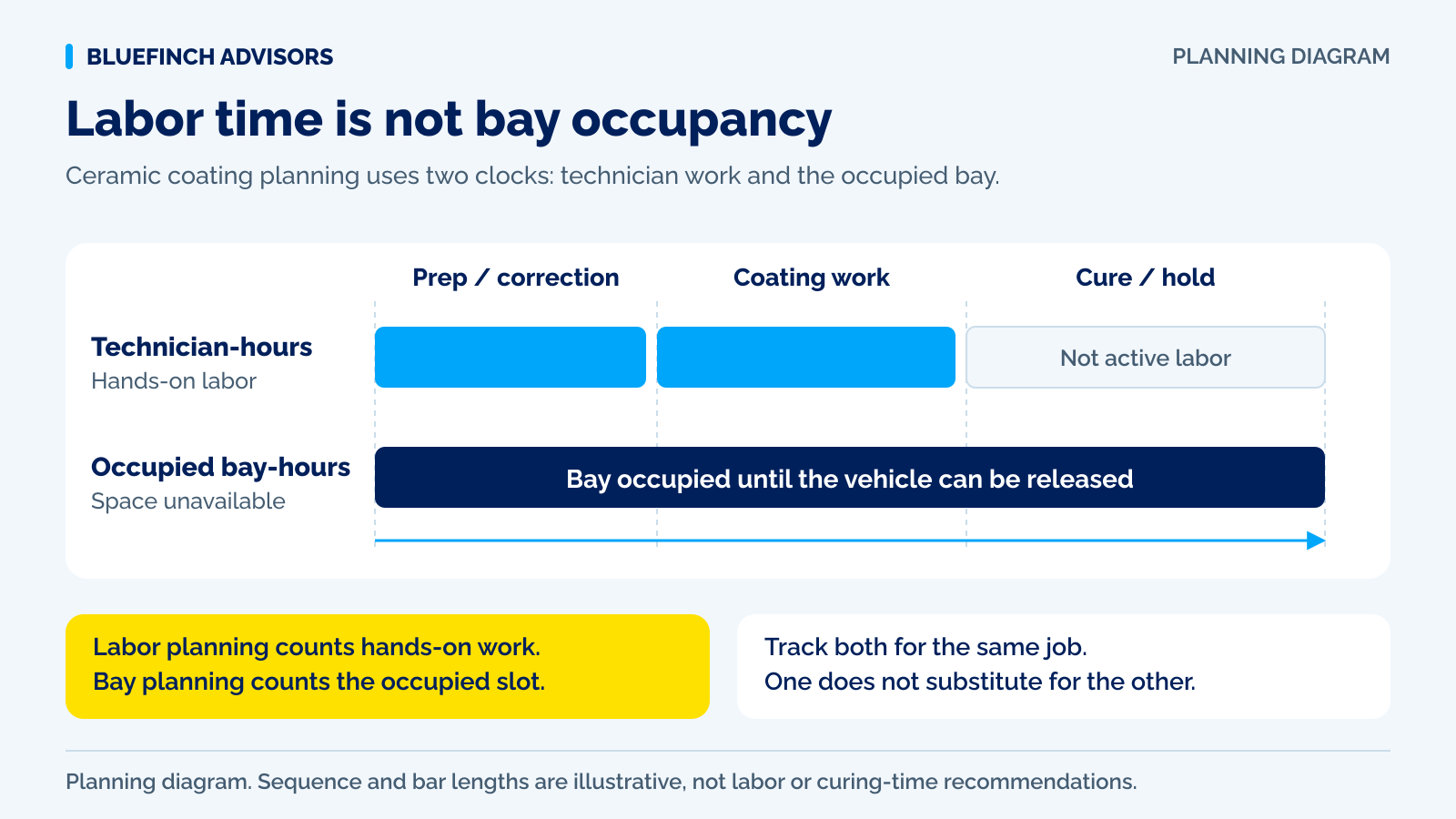
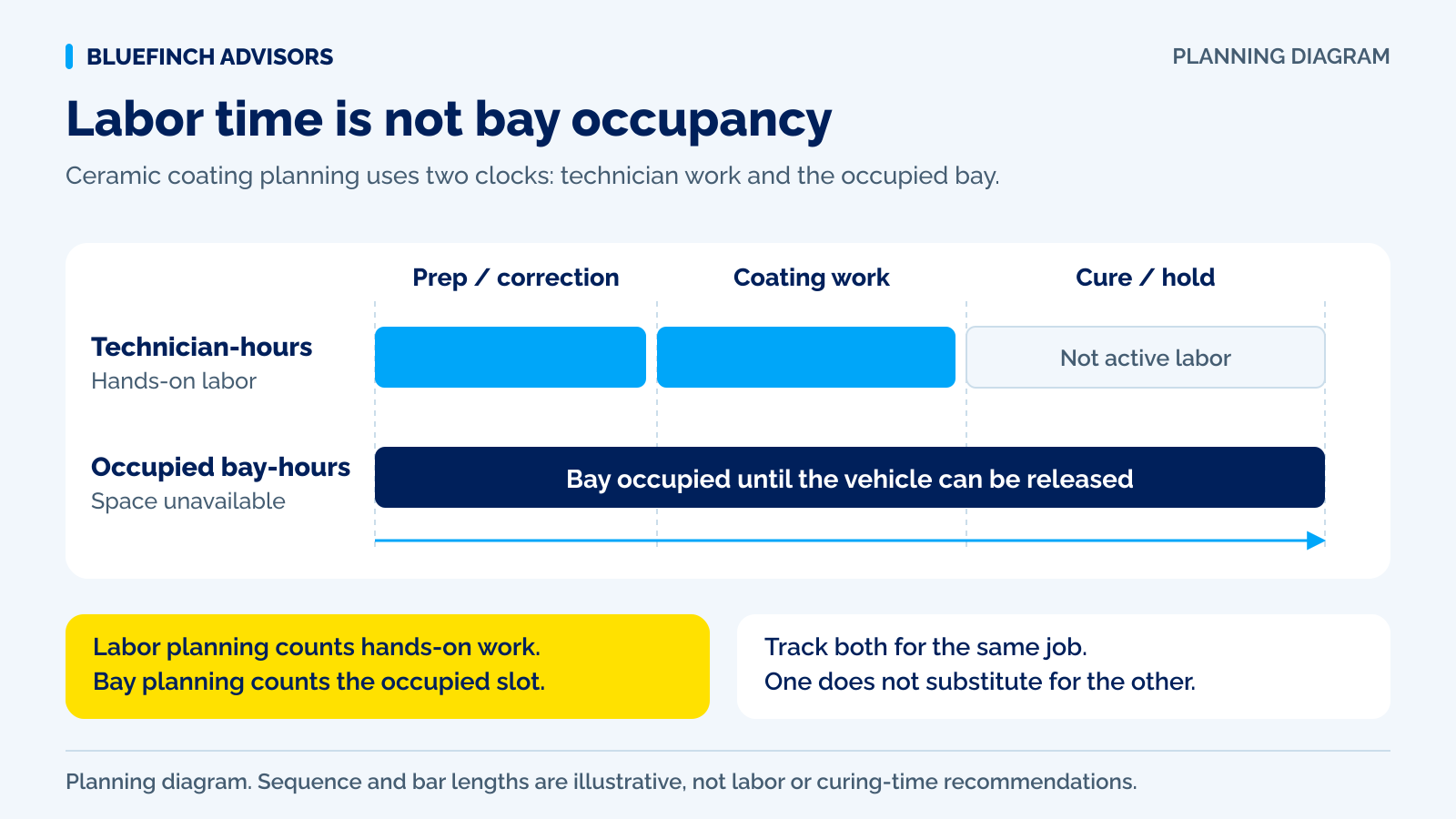
- Bay-hours count elapsed occupancy; labor-hours count total person-hours. Each uses a different denominator.
- This assumes full collection of the job price entered, without forecasting settlement dates or demand.
Download this worked example (CSV). Use the interactive version to export your own inputs and results.
Download infographic (PNG) · Download vector (SVG) · Link to the source and methodology

The short version
- Track total person-hours and elapsed bay occupancy separately.
- Count required cure time when it occupies the bay, using your product instructions and facility plan.
- The contribution left after entered job costs must still cover overhead and expenses you haven't entered.
You've finished applying the coating, but the car is still in the bay needed for the next job. Labor hours don't show that occupied time. This calculator divides the same job contribution by two measures: elapsed bay-hours and total person-hours.
Start with a completed job or a clearly defined quote, including the prep, correction and application promised in the price. The sample uses a fictional $1,800 job. It isn't a BlueFinch customer case or a recommended market price.
Use with this guide
Job cash flow planner
Track when payments become available and when job expenses leave the bank.
Ceramic coating revisits: budget cash for the work you may owe later
Future warranty work takes labor and cash. Use actual revisit records to plan for it rather than guessing a percentage of sales.
Browse the complete window tint guides and worksheets.
Count bay occupancy until the car leaves it
Gtechniq instructs users of Crystal Serum Light to keep the vehicle indoors for 12 hours after application. That timing applies to this product, not every ceramic coating. Follow the current instructions for the product you're installing.
Count the time this job prevents another vehicle from using the bay. If you move the car to a separate approved holding area after application, end this bay's occupancy at that move and plan holding-area capacity separately. Total the workers' person-hours independently, including when two technicians use the same bay.
Sources for this section: Gtechniq: Crystal Serum Light application information
Example: $1,026 of contribution across 24 bay-hours
For the sample $1,800 job, the assumed 3% payment fee is $54. Direct costs are $220 in coating, $60 in consumables, $80 in outside work and $360 for 12 person-hours at $30 each. Those direct costs total $720, leaving $1,026 after fees and the costs entered.
Dividing by 24 occupied bay-hours gives $42.75 per bay-hour. Dividing the same $1,026 by 12 person-hours gives $85.50 per labor-hour. Both describe the same contribution; adding them would count the job twice.
| Illustrative measure | Result |
|---|---|
| Price less payment fees | $1,746 |
| Entered direct job costs | $720 |
| Job contribution before overhead and tax | $1,026 |
| Contribution per occupied bay-hour | $42.75 |
| Contribution per person-hour | $85.50 |
Test one operating assumption at a time
The SBA distinguishes variable and fixed costs in its break-even guidance. Your coating contribution still needs to cover expenses this worksheet leaves out, including rent and administration. A good bay-hour result alone doesn't show business profit.
Identify whether labor, space or equipment is limiting the schedule. Even a low-labor job may occupy your only prepared bay into the next working day. Moving the car to an appropriate holding area could release that bay without reducing the job's labor cost.
Review the schedule, scope and price together using the result. If you revise a quote, spell out the correction and coating work still promised. This calculator compares entered figures; it can't establish demand, recommend shorter curing or determine safe holding conditions.
Sources for this section: U.S. Small Business Administration: break-even analysis and fixed costs
Support the calculation with a completed-job record
Keep the approved scope, material use, person-hours, bay arrival and release times, and final payment record. Enter those actual figures instead of the samples. If the job needed another prep pass, include its time and consumables rather than relying on the earlier estimate.
A deposit alone isn't the collected job price because this model assumes full payment. Use the job cash flow planner for deposit dates, supplier payments and final settlement. Review processing fees from your statement separately from the coating work's value.
Questions business owners ask
Is curing time also labor time?
Count labor while someone is working. Count cure time as bay occupancy if the car blocks the bay, following the product's required conditions.
Does contribution per bay-hour show hourly shop profit?
No. It divides the modeled job contribution by occupied bay-hours. That contribution must still cover rent, administration, tax and other costs you haven't entered.
Why can't I see a per-hour result?
There is no meaningful per-hour rate when hours are zero. Enter measured bay-hours or person-hours to calculate it.
Primary sources
BlueFinch last reviewed these sources on September 7, 2026. Payment rules and state requirements can change.
- Gtechniq: Crystal Serum Light application information
- U.S. Small Business Administration: break-even analysis and fixed costs
Use this page for general business information. It is not legal, tax, or accounting advice.