The short version
- Base the deposit on cash committed before you next collect payment.
- Document coverage changes before buying extra film or taking another deposit.
- Record supplier credits, customer refunds and card settlements separately.
A customer approves a full-front PPF package. You order film, reserve bay time and arrange paint correction before the car arrives. Your usual deposit might cover those commitments, but you can't tell from the quote alone.
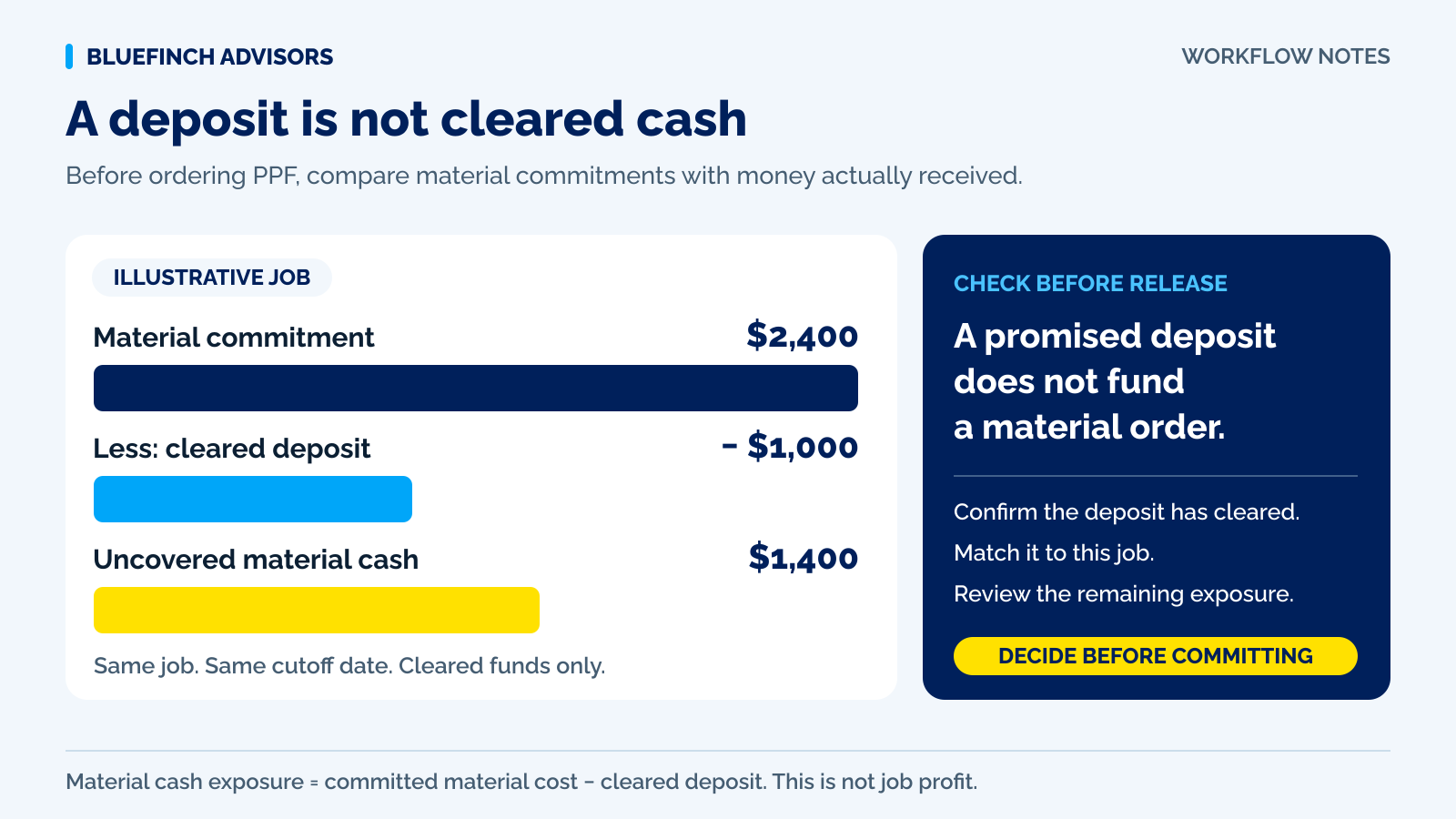
List costs and collection dates together. Find the shop cash tied up after the deposit settles, once preparation starts and before final payment. Use your own costs; the fictional example below isn't a BlueFinch customer's job.
Use with this guide
Job cash-flow planner
Track committed cash and collected payments at each project milestone.
Ceramic coating bay-hour calculator: compare space and labor
Twelve person-hours of work can occupy a bay for a full day. Compare the same job contribution against both measures after deducting the costs you enter.
Vehicle wrap film roll planner: calculate repeated rectangular cuts
Separate film consumed on a job from the cost of buying a roll. Plan repeated rectangular cuts while keeping directional film in the same orientation.
Browse the complete window tint guides and worksheets.
Confirm coverage before accepting a deposit
Write down the vehicle, areas covered, film product, removal and agreed preparation. Keep optional coating or correction separate from the approved PPF work. If the bumper needs extra prep, record who approved the additional charge and the date.
A full-front package needs different materials and bay time from a whole-vehicle installation. Confirm the scope version, appointment, deposit, estimated balance and cancellation contact. King Tutt Graphics' published terms connect deposits with material and production commitments, but that installer's percentages and refund terms don't automatically apply to your shop.
Sources for this section: King Tutt Graphics: published project and deposit terms
Distinguish cash spending from reserved capacity
Include film for the job, outside prep payable before delivery, consumables and labor paid during the work. Show the retail value of reserved bay time separately. Lost capacity matters, but counting an unused appointment's full selling price as a cash expense overstates the money leaving your bank.
Check when suppliers expect payment. Film purchased on account may be due after pickup, while a promised return credit isn't cash you've received. Add an expected payment date to each amount so the model reflects your bank balance.
Cash-flow example for a $4,800 PPF job
For a fictional $4,800 job, suppose you collect a $1,200 deposit. Before the final payment, you pay $1,450 for film and consumables, $350 for outside prep and $600 for job labor: $2,400 altogether. After the deposit, your shop supplies the other $1,200 until pickup.
If accepted under your written terms, a $1,800 deposit would leave a $600 gap. These aren't deposit recommendations for every installer, and neither example includes taxes or payment fees. To model your bank position, use net settled receipts or list processing fees as separate cash outflows.
| Milestone | Cumulative cash paid | Cumulative receipts | Shop cash tied up |
|---|---|---|---|
| Deposit received | $0 | $1,200 | $0; $1,200 ahead |
| Film and prep paid | $1,800 | $1,200 | $600 |
| Labor paid before pickup | $2,400 | $1,200 | $1,200 |
| Final $3,600 received | $2,400 | $4,800 | $0; $2,400 ahead |
Revise the job when the customer upgrades
Adding rocker panels changes the scope, materials, labor, total price and payment schedule. Update them together and keep the first deposit linked to its transaction. Before collecting another full deposit, show how the original payment is applied.
If the job is cancelled, document committed materials, returns the supplier accepts, work completed and the outcome approved under your policy and applicable law. A supplier refusing a film return doesn't by itself determine the customer's refund rights.
Complete and print the PPF cash worksheet
Use a sheet for each version of the scope. Keep supplier invoices beside your estimates, and record actual payment dates in place of expected dates after settlement.
| Record | Amount or detail | Date / reference |
|---|---|---|
| Vehicle and approved coverage | ________________ | ________________ |
| Film and consumables payable | $_______________ | ________________ |
| Prep, labor, and outside work payable | $_______________ | ________________ |
| Customer deposit received | $_______________ | ________________ |
| Added work approved | $_______________ | ________________ |
| Supplier credit actually received | $_______________ | ________________ |
| Final customer balance | $_______________ | ________________ |
| Largest cash gap before collection | $_______________ | ________________ |
Download it free, with no email signup. Add business or customer details only to your own copy.
Match final payment with the installation records
At delivery, check the installed coverage against the final invoice, deposits applied and balance collected. Handle manufacturer warranty registration separately. 3M's PPF registration asks for installation and vehicle details; the payment receipt alone doesn't complete that file.
If you offer cash and card prices, show the approved prices before collecting the first payment and again after scope changes. Credit-card surcharging is a different model. Before changing checkout, test deposits, debit, remote links and partial refunds with your processor.
Sources for this section: 3M: paint protection film installer warranty registration
Questions business owners ask
How do I choose a PPF deposit amount?
Calculate the cash needed before the next customer payment, then review your customer terms and applicable rules. A fixed percentage is only an assumption until you know the job's costs and dates.
Will the worksheet tell me whether to refund a deposit?
No. It tracks spending and collections. The accepted terms, circumstances and applicable law determine refund obligations.
Primary sources
BlueFinch last reviewed these sources on September 7, 2026. Payment rules and state requirements can change.
- King Tutt Graphics: published project and deposit terms
- 3M: paint protection film installer warranty registration
Use this page for general business information. It is not legal, tax, or accounting advice.