Price the recurring-payment cutover
Compare setup, follow-up labor and unrecovered billing with verified monthly savings.
Use the interactive tool without signing up. It runs in your browser: enter your numbers, save a comparison, download results or print a working copy. Your numbers are not sent to BlueFinch.
Illustrative example inputs
These starting values show how the math works. They are not industry averages, customer results or a quote.
| Input | Example value |
|---|---|
Recurring members to move Active authorized subscriptions in the cutover cohort. | 400 |
Members needing follow-up Planning percentage based on vendor readiness or a pilot, not an industry average. | 15% |
Staff minutes per exception Total follow-up and verification time per member. | 12 |
Loaded staff cost per hour Compensation and related costs you choose to include. | $30.00 |
Transition billing not recovered Only amounts expected to remain uncollected, not merely late. | $900.00 |
Setup and parallel-system costs Migration fees, training, and temporary overlapping costs. | $2,400.00 |
Current monthly retained costs All relevant processing, software, debit, and account costs. | $1,500.00 |
Proposed monthly retained costs Use the same collection volume and scope as the current amount. | $1,000.00 |
Example results
| Measure | Result |
|---|---|
Members requiring follow-up Expected workload; fractional members are an estimate. | 60 |
Transition exposure One-time costs plus follow-up labor and unrecovered billing. | $3,660.00 |
Monthly retained-cost reduction A negative result means the proposal costs more each month. | $500.00 |
Exposure / monthly reduction Interpret as payback months only when the denominator is positive. | 7.32 |
Calculation detail
| Measure | Result |
|---|---|
| Exception follow-up labor | $360.00 |
| Unrecovered transition billing | $900.00 |
Model assumptions
- Defaults are a fictional migration scenario.
- The break-even ratio assumes positive, stable monthly savings. Zero savings returns Not available; a negative ratio means there is no positive payback under these inputs.
Read alongside these results
- This is a planning comparison, not a guarantee of token portability, authorization, savings, or recovery.
- Contract termination fees and hardware purchases belong in setup if applicable.
Download this worked example (CSV). Use the interactive version to export your own inputs and results.
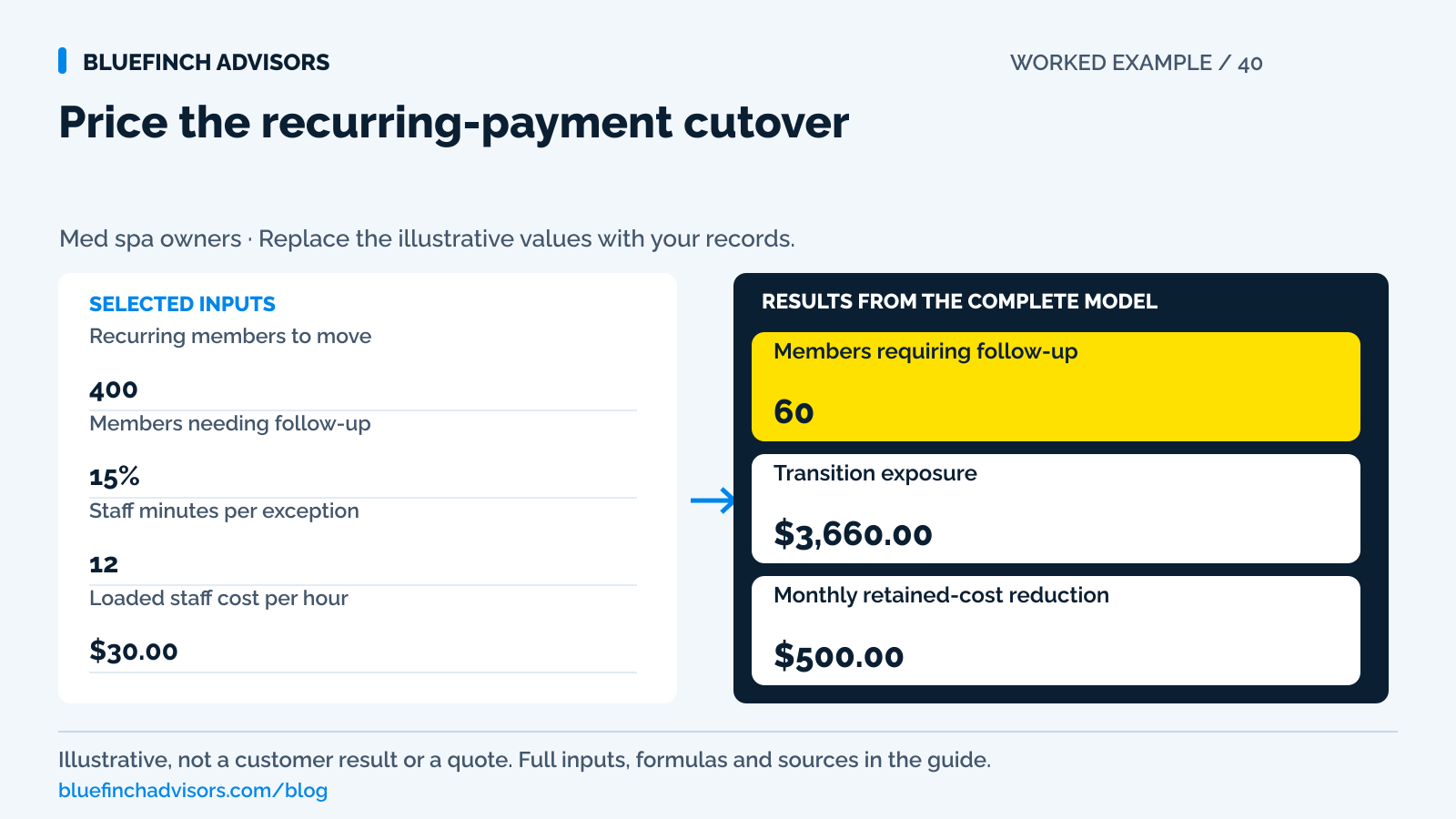
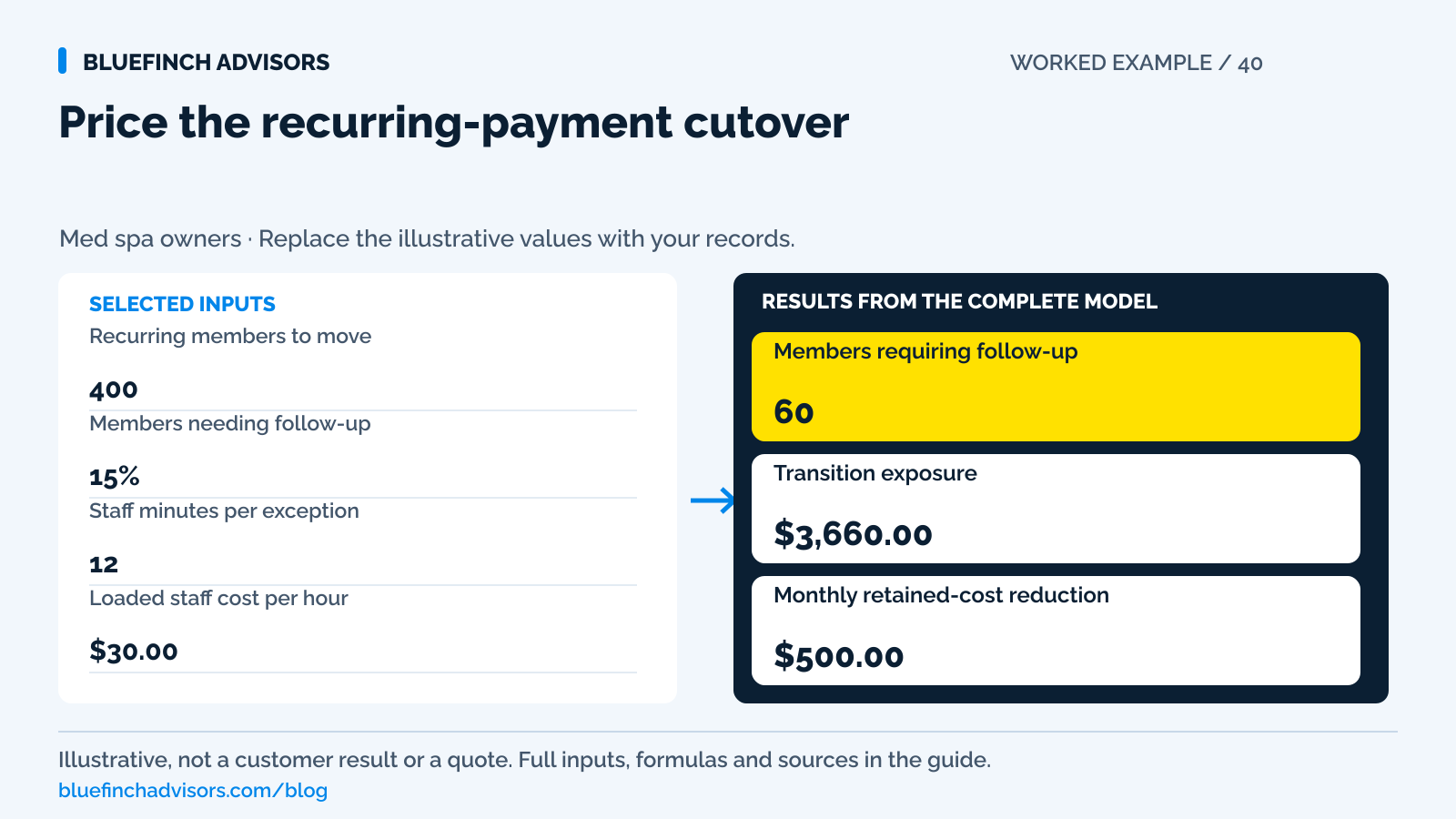
Download infographic (PNG) · Download vector (SVG) · Link to the source and methodology


The short version
- Verify subscription schedules separately from transferred payment credentials.
- Estimate follow-up work and overlapping system costs before signing.
- Compare all retained monthly costs rather than the eligible-credit rate alone.
A new processing proposal saves $500 a month on paper. You have 400 recurring members, a booking system tied to the old provider, and no written answer about which stored credentials can move. The proposal may still be good. Its break-even date is not yet known.
This worksheet puts a price on the transition without assuming every token is portable or every failed charge becomes lost revenue. The example is fictional, and all costs are entered by the owner. Use it after the outgoing processor, incoming processor, and subscription software have described the supported migration path.
Use with this guide
Membership collections calculator
Establish current decline and recovery behavior before estimating migration losses.
Stored-card checklist
Review credential handling and role access.
Med spa effective-rate audit
Build the complete current-cost baseline.
Square alternatives for med spas: map software dependencies
Compare med-spa payment providers without losing package balances or recurring arrangements. Map eligibility, exports and nonclinical software dependencies.
Browse the complete medical spa guides and worksheets.
Ask for three separate inventories
List customer identities, payment credentials, and billing instructions separately. A customer can exist in the new system without a usable card. A card can be imported without being selected as the default for a subscription. A subscription can exist with the wrong next billing date. A file count alone does not prove readiness.
Stripe's migration documentation separates payment-data import from subscription migration. Its payment-method guide also describes default-card behavior and limitations for wallet credentials. These are useful questions for any vendor, even if neither your current nor proposed system uses Stripe. Ask for answers specific to your account and platform version.
The inventory should show active, paused, canceled, and failed-payment accounts. Move only the states you actually intend to move. A canceled account with a valid token must not accidentally become an active recurring charge because the importer treated every customer as a subscriber.
Sources for this section: Stripe: importing payment methods and migration limitations · Stripe: subscription migration stages
Get the savings denominator right
Compare the same month of collections under both proposals. Keep eligible credit, debit, card-not-present, recurring billing, gateway, software, monthly, and account-specific costs visible. Any new dual-pricing program needs its own disclosure and implementation review. It should not be treated as a magic switch that removes every expense.
In particular, recurring debit does not become credit because the transaction is unattended. A wallet is an interface, not proof of the underlying card type. Visa prohibits surcharging its debit and prepaid cards, and distinguishes a displayed cash/card price arrangement from adding a fee at the end. Have the acquirer confirm the exact recurring flow before announcing changed prices to members.
A lower processing line can be offset by a higher booking subscription or mandatory support tier. Conversely, a useful operational improvement may justify a change even when fee savings are modest. Keep those benefits separate so the financial case does not depend on unmeasured claims about saved staff time.
Sources for this section: Visa: U.S. merchant surcharging and displayed-price distinctions
The sample transition takes 7.32 months to repay
For 400 members, a 15% follow-up share creates 60 expected exceptions. At 12 minutes each, that is 12 staff hours. With a $30 loaded hourly cost, the work costs $360. Add $2,400 of setup and overlapping-system costs and $900 of billing that remains uncollected. Total modeled exposure is $3,660.
Current retained costs of $1,500 less proposed retained costs of $1,000 produce $500 of monthly savings. Divide $3,660 by $500: the simple payback is 7.32 months. This does not discount cash flows or include future changes in volume. It answers whether the near-term benefit plausibly covers the transition effort.
Now change the follow-up share to 30%. Labor rises to $720, total exposure becomes $4,020, and payback is 8.04 months if lost billing does not change. That last condition may be unrealistic. More exceptions may also mean more uncollected charges. Change each input explicitly instead of assuming one field automatically captures the entire risk.
Let the providers move sensitive credentials
Do not ask the front desk to export card numbers into a spreadsheet and email them to the new provider. Establish the provider-to-provider transfer procedure, named contacts, encrypted transport, and completion report. Your operating workbook needs customer references, status, and mapping results, not raw credentials.
PCI SSC states that card verification codes cannot be retained after authorization for card-on-file or recurring transactions, even with customer permission. A request to collect everyone's CVV for a migration spreadsheet is a reason to stop that proposed step and get the providers' security teams involved.
When a credential cannot move, use the incoming provider's approved secure update flow. Explain who is requesting the update and why. Do not put treatment information into a payment-update message. Keep the update request separate from any change to membership price or terms so the client can understand each action.
Sources for this section: PCI Security Standards Council: no CVV storage for recurring payments
Cut over by verified cohort, not by hope
Choose a small cohort with different billing states: one normal renewal, one scheduled pause, one card change, one credit balance, and one canceled account retained for records. Verify the next billing date, amount, default payment method, consent record, and benefit balance. If testing requires a live payment, agree on a supported, authorized test with the provider rather than creating unexplained charges.
Designate one system as the billing authority for each member on each date. Keep a cutover register with the last old-system bill and first new-system bill. Parallel access is useful for records and refunds. Parallel automatic billing for the same member is not.
After the first cycle, compare expected bills, attempted bills, settled charges, benefit grants, and exceptions. A successful import count is not the acceptance criterion. A correct first billing cycle and a documented queue for everything else are more useful evidence.
Sources for this section: Stripe: subscription migration stages
Keep the old refund path until it is no longer needed
Ask how refunds of old payments will work after closure, how reports can be exported, and how long support access remains available. Do not assume a new terminal can reverse a charge acquired by another provider. Stripe's documentation, for example, requires refunds to return to the original payment method for its charges.
Preserve the original posted-price version and tender type with historical transactions. A refund on an old program should not be recalculated using today's menu or a new fee setting. Verify the actual program rules with the provider and keep any retained original processing cost visible in your comparison.
Your next action is a written readiness call with all three parties: current processor, incoming processor, and membership platform. Bring the exception estimate, cost comparison, cutover ownership, and historical refund questions. Do not set the final shutdown date until those responsibilities have names.
Sources for this section: Stripe: refund funding, destinations, and refund status
Questions business owners ask
Does tokenized mean portable?
No. Portability depends on the token type, providers, platform support, and approved transfer process. Obtain a written account-specific answer.
Should delayed membership collections count as lost?
Only if you expect not to recover them. Track temporary cash timing separately from the permanent collection loss used here.
What does a negative payback figure mean?
The proposed monthly cost exceeds the current cost. There is no positive fee-savings payback under those inputs. Assess other benefits separately.
Primary sources
BlueFinch last reviewed these sources on October 2, 2026. Payment rules and state requirements can change.
- Stripe: importing payment methods and migration limitations
- Stripe: subscription migration stages
- Visa: U.S. merchant surcharging and displayed-price distinctions
- PCI Security Standards Council: no CVV storage for recurring payments
- Stripe: refund funding, destinations, and refund status
Use this page for general business information. It is not legal, tax, or accounting advice.