Reconcile an approved retail exchange
Check the customer's new balance separately from the exchange's change in contribution after stock costs and fees.
Use the interactive tool without signing up. It runs in your browser: enter your numbers, save a comparison, download results or print a working copy. Your numbers are not sent to BlueFinch.
Illustrative example inputs
These starting values show how the math works. They are not industry averages, customer results or a quote.
| Input | Example value |
|---|---|
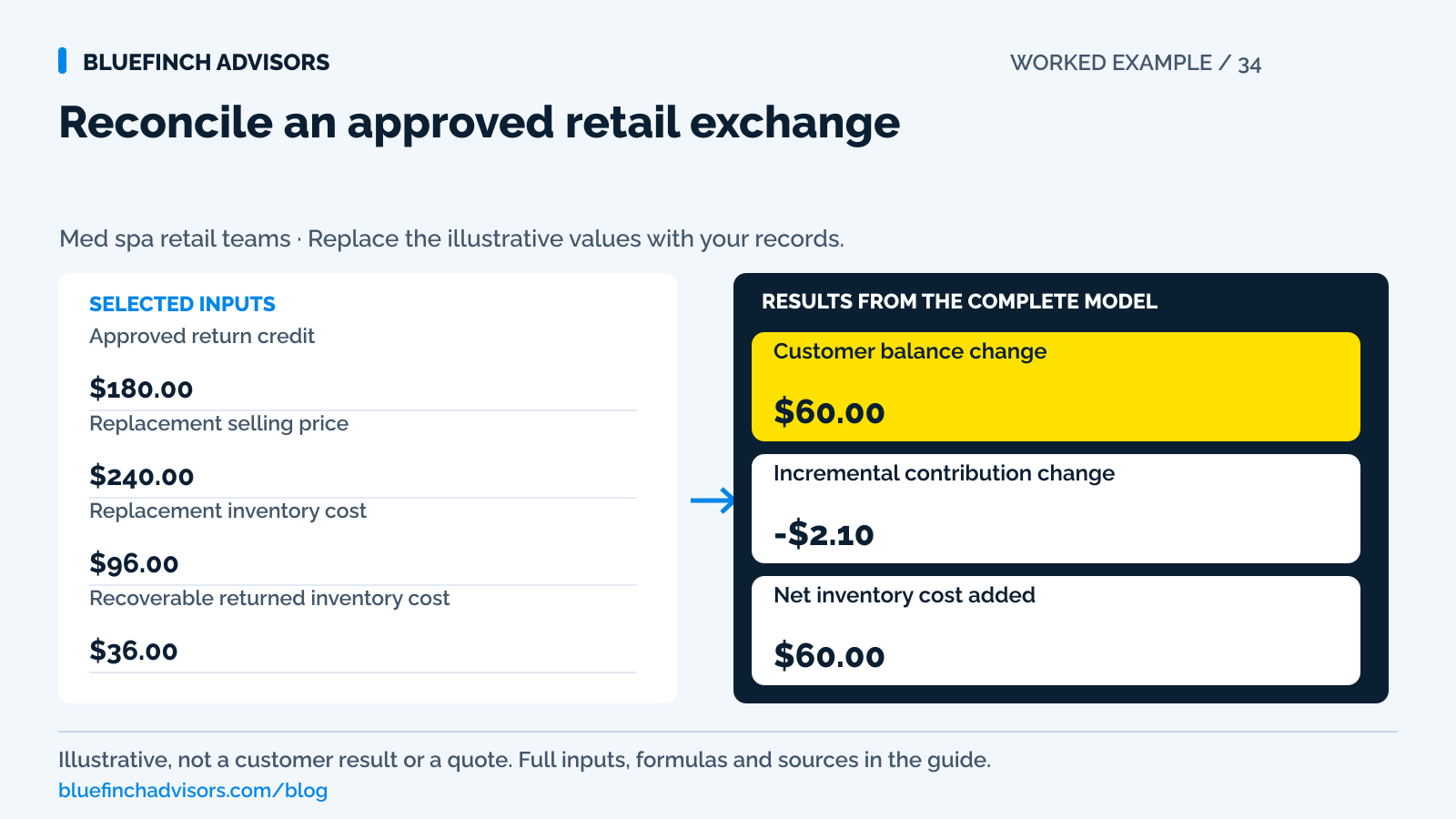
Approved return credit The agreed original-price value of the accepted items. | $180.00 |
Replacement selling price Price shown and accepted for the replacement items. | $240.00 |
Replacement inventory cost Actual cost assigned to items leaving stock. | $96.00 |
Recoverable returned inventory cost Only stock approved as usable; not the returned retail price. | $36.00 |
New payment and return charges Actual incremental merchant costs; original fees are excluded. | $2.10 |
Example results
| Measure | Result |
|---|---|
Customer balance change Positive means additional payment; negative means refund or approved credit. | $60.00 |
Incremental contribution change New cash plus recoverable inventory less replacement cost and new fees. | -$2.10 |
Net inventory cost added Replacement stock cost less verified recovery. | $60.00 |
Calculation detail
| Measure | Result |
|---|---|
| Replacement price | $240.00 |
| Approved return credit | $180.00 |
| New merchant payment expense | $2.10 |
Model assumptions
- Illustrative approved exchange, excluding tax and shipping.
- Inventory recovery requires your product-handling approval. This calculator cannot decide whether a returned product is safe to resell.
Read alongside these results
- A negative contribution change is visible even when the customer pays more.
- The model measures the change from this exchange, not profit on the original sale.
Download this worked example (CSV). Use the interactive version to export your own inputs and results.
Download infographic (PNG) · Download vector (SVG) · Link to the source and methodology


The short version
- Check whether an accepted return can be restocked; payment approval doesn't decide that.
- Compare approved return credit with the replacement price to find the new balance.
- Test exchanges as well as refunds before changing payment software or pricing.
A client returns two retail products and selects a more expensive replacement. The desk sees a small balance due, while the inventory report shows several item movements. If the manager checks only the bank deposit, the exchange may disappear from the review even though margin changed materially.
This guide begins after the practice has approved a return under its applicable policy. It does not decide product safety, medical suitability, return rights, or tax treatment. The calculator separates the customer balance from the change in retained cash and recoverable inventory. Its example excludes tax and uses fictional costs.
Use with this guide
Payment software scorecard
Include positive, negative, and even exchanges in the vendor demonstration.
Processing cost audit
Check retained fees instead of assuming a refund reverses every expense.
Payment channel map
Trace retail returns from online and front-desk sales.
Browse the complete medical spa guides and worksheets.
Keep three records attached to the exchange
The first record is the original sale: items, quantities, price paid, tender, receipt, and any discount. The second is the approved return: accepted items, value credited, reason, and disposition. The third is the replacement sale: items leaving stock, current accepted price, and any new payment or remaining credit.
Those records answer different questions. A customer may receive an approved credit for a product that cannot return to saleable inventory. Recording that item as restocked simply because the refund succeeded would overstate available stock. Clinical or product-safety questions should go to the appropriate professional, not be inferred from the payment action.
Square's retail documentation distinguishes refunds, returns, and exchanges and describes how an exchange can leave a positive, negative, or even cart total. Use that behavior as a test case for your own system rather than assuming every point-of-sale product treats the records identically.
Sources for this section: Square: returns, exchanges, and unlinked refunds
Use the price the client actually paid
If a product was discounted within a bundle, locate the original allocation before approving the return value. Today's shelf price may be different. Staff need a reliable way to find the actual transaction, not a policy that depends on remembering last month's promotion.
For a split-tender sale, record which part was cash, card, or prepaid value. The appropriate return route depends on the approved policy, payment provider, and original transaction. Do not refund a gift-value purchase as an unrelated card credit just because that button is convenient.
Stripe's refund guidance illustrates why provider rules matter: its refunds return to the original payment method. Square supports certain unlinked-refund workflows, but its documentation explicitly warns about their loss and misuse risks. Those differences mean an exchange test must use the actual account and permissions you plan to operate.
Sources for this section: Stripe: refund funding, destinations, and refund status · Square: returns, exchanges, and unlinked refunds
A $60 new payment can still reduce contribution
The fictional return has an approved value of $180. Replacement items sell for $240, leaving a $60 additional payment. The replacements cost the practice $96. Of the returned stock, only $36 of inventory cost is approved as recoverable. The new payment and return workflow costs $2.10.
Incremental contribution is $60 plus $36, less $96 and $2.10: negative $2.10. The customer bought a more expensive replacement, but the exchange did not add contribution under these assumptions. That is not automatically a bad service decision. It is a clear measure of the cost of the chosen resolution.
If none of the returned product can be recovered, change the recovery input to zero. The contribution change becomes negative $38.10. Do not enter the $180 retail credit as inventory recovery. That would confuse the customer-facing price with the practice's stock cost and make the result appear much stronger.
An even exchange may be absent from the transfer report
Square notes that exchanges do not appear on its Transfer Summary or accounting integration in the same way as ordinary payment movements. A bank-focused review can therefore miss the underlying item activity. Pull the exchange or transaction report alongside the settlement file and inventory adjustment record.
The manager should be able to explain both totals: what changed in the customer balance and what changed in stock. An even exchange has zero new cash but can still change inventory cost. A refund to store credit has no immediate bank outflow but creates value that may be redeemed later.
Use a shared exchange reference on all supported records. For a manual exception, include the approver, original receipt, return decision, replacement sale, and payment reference. Do not record the same approved credit once as a card refund and again as a discount on the replacement unless both are intentionally part of the remedy.
Sources for this section: Square: returns, exchanges, and unlinked refunds
Test the exchange under both old and new price settings
A practice adopting dual pricing should test a return from before the change and a replacement bought after it. Preserve the original refund basis and show the new replacement price before authorization. Staff should not recalculate the old sale using the new card-price setting.
Also test an exchange with debit, a credit-card purchase, and prepaid gift value plus a new card balance. Debit and prepaid cards remain ineligible for Visa surcharges even when processed without a PIN. A displayed cash/card price arrangement and a checkout surcharge have different rules. The provider must configure the approved program for each supported transaction path.
Include retained original fees and any new exchange charges in a processor comparison. An eligible-credit rate of zero does not prove returns are costless. Software subscriptions, debit expense, refund-related costs, and support time can remain. Use actual statements and observed workflow results.
Sources for this section: Visa: U.S. merchant surcharging and displayed-price distinctions
Make the exception route narrow and usable
Permit routine linked returns under the practice's approved limits. Require review for a missing receipt, an unlinked payment, an unusually large credit, a different refund destination, or an item that was never on the original invoice. This is a practical ownership rule, not a claim that every exception is improper.
At close, sample a cash-negative exchange, an even exchange, and a cash-positive exchange. Verify the returned quantity, stock disposition, customer receipt, and payment status. Look for duplicate credits created when a staff member retried a slow screen without checking the first attempt.
Before switching systems, ask the vendor to demonstrate those same cases and export the results. The next action is one approved test exchange followed from receipt to stock to settlement. If any link disappears, resolve that specific gap before putting the new process in front of clients.
Sources for this section: Stripe: matching transactions to automatic payouts
Questions business owners ask
Why is the original processing fee excluded from the calculator?
It was incurred before this exchange. The tool measures the incremental change. Keep the original fee in the full sale-and-return profitability review.
Is store credit the same as a completed cash refund?
No. It preserves a future promise rather than returning bank funds immediately. Record the approved credit and its later redemption separately.
Can staff restock every accepted return?
No. Payment approval does not establish product condition or suitability for resale. Use the practice's authorized product-handling decision.
Primary sources
BlueFinch last reviewed these sources on October 2, 2026. Payment rules and state requirements can change.
- Square: returns, exchanges, and unlinked refunds
- Stripe: refund funding, destinations, and refund status
- Visa: U.S. merchant surcharging and displayed-price distinctions
- Stripe: matching transactions to automatic payouts
Use this page for general business information. It is not legal, tax, or accounting advice.