Check what's missing and what's unavailable at the bank
Separate amounts not yet received from checks received but not yet available to spend.
Use the interactive tool without signing up. It runs in your browser: enter your numbers, save a comparison, download results or print a working copy. Your numbers are not sent to BlueFinch.
Illustrative example inputs
These starting values show how the math works. They are not industry averages, customer results or a quote.
| Input | Example value |
|---|---|
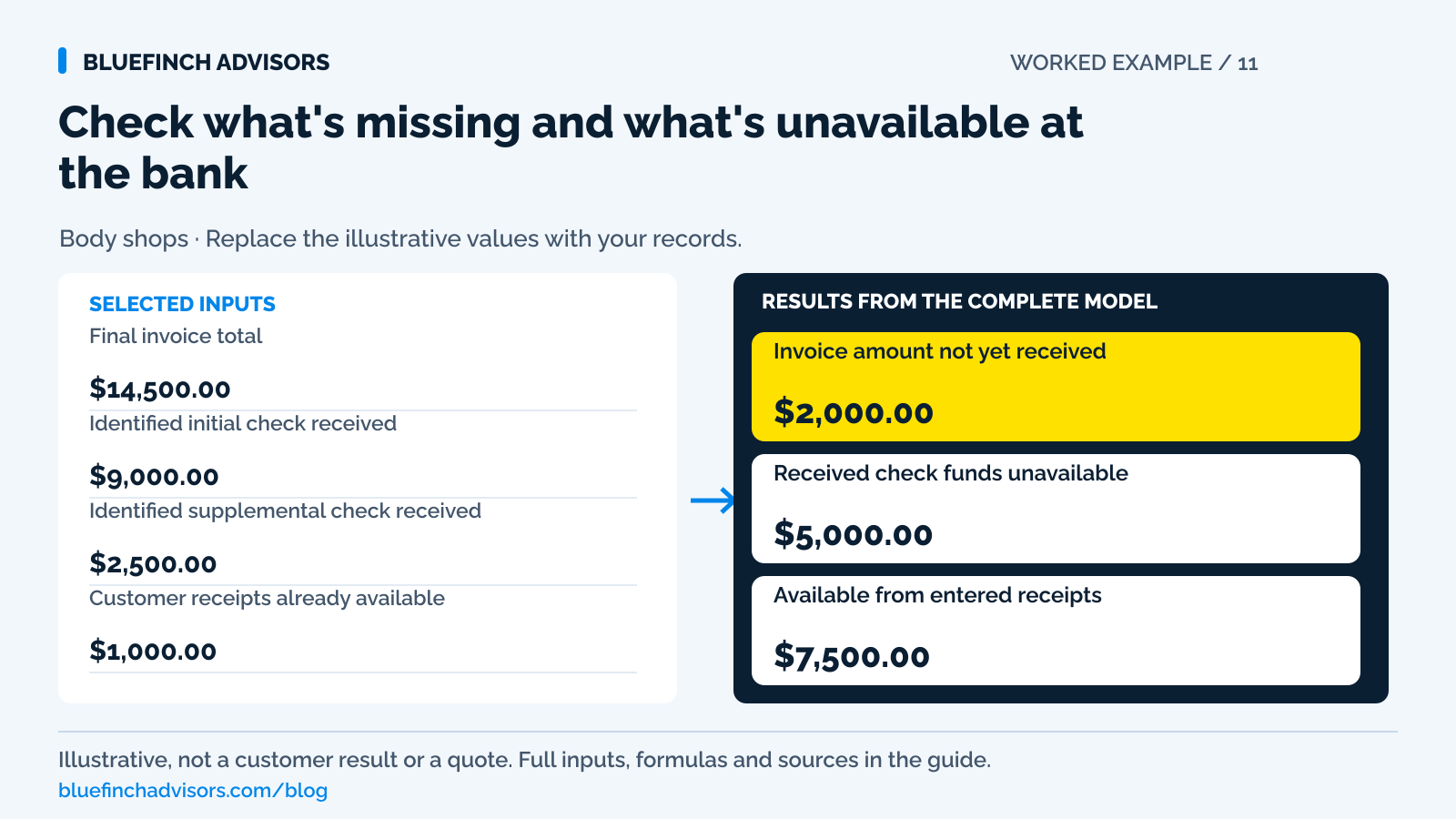
Final invoice total Use the current approved repair total. | $14,500.00 |
Identified initial check received Do not count a replaced or canceled duplicate. | $9,000.00 |
Identified supplemental check received A different instrument allocated to this invoice. | $2,500.00 |
Customer receipts already available Use only collected, available customer funds in this simplified model. | $1,000.00 |
Funds available from these checks Use actual bank availability, not the face value of deposited checks. | $6,500.00 |
Example results
| Measure | Result |
|---|---|
Invoice amount not yet received Negative means excess or inconsistent recorded receipts. | $2,000.00 |
Received check funds unavailable Includes received checks not yet deposited and bank-held amounts. | $5,000.00 |
Available from entered receipts Available customer money plus confirmed check availability. | $7,500.00 |
Calculation detail
| Measure | Result |
|---|---|
| Identified checks received | $11,500.00 |
| All identified receipts | $12,500.00 |
| Invoice less available receipts | $7,000.00 |
Model assumptions
- All defaults are illustrative. The checks are uniquely identified and allocated to this invoice.
- Received checks can include items awaiting deposit; they do not all become available cash.
- The customer receipt input is assumed available. The tool does not prove check validity or final settlement.
Read alongside these results
- Available check funds above the entered check total indicate inconsistent inputs.
- Verify payees, deposit acceptance, bank holds, unusual overpayments, and vehicle-release requirements separately.
Download this worked example (CSV). Use the interactive version to export your own inputs and results.
Download infographic (PNG) · Download vector (SVG) · Link to the source and methodology

The short version
- Track which check pays which balance separately from when funds become available.
- Confirm named-payee handling with the insurer and bank instead of guessing who must endorse.
- An available balance doesn't prove an unfamiliar check is genuine or finally settled.
The office has an initial insurance check, a supplemental check, and the customer's deductible payment. The repair-order total still does not equal the money received, and the bank has made only part of the deposited checks available. Those are two different gaps. Calling the job paid because the envelopes arrived hides both.
Record each check or payment in a receipt register and track available cash separately. This matters when a check names the vehicle owner, a lienholder, the shop or several payees. The steps below help the office identify which document, payer or bank question needs resolving. They don't decide endorsement law or vehicle-release rights.
Use with this guide
Keep insurer checks outside card volume
Separate payer identity from the method used to collect each amount.
Prepare the release review
Show the payment facts and unresolved amounts before the delivery decision.
Check the payer allocation
Identify whether an unreceived amount belongs to the carrier or customer.
Browse the complete auto body guides and worksheets.
Read the payee line before planning the deposit
Match the check to the claim, repair order, payer, amount, and current invoice allocation. Record the exact payee names in the secure payment file and note whether a correction or additional step is needed. Do not assume that a check handed to the shop is payable to the shop, or that a customer's signature alone satisfies the bank's requirements for every payee arrangement.
Progressive explains that a financed vehicle's claim payment may name both the owner and lienholder, while its network-shop payment can follow a different route. That is evidence that payment arrangements differ, not a universal endorsement instruction. Ask the issuing insurer and the bank about the actual instrument. If reissue or lienholder involvement is needed, assign an owner and target date before the vehicle is scheduled for pickup.
Sources for this section: Progressive: Car repair estimate and payment questions
Identify each check once, including replacements
Use payer, check number, issue date, amount, and claim reference to distinguish the initial payment from supplements or replacements. Record whether a check is received, awaiting payee resolution, deposited, returned, canceled, or replaced. A replacement for a lost check is not another collection. Keep its connection to the canceled original so both instruments cannot accidentally be counted against the invoice.
If two insurers or claim administrators are involved, confirm which approved portion each payment covers. Do not allocate both to the same line simply because each remittance references the same vehicle. Separate customer money from carrier money, then reconcile the combined allocation to the invoice. Any excess or shortage needs an explanation; the shop should not force the totals to agree by assigning an unexplained amount to the deductible.
Sources for this section: Progressive: Car repair estimate and payment questions · California BAR: Write It Right
Use different columns for received and available
The received column answers which identified payments or instruments the shop has in hand. The deposited column shows what reached the bank. The available column shows funds the bank currently permits the shop to use. Each can differ. A $2,500 check waiting for a payee correction belongs in the receipt register but not in today's available cash.
The OCC describes circumstances in which banks can extend check holds and points account holders to their deposit agreement. Do not convert a general funds-availability summary into a promised date for this business deposit. Ask the bank for the actual availability schedule and any hold notice. If several checks are deposited together, retain enough detail to connect the combined bank entry back to the individual instruments.
Sources for this section: OCC: Availability of deposited check funds
A $2,000 collection gap and a $5,000 availability gap
Assume a $14,500 invoice. The shop has a $9,000 initial check, a $2,500 supplemental check, and $1,000 of customer money already available. Identified receipts total $12,500, leaving $2,000 of the invoice not yet received. That shortage requires a payer review regardless of when the bank releases the checks.
The checks total $11,500, but only $6,500 is currently available at the bank. The check-availability gap is therefore $5,000. Adding the available $1,000 customer payment gives $7,500 available from the entered receipts. The missing $2,000 is not inside the bank hold; it has not been received at all. Chasing the bank for that amount would send the office to the wrong problem owner.
Availability does not prove a check is genuine
The FTC warns that fake checks can appear in an account before a bank discovers the problem. A visible available balance is therefore not sufficient evidence to refund an unexpected overpayment or send part of a check's proceeds elsewhere. Verify unfamiliar or unusual payment instructions through known contacts, not a phone number supplied only in a suspicious message.
An unexpected check above the amount owed deserves a pause and an issuer review. Do not use the excess to pay a supposed transporter, refund a third party, buy gift cards, or move money through another payment channel. Keep the repair and claim allocation intact while the bank and payer resolve the instrument. This is a control for an unusual payment, not a claim that ordinary insurer checks are inherently suspect.
Sources for this section: FTC: How to spot, avoid, and report fake check scams
Do not add a card payment without retiring the duplicate route
A customer may offer a card while an insurance check is being corrected. Before accepting, clarify what the new payment covers and what will happen when the original check is resolved. If the shop accepts both without a linked credit plan, the invoice can become overpaid and the refund can go to the wrong party. Keep the original payer, substitute payer, and any reimbursement arrangement explicit.
If the shop has an approved dual-price program, show the applicable price for the newly agreed customer payment before it is authorized. Do not treat an insurer check as card volume or add an unrelated card-price amount to the claim simply because the collection route is inconvenient. Debit and prepaid remain distinct from credit. A payment-method workaround should not quietly change the underlying invoice allocation.
Sources for this section: Visa: U.S. merchant surcharge questions and answers
Show the payment facts before the vehicle-release decision
Before delivery, present the invoice total, confirmed payer allocation, payments received, unresolved payee issues, deposits made, and known bank holds. The shop's release decision depends on its agreements and applicable law, which this article does not determine. A useful record allows the authorized manager to make that decision without confusing a check in the office with a completed cash collection.
If the remaining $2,000 in the example belongs to a carrier supplement, place it in the carrier follow-up queue. If part is a separately authorized customer obligation, show that amount and the basis for it. If responsibility is not confirmed, keep it unresolved. Do not make the customer responsible for every collection shortfall merely because they are the easiest person to reach.
Sources for this section: California BAR: Write It Right · Progressive: Car repair estimate and payment questions
Clear the receipt register after the bank and claim agree
Match deposited checks to bank entries and record any return or adjustment promptly. Then confirm that every payment is applied to the correct repair-order balance. A bank deposit can be correct while the office applied it to the wrong claim; a claim balance can look correct while a deposited check later returns. Keep those reconciliation steps distinct and give each exception a next action.
For the next check-heavy week, review the oldest received-but-not-deposited items first, then the deposited-but-unavailable items, then the invoice amounts not received. That ordering produces three clear work queues: payee or document problems, bank timing questions, and payer collection work. Use the worksheet to size each gap, then resolve it with the party who can actually change the result.
Sources for this section: OCC: Availability of deposited check funds
Questions business owners ask
Can a check received by the shop be counted as available cash?
Not automatically. It may require payee resolution, deposit, or a bank hold. Record receipt and availability separately.
Does this guide say who must endorse a multi-payee check?
No. Ask the issuing insurer and the receiving bank about the actual named payees and instrument. Do not rely on a general article for an endorsement decision.
What if total receipts exceed the invoice?
The tool shows a negative unreceived balance. Investigate duplicate, replaced, misapplied, or excess payments before issuing a refund or changing the invoice.
Primary sources
BlueFinch last reviewed these sources on October 2, 2026. Payment rules and state requirements can change.
- Progressive: Car repair estimate and payment questions
- OCC: Availability of deposited check funds
- FTC: How to spot, avoid, and report fake check scams
- California BAR: Write It Right
- Visa: U.S. merchant surcharge questions and answers
Use this page for general business information. It is not legal, tax, or accounting advice.