Plan a coating revisit cash allowance
Use explicit assumptions to estimate qualifying revisit events and their net cash cost.
Use the interactive tool without signing up. It runs in your browser: enter your numbers, save a comparison, download results or print a working copy. Your numbers are not sent to BlueFinch.
Illustrative example inputs
These starting values show how the math works. They are not industry averages, customer results or a quote.
| Input | Example value |
|---|---|
Coating jobs in the modeled cohort Jobs sold in one cohort; the associated revisit allowance may be used later. | 24 |
Qualifying revisits per 100 original jobs Count repeat visits separately. Enter 120 for 1.2 events per original job, not a 120% defect probability. Tool limit: 1,000 events per 100 jobs. | 8% |
Average paid hours per revisit Incremental labor hours, not full bay occupancy. | 6 hours |
Loaded labor cost per hour Cash labor cost rather than the retail selling rate. | $35.00 |
Average material cost per revisit Product and consumables used in the defined remedy. | $55.00 |
Usable recovery per revisit Only a supported planning assumption; set to zero if reimbursement is uncertain. | $80.00 |
Separate customer refund allowance Refund cash not already included in the revisit cost or recovery. | $120.00 |
Example results
| Measure | Result |
|---|---|
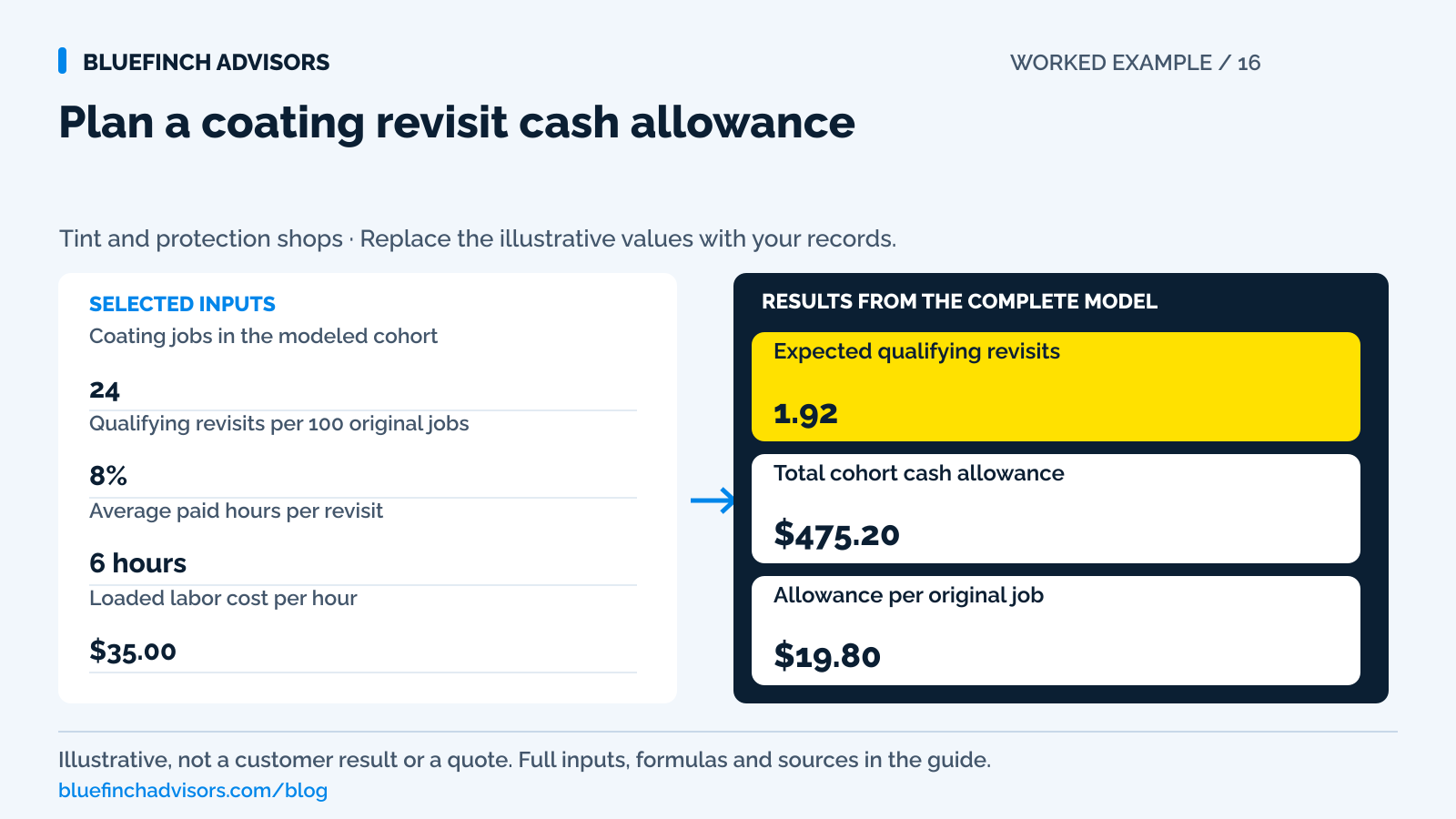
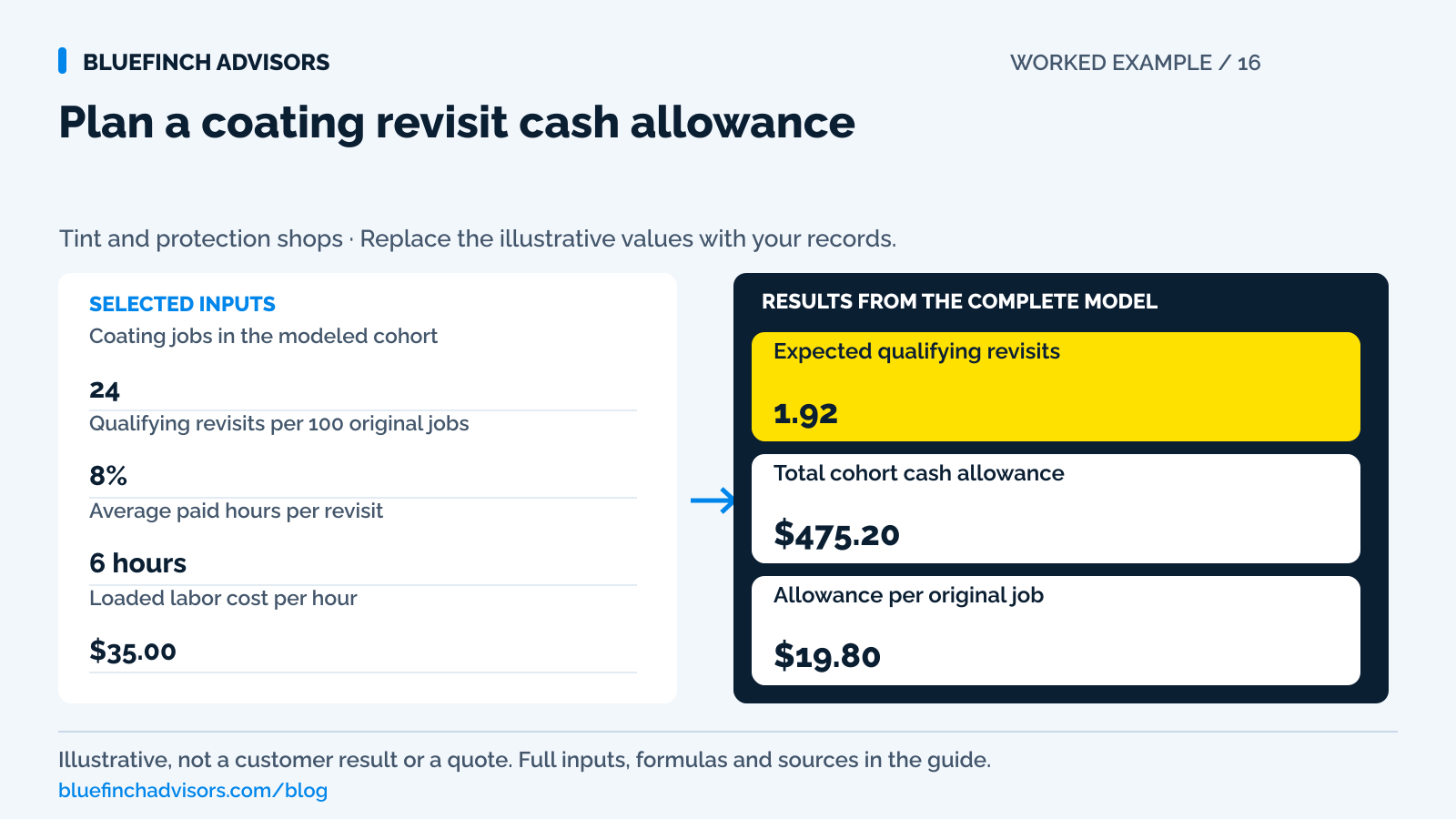
Expected qualifying revisits An expected value, not a fractional appointment to schedule. | 1.92 |
Total cohort cash allowance Expected net revisit costs plus the separate refund allowance. | $475.20 |
Allowance per original job Not available when the cohort has zero jobs. | $19.80 |
Calculation detail
| Measure | Result |
|---|---|
| Gross cost per revisit | $265.00 |
| Net cost per revisit | $185.00 |
Model assumptions
- Starting values are examples, not market benchmarks or payment quotes.
- Use one currency and a consistent before-tax basis. Work out taxes and program-specific adjustments separately.
Read alongside these results
- This is a cash-planning expected value, not a warranty promise, accounting provision, or industry failure rate.
- Small cohorts vary sharply. Do not reduce customer remedies to fit the calculated allowance.
Download this worked example (CSV). Use the interactive version to export your own inputs and results.
Download infographic (PNG) · Download vector (SVG) · Link to the source and methodology

The short version
- Track included inspections, paid maintenance and corrective visits separately.
- Use your own revisit frequency and loaded costs, not the retail ticket price.
- Check warranty coverage and accounting treatment separately from this cash allowance.
The coating sale is collected today, while a return visit may use labor and materials months later. If every revisit is labeled warranty, the owner cannot tell whether the shop is correcting work, performing included maintenance, handling a manufacturer-approved claim, or selling a new service. The payment policy and the cost plan become equally unclear.
Define the revisit categories you want to fund. Enter the monthly job count, assumed revisit frequency, cost per qualifying visit, expected recovery and a separate refund allowance. This plans cash; it doesn't predict defects or set a formal accounting reserve. Use your own records and test a higher-cost case before deciding how much to set aside.
Use with this guide
Measure coating bay economics
Keep occupied capacity separate from the cash cost of later revisits.
Preserve warranty records
Connect installed product, customer terms, and the chosen remedy.
Clarify package payment promises
Show which services and later visits are included.
Browse the complete window tint guides and worksheets.
Decide which visits belong in the allowance
Define the service event before measuring its frequency. A scheduled inspection included in the package, a paid maintenance wash, a shop correction, and a manufacturer-approved remedy have different payment consequences. If all four are counted as defects, the estimated corrective cost will be inflated. If included inspections are counted as new paid sales, the shop may appear to have more future revenue than the customer actually agreed to provide.
XPEL's product-care information includes coating-specific maintenance and inspection guidance. Its warranty information separately describes claim review, required evidence, and approval before covered work. Those sources support distinguishing care from a remedy; they do not establish the terms of every coating sold by every installer. Retrieve the exact product and package promises the customer received. The allowance should fund the defined responsibility, not a generic interpretation of the word warranty.
Sources for this section: XPEL: product-specific coating and film care · XPEL: warranty claims, approval, and product-specific coverage
Match revisit events to the original jobs that produced them
Compare completed original jobs with the qualifying revisits associated with those same jobs. Looking at this month's sales and this month's returns can misstate the rate when returns relate to older work. Keep the installation date, return date, reason, hours, consumables, amount charged if any, and approved recovery. Decide whether the model counts customers with any return or total revisit events; repeat visits make those denominators different.
The sample uses revisit events per 100 original jobs and an average cost per event. If some jobs return twice, their two events belong in the count. A rate of 120 means 1.2 visits per original job, not a 120% probability of a defect. The tool accepts rates up to 1,000 events per 100 original jobs, or ten visits per job. That is an input limit, not an industry benchmark. A small shop can keep a low, central, and high scenario while history develops. Label assumptions honestly rather than treating a handful of cases as a precise forecast.
The sample allowance is $475.20 for 24 original jobs
The illustrative cohort contains 24 jobs with an assumed rate of eight qualifying revisit events per 100 original jobs. That produces 1.92 expected events. Each event uses six paid hours at $35, or $210, plus $55 in materials. Gross cost is $265. With a supported $80 usable recovery assumption, net cost is $185 per event. Multiplying by 1.92 gives $355.20. Add a separate $120 refund allowance and total planned cash is $475.20.
Spread across the 24 original jobs, the allowance is $19.80 per job. These are expected values, not instructions to schedule 1.92 vehicles or charge a $19.80 warranty fee. Set recovery to zero when it is uncertain: the cohort allowance rises to $628.80. A shop with one expensive return can exceed either amount. Use the result to compare assumptions and protect liquidity, not to cap a customer's valid remedy when the allowance runs out.
Make the original price clear about what future visits include
At the original sale, state which inspections or follow-up services are included and which are separately priced. If a later maintenance visit is chargeable, present its price and payment choices before authorization. Under dual pricing, that may mean a regular card price and lower cash price for the new paid service. An included visit should not become chargeable because the customer arrives with a credit card or because the shop underestimated its labor.
A surcharge program is different from a dual-price offer or a cash discount. Mastercard excludes debit and prepaid from its surcharge permissions. A stored credential or digital wallet does not remove that boundary. Treat payment acceptance cost as part of the business review, using actual fees and remaining account charges. An eligible 0% merchant credit-card rate may change one cost category; it does not pay for six hours of corrective labor.
Sources for this section: Mastercard: merchant surcharge rules and debit exclusions
Check whether expected recovery can fund today's work
The recovery input is useful for an expected-cost scenario, but the owner should also run zero recovery when approval or timing is uncertain. Record whether support is a cash reimbursement, material replacement, supplier credit, or another remedy. A credit that cannot be used until the next order does not fund today's labor. The actual cash schedule may therefore need a larger buffer than the expected net cost suggests.
XPEL's general claim information says labor coverage depends on the product and situation and requires pre-approval of repairs. Apply the relevant manufacturer's process before promising reimbursement to the customer or assigning it to the shop's funding plan. Keep the customer's remedy decision distinct from the supplier claim. A shop may choose to act promptly for its own service reasons, but that choice should be approved with the knowledge that the recovery could be delayed or denied.
Sources for this section: XPEL: warranty claims, approval, and product-specific coverage
Reconcile actual returns and refunds against the assumption
After each qualifying revisit, record actual cash cost and the eventual recovery. Keep customer refunds separate from labor and product so a combined resolution is not counted twice. Stripe's refund documentation explains that a refund can be pending or fail and that it follows the original payment method. Verify the shop's own provider and close the status instead of treating a button click as completed cash returned.
Review the cohort when enough time has passed to observe the defined event window. Compare frequency, cost per event, recovery timing, and refunds with the starting assumptions. If the biggest difference is labor, the next decision may concern installation process or scheduling rather than the merchant rate. If the issue is unclear package terms, fix the original sales explanation. The cash model is useful because it points to the variable that changed, not because it assigns a precise reserve to every future complaint.
Sources for this section: Stripe: refund destinations, partial refunds, and refund status
Questions business owners ask
Is this the reserve our accountant should book?
No. It is an operating cash-planning model. Accounting recognition and warranty obligations need separate review using the actual facts and applicable standards.
Why is the expected revisit count fractional?
Expected-value arithmetic averages events across a cohort. Actual visits are whole events and can vary substantially, especially with small job counts.
Should we add the per-job allowance as a customer fee?
Not automatically. It is a cost-planning result. Establish the actual package price and included services before sale rather than appending an undisclosed warranty fee later.
Primary sources
BlueFinch last reviewed these sources on October 2, 2026. Payment rules and state requirements can change.
- XPEL: product-specific coating and film care
- XPEL: warranty claims, approval, and product-specific coverage
- Mastercard: merchant surcharge rules and debit exclusions
- Stripe: refund destinations, partial refunds, and refund status
Use this page for general business information. It is not legal, tax, or accounting advice.