Reconcile patient and payer balances separately
Enter verified patient amounts separately from payer payments and adjustments, then compare the expected EFT with the bank deposit.
Use the interactive tool without signing up. It runs in your browser: enter your numbers, save a comparison, download results or print a working copy. Your numbers are not sent to BlueFinch.
Illustrative example inputs
These starting values show how the math works. They are not industry averages, customer results or a quote.
| Input | Example value |
|---|---|
Verified patient responsibility Adjudicated amount the billing team has confirmed for this patient cohort. | $900.00 |
Patient payments collected Successful payments assigned to the same claims or visits. | $1,050.00 |
Patient refunds completed Completed refunds reducing net patient collections. | $100.00 |
Payer claim payments on remittance Sum of payer payments before separately shown provider-level adjustments. | $3,000.00 |
Signed provider-level adjustment Positive increases the EFT; negative reduces it. Use the remittance sign convention translated to this model. | -$250.00 |
Matching payer bank deposit Match with the remittance trace reference, not just the date. | $2,750.00 |
Example results
| Measure | Result |
|---|---|
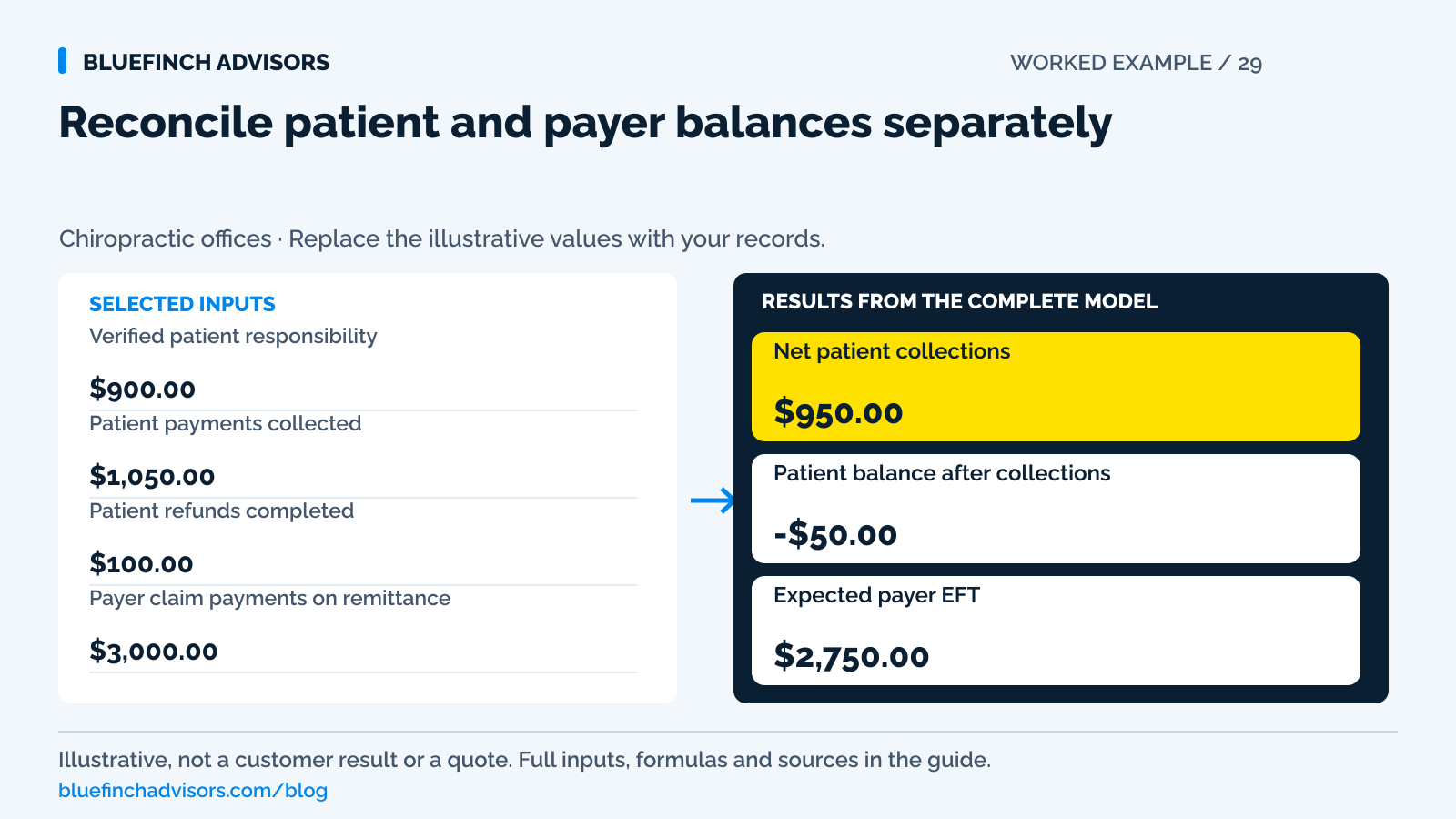
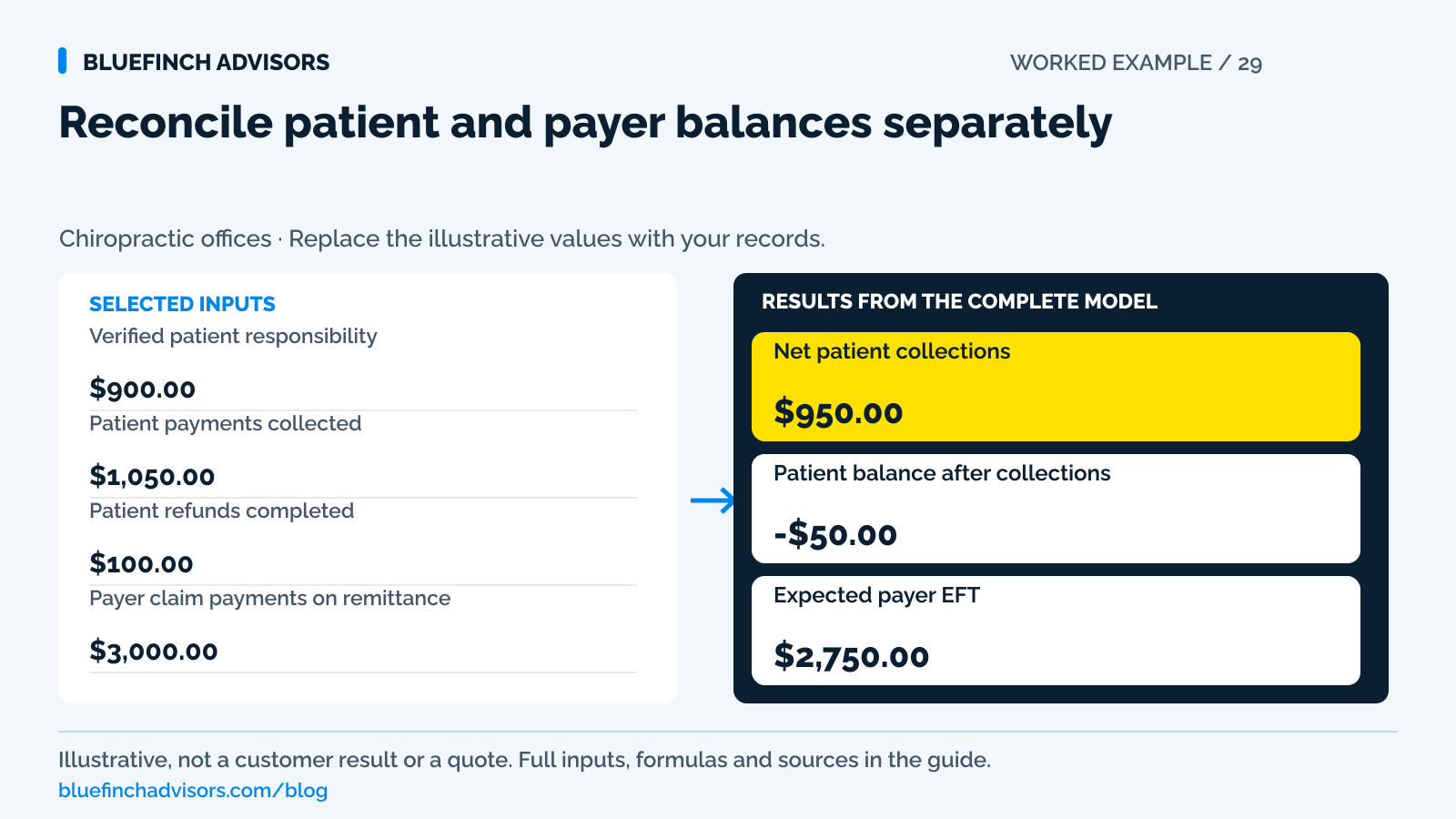
Net patient collections Collected payments less completed refunds. | $950.00 |
Patient balance after collections Positive is an apparent remaining balance; negative is an apparent credit requiring review. | -$50.00 |
Expected payer EFT Claim payments plus the signed provider-level adjustment. | $2,750.00 |
Actual EFT minus expected Payer settlement difference, not automatically patient responsibility. | $0.00 |
Calculation detail
| Measure | Result |
|---|---|
| Verified patient responsibility | $900.00 |
| Claim-level payer payments | $3,000.00 |
| Provider-level adjustment | -$250.00 |
Model assumptions
- Illustrative reconciliation after adjudication and billing review.
- A negative patient balance signals a credit for review; it does not determine the legally required remedy or deadline.
Read alongside these results
- Do not transfer a payer shortfall to the patient without a supported adjudication and contractual basis.
- Payer-specific, Medicare, Medicaid, and state requirements need qualified review.
Download this worked example (CSV). Use the interactive version to export your own inputs and results.
Download infographic (PNG) · Download vector (SVG) · Link to the source and methodology


The short version
- Match a payer EFT to all the claims and provider-level adjustments it covers.
- Use patient responsibility verified after adjudication, not the billed charge.
- Keep deductibles and contracted patient obligations unchanged by a payment-pricing program.
The office collected an estimated patient payment at the visit. The remittance later assigns a smaller patient responsibility, while the payer's bank deposit is also lower than the claim-payment total. Those two differences may have different explanations. Combining them can lead staff to collect money the patient does not owe.
This worksheet begins with verified billing information supplied by the office's qualified billing team. It does not determine coverage, coding, medical necessity, contractual adjustments, refund deadlines, or what a plan permits the office to charge. The example is fictional and makes no claim about chiropractic treatment outcomes.
Use with this guide
Wellness processing audit
Exclude payer EFT and billed charges from card-volume comparisons.
HSA and FSA payment guide
Keep payment authorization separate from eligibility determinations.
Self-pay estimate workflow
Review a related estimate-to-payment process without treating it as payer adjudication.
Browse the complete wellness center guides and worksheets.
Let the remittance explain the payer deposit
CMS describes an electronic remittance advice as the explanation of a health plan's claim payment. One remittance can contain multiple claims and adjustments at line, claim, or provider level. The bank deposit is the cash result. It is not a complete explanation of how each patient account should be posted.
In Medicare remittance guidance, CMS distinguishes contractual-obligation and patient-responsibility group codes and explains that provider-level adjustments can include a recovery of an earlier overpayment or other items. Those Medicare details should not be casually generalized to every payer. They do show why a net EFT shortfall cannot simply become a new patient charge.
Before applying money, the billing team should identify the adjudication, relevant codes, claim references, and any provider-level adjustment. If a remittance is missing or unreadable, place the payment in the office's approved unresolved process rather than guessing an allocation.
Sources for this section: CMS: claim adjustments and payment remittance advice
Reconcile the patient estimate after adjudication
An amount collected at the visit may have been an estimate. Compare it with the verified patient responsibility once the applicable payer process is complete. Include prior patient payments and completed refunds for the same claims or visits. Avoid comparing one visit's responsibility with a whole account's collections.
Keep pending secondary-payer activity visible. This calculator assumes the responsibility input has already been confirmed for the chosen cohort. It does not decide whether the claim is final. A billing manager may need to wait for a supported adjudication before determining the appropriate account action.
If the ledger shows a credit, assign it for review and resolution under the applicable rules. Do not silently apply it to an unrelated future visit or treat it as extra office revenue. The correct route depends on the actual payer, agreement, account circumstances, and legal requirements.
Sources for this section: CMS: claim adjustments and payment remittance advice
The sample has a $50 patient credit and no EFT difference
Verified patient responsibility is $900. The office collected $1,050 and already completed $100 in refunds. Net patient collections are $950. Subtract those collections from $900 and the patient ledger shows negative $50, an apparent credit to review.
The payer remittance lists $3,000 of claim payments and a negative $250 provider-level adjustment. Expected EFT is $2,750. The matching bank deposit is also $2,750, so the payout bridge reconciles exactly. The $250 reduction is already explained at the provider level in this illustration.
There is no basis in these numbers to add $250 to the patient's account. The patient-side question is the $50 credit. The payer-side question is whether the documented provider adjustment was correctly understood and posted. Keeping the two calculations side by side prevents one from being used to conceal the other.
Match EFT and ERA with their references
CMS explains that matching trace information in the EFT addenda and electronic remittance supports reassociation of the payment with its advice. Ask the bank and billing system how staff can access those references. Matching only by amount and date becomes unreliable when the office receives several similar deposits.
Keep the claim-payment total, signed provider adjustment, expected deposit, actual deposit, and unresolved difference together. If the payment combines locations or providers, preserve those identifiers in the supported billing record. A single group bank account does not eliminate the need for accurate account assignment.
Use a separate exception category for payer recoupments or adjustments affecting earlier periods. The office may need a payer inquiry or specialist review. Do not force such an item into today's patient payment report merely because that report is the one the front desk knows how to export.
Sources for this section: CMS: matching EFT payments and electronic remittance advice
Do not use a payment program to alter payer obligations
If the office is considering dual pricing, start by identifying which self-pay and patient-balance transactions are actually eligible under its agreements and applicable requirements. Contracted fees, deductibles, coinsurance, and other patient obligations need billing and compliance review. A processor's marketing materials cannot approve a change to them.
For any approved program, show the applicable price before authorization and confirm the treatment of debit, prepaid, wallets, credits, and refunds. Visa prohibits surcharging Visa debit and prepaid cards and distinguishes posted cash/card pricing from a checkout fee. Those network distinctions do not resolve payer-contract questions.
Compare retained merchant costs on actual patient card collections, not insurance EFT or gross billed charges. A payer bank transfer is not credit-card volume. A zero eligible-credit rate can still leave debit, monthly, software, and other account costs. Keep those expenses out of the patient-responsibility calculation unless a separately valid basis applies.
Sources for this section: Visa: U.S. merchant surcharging and displayed-price distinctions
Give the payment team only the records it needs
HHS includes certain health-care payment information within protected health information when the Privacy Rule applies. Use the office's approved systems and access controls. An outside processor does not need a full clinical chart to investigate a card refund or settlement reference.
The close should identify the reviewer for patient credits, the owner of payer exceptions, and the person matching bank deposits. These roles can be held by the same qualified person in a small office, but the responsibilities should remain distinct. A front-desk balance override should not replace billing review.
The next action is to choose one fully adjudicated remittance and trace it through the EFT, the provider adjustment, and the related patient accounts. Resolve any credit through the approved process. Then repeat the reconciliation for the rest of the period using the same cohort and sign convention.
Sources for this section: HHS: Privacy Rule coverage and protected payment information
Questions business owners ask
Does a lower insurance deposit mean the patient owes the difference?
No. The remittance may include contractual or provider-level adjustments. The billing team must establish any patient responsibility independently.
Does a negative patient balance automatically authorize a refund?
It identifies an apparent credit. Confirm the underlying claims, other payer activity, prior refunds, and applicable requirements before taking the correct action.
Can this calculate insurance eligibility?
No. Enter responsibility already verified by the qualified billing team. The tool only reconciles the supplied amounts.
Primary sources
BlueFinch last reviewed these sources on October 2, 2026. Payment rules and state requirements can change.
- CMS: claim adjustments and payment remittance advice
- CMS: matching EFT payments and electronic remittance advice
- Visa: U.S. merchant surcharging and displayed-price distinctions
- HHS: Privacy Rule coverage and protected payment information
Use this page for general business information. It is not legal, tax, or accounting advice.