Price a color-change wrap revision
Calculate the agreed scope change, then apply the existing payment to the revised balance.
Use the interactive tool without signing up. It runs in your browser: enter your numbers, save a comparison, download results or print a working copy. Your numbers are not sent to BlueFinch.
Illustrative example inputs
These starting values show how the math works. They are not industry averages, customer results or a quote.
| Input | Example value |
|---|---|
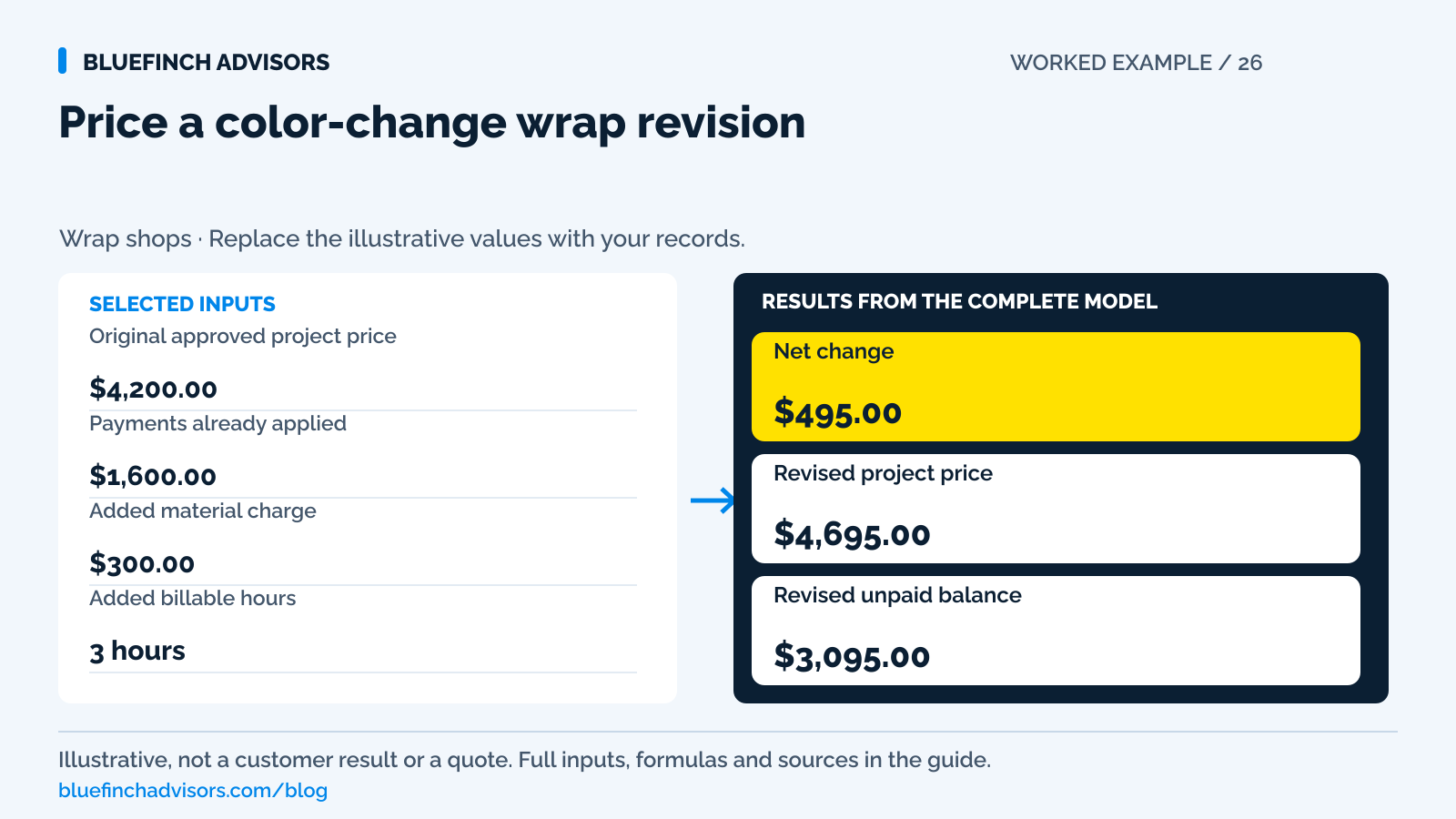
Original approved project price Use the same selected payment-price basis as the change. | $4,200.00 |
Payments already applied Completed payments assigned to this job, net of processed refunds. | $1,600.00 |
Added material charge Incremental customer charge, not the full replacement roll cost unless agreed. | $300.00 |
Added billable hours Additional approved hours only. | 3 hours |
Agreed hourly selling rate Customer labor rate for the added work. | $85.00 |
Additional agreed freight Customer-approved incremental shipping charge. | $60.00 |
Agreed credit for removed scope Actual agreed reduction; do not assume every supplier purchase can be returned. | $120.00 |
Example results
| Measure | Result |
|---|---|
Net change Added charges less the agreed credit. | $495.00 |
Revised project price Original price plus the net change. | $4,695.00 |
Revised unpaid balance Negative indicates an overpayment to resolve, not a zero balance. | $3,095.00 |
Calculation detail
| Measure | Result |
|---|---|
| Additional labor | $255.00 |
| Existing payments | $1,600.00 |
Model assumptions
- Starting values are examples, not market benchmarks or payment quotes.
- Use one currency and a consistent before-tax basis. Work out taxes and program-specific adjustments separately.
Read alongside these results
- The tool does not decide refund rights, supplier returns, paint suitability, or scope consent.
- Negative changes and balances remain visible for review; no charge should occur before approval.
Download this worked example (CSV). Use the interactive version to export your own inputs and results.
Download infographic (PNG) · Download vector (SVG) · Link to the source and methodology

The short version
- Record removed work as clearly as added work.
- Base returned-material credit on confirmed supplier credit and the customer agreement.
- Apply the original deposit once and get approval for the revised amount.
A customer switches from gloss to a specialty finish after film has been ordered. Or the walkaround adds jambs, trim removal, and a roof that was excluded from the first quote. The owner needs a revised price and a collection decision, not another full-vehicle estimate with no history. The useful number is the net change to the approved job and what remains due after money already paid.
Keep the starting quote and list added material, labor, freight and the agreed credit for old material separately. Defaults are examples, not recommended wrap prices, labor rates, cancellation charges or warranty rules. Enter the actual scope on the selected payment-price basis before requesting approval.
Use with this guide
Plan the original wrap deposit
Define which early commitments the first payment funds.
Review wrap cancellation terms
Separate commercial policy from supplier return assumptions.
Preserve proof and scope approval
Keep the revision history next to the payment record.
Rush wrap printing: price the approved production change
Record rush wrap printing costs before collecting a revised amount. Use the approval sheet to connect supplier timing, accepted scope and the customer balance.
Browse the complete vehicle wrap guides and worksheets.
Write the physical change before the price change
Name the vehicle, film product, finish, coverage areas, and any removal or disassembly being added. Put the superseded choice beside the replacement choice. A message saying upgrade approved is weak evidence when one person means a new finish and another means additional body coverage. The customer should be able to understand what disappears from the original order and what takes its place without reading a production team's shorthand.
Wrapmate's published terms provide a concrete industry example: supplemental work is quoted in advance, before it proceeds. Its own production and refund terms belong to that business and cannot simply become another shop's policy. The useful practice is the timing of the conversation. Resolve the revised scope while the customer still has a choice, before cutting material or occupying more installation time makes that choice expensive.
Sources for this section: Wrapmate: production, supplemental charges, and approval terms
Explain what the added material charge and credit cover
The material line needs a clear meaning. It may be the price difference between two approved films, a charge for extra coverage, or a separately agreed cost of material that cannot be reused. Those are different reasons for collecting money. If the first roll stays usable inventory, the owner should decide how that affects the customer agreement instead of labeling the entire purchase waste. If it is custom or damaged, preserve the supporting record.
Supplier credits should be entered only when confirmed and appropriate to pass through under the agreement. A return request is not a posted credit. Restocking, freight, and opened-roll conditions can change the amount. Keep the supplier transaction and customer credit separate so accounting can reconcile both. The customer should see the agreed reduction on the change order, not a promise that depends on an unreviewed return policy.
The sample revision adds $495, not a second deposit
Start with the illustrative $4,200 approved project and $1,600 already paid. The revision adds $300 of material, three hours at $85, and $60 of freight. Added charges total $615. Subtract the agreed $120 credit for removed scope and the net change is $495. The revised project becomes $4,695. After applying the existing $1,600 once, the unpaid balance is $3,095.
If the shop collects the entire $495 change immediately, the later balance becomes $2,600. Record that as another payment against the same revised total. Do not add the change again at delivery, and do not call the original deposit a discount. If a later revision lowers the project below total payments, the negative balance should trigger a credit or refund decision. Hiding it at zero makes the customer overpayment disappear from the worksheet without resolving it.
Keep both customer prices current when the scope changes
A dual-priced quote needs the revised regular card price and lower cash price before the customer chooses and authorizes payment. The calculator handles one selected basis at a time; it does not manufacture the other price by multiplying everything by a surcharge cap. If the customer paid the deposit one way and wants to pay the addition another way, use the processor-approved split-tender method and the shop's disclosed terms.
A surcharge program follows its own restrictions and disclosures. Mastercard's published rules exclude debit and prepaid from surcharging. A card saved in the booking system or presented through a wallet does not become credit because the cashier cannot see its physical label. Confirm how the system identifies it. Never erase an agreed material credit to offset processing cost; the revised invoice should explain the commercial change separately from the approved payment presentation.
Sources for this section: Mastercard: merchant surcharge rules and debit exclusions · Visa: merchant fees, rules, and surcharge disclosure
Separate a paid upgrade from correcting defective work
A customer-requested finish change is not the same event as replacing material under a product warranty or correcting installation work. Classify the reason before writing the payment request. 3M publishes different warranty resources for wrap film, paint protection film, and window film. That is a reason to retrieve the actual product document, not to promise that any color-change material or labor will be reimbursed.
When the shop is correcting its own work, charging the customer for a new upgrade should cover only the separately agreed additional scope. Keep the remedy and optional upgrade on separate lines. A goodwill credit can then be seen without implying that the customer purchased the correction. If a manufacturer claim is pending, do not present an expected reimbursement as cash already received. The payment file must survive a denial or partial approval without needing to rewrite the original story.
Sources for this section: 3M: separate warranty resources for wrap, PPF, and window film
Use the approved revision for the next payment request
Have the customer approve the revision number, added work, removed work, new total, amount due now, and expected delivery effect. Disable or withdraw superseded payment links where the platform supports it. Otherwise a customer can pay the older balance while a team member collects the addition, leaving accounting to discover the overlap after the vehicle is ready. A single current invoice number makes that check easier.
If money must be returned, follow the provider's original-payment refund process and track the refund status. Stripe, for example, distinguishes successful payments, partial refunds, and refunds awaiting sufficient available balance. Its documentation also says original processing fees are not returned under its pricing. Those are provider-specific facts to verify for the shop's account. Finish the change by reconciling the customer balance, supplier credit, and payment record; approval alone completes none of those three tasks.
Sources for this section: Stripe: refund destinations, partial refunds, and refund status
Questions business owners ask
Should the original quote be deleted after a finish change?
No. Keep it with a clear superseded status and identify the current revision. The history explains what the customer originally approved and why the amount changed.
Does the material credit have to equal the supplier refund?
Not automatically. The customer credit follows the agreed commercial terms. Keep its basis clear and track the supplier transaction separately.
Can the shop charge the saved deposit card for the difference?
Only through a supported payment flow with appropriate consent for that charge. Approval of a new finish does not by itself establish permission to charge a stored card.
Primary sources
BlueFinch last reviewed these sources on October 2, 2026. Payment rules and state requirements can change.
- Wrapmate: production, supplemental charges, and approval terms
- Mastercard: merchant surcharge rules and debit exclusions
- Visa: merchant fees, rules, and surcharge disclosure
- 3M: separate warranty resources for wrap, PPF, and window film
- Stripe: refund destinations, partial refunds, and refund status
Use this page for general business information. It is not legal, tax, or accounting advice.