Calculate the diagnostic credit and final balance
Keep service charges, the promised discount and money already paid separate on one combined invoice.
Use the interactive tool without signing up. It runs in your browser: enter your numbers, save a comparison, download results or print a working copy. Your numbers are not sent to BlueFinch.
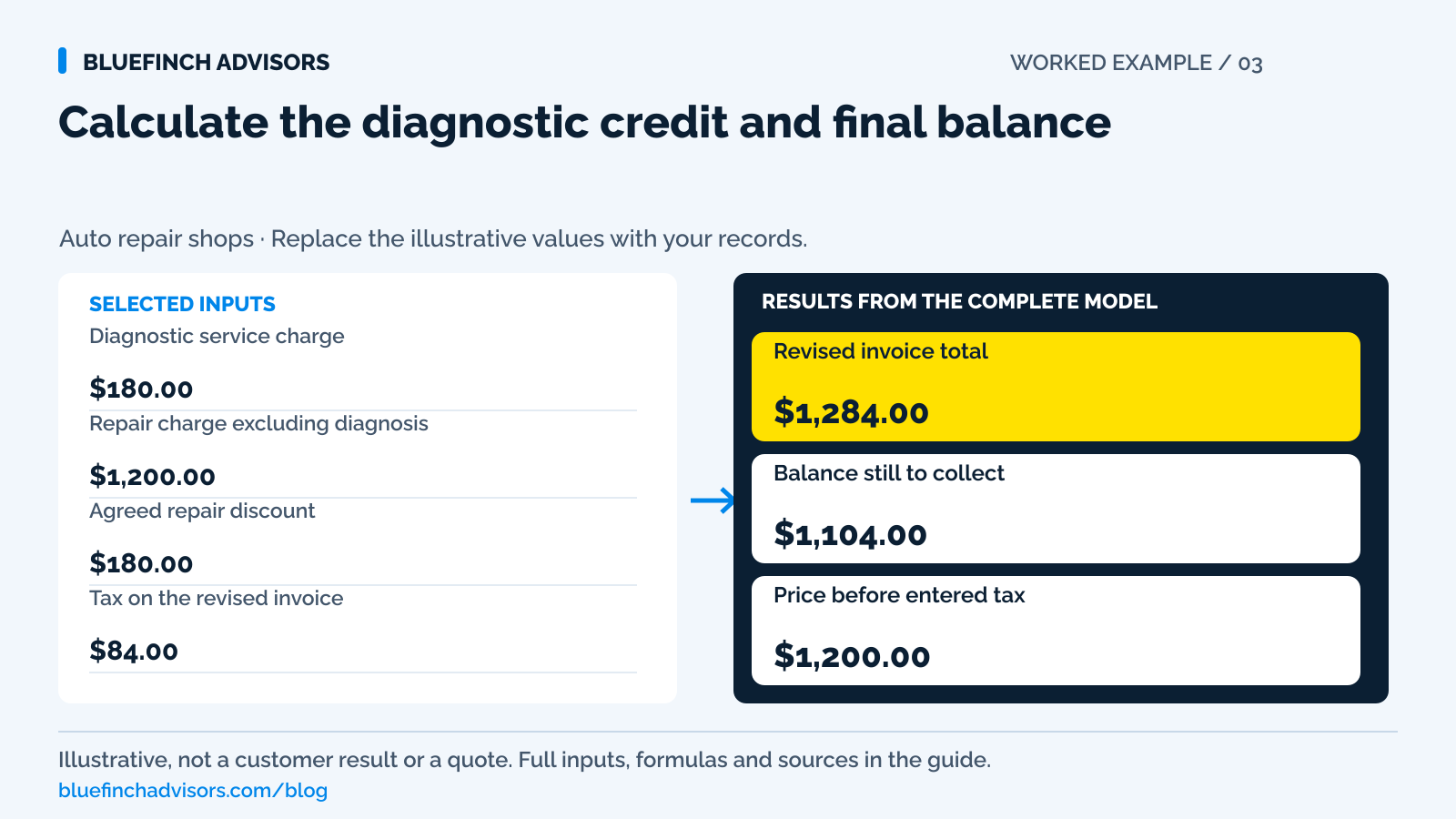
Illustrative example inputs
These starting values show how the math works. They are not industry averages, customer results or a quote.
| Input | Example value |
|---|---|
Diagnostic service charge Enter the diagnostic price originally authorized. | $180.00 |
Repair charge excluding diagnosis Exclude diagnosis already listed separately; don't enter an inclusive package price. | $1,200.00 |
Agreed repair discount Enter the price reduction promised on repair approval. | $180.00 |
Tax on the revised invoice Enter the correctly determined tax. This tool doesn't calculate it. | $84.00 |
Prior payment actually collected Leave out expired holds and payments already refunded. | $180.00 |
Example results
| Measure | Result |
|---|---|
Revised invoice total Service charges minus the agreed discount, plus entered tax. | $1,284.00 |
Balance still to collect Subtracts the prior payment once. | $1,104.00 |
Price before entered tax Diagnostic and repair charges after the discount. | $1,200.00 |
Calculation detail
| Measure | Result |
|---|---|
| Diagnostic line | $180.00 |
| Separate repair line | $1,200.00 |
| Agreed discount | $180.00 |
| Tax entered | $84.00 |
| Prior payment credit | $180.00 |
Model assumptions
- Defaults are examples. The repair amount excludes the diagnostic service listed separately.
- The authorized discount changes the price. The prior payment applies existing cash separately.
- Enter the actual tax and check how your accounting system transfers credits.
Read alongside these results
- A negative balance stays visible so you can check for an overpayment or inconsistent inputs.
- The worksheet reconciles amounts; it doesn't decide whether a diagnostic discount or refund is owed.
Download this worked example (CSV). Use the interactive version to export your own inputs and results.
Download infographic (PNG) · Download vector (SVG) · Link to the source and methodology

The short version
- Apply a payment to the balance and a discount to the invoice price.
- Before promising a credit, explain whether the repair quote includes diagnosis.
- Keep the diagnostic receipt and record its payment transfer to the final repair order.
A customer hears, 'We credit the diagnostic fee if you approve the repair.' The advisor means a discount. The cashier sees a prior payment. The repair quote may already include diagnosis. Without a clear invoice structure, that simple promise can produce either a duplicate charge or a double credit.
Before the first payment, explain the diagnostic price, what changes if the customer approves a repair and where that payment will appear. The combined-invoice example and calculator below keep the service charge, discount, tax and payment in separate fields.
Use with this guide
Document staged authorization
Separate diagnostic permission from the later repair decision.
Keep the diagnostic agreement
Preserve the offered credit, work record, approval, and receipts.
Test payment-credit transfer
Check that a prior payment stays visible when an invoice changes.
Browse the complete auto repair guides and worksheets.
Check your own costs: calculate your effective processing rate or upload a merchant statement for analysis.
Explain exactly what you mean by a diagnostic credit
There are several defensible ways to price diagnosis and repair, but the customer needs one clear promise. A shop can charge diagnosis separately and offer a later repair discount. It can include diagnosis within a package price and apply the earlier payment to that package. It can charge diagnosis and repair independently with no discount. Those are different offers, and the invoice must follow the one actually authorized.
The FTC says many shops charge for diagnostic time and recommends asking about diagnostic charges and written estimates. It does not establish a universal rule that diagnosis must be free when a repair is approved. Avoid telling customers that every shop handles credits the same way. Write the eligibility condition plainly, including which repair, which vehicle, and whether approval by a stated date is required under the shop's reviewed terms.
Sources for this section: FTC: Auto Repair Basics
Show the discount and payment in separate columns
A $180 diagnostic payment proves $180 was collected. A $180 repair discount proves the shop reduced its selling price by $180. Both can appear on a combined invoice, but they do different work. The discount reduces the invoice total; the payment then reduces the amount still due. If the repair quote already includes diagnosis, adding diagnosis again without the matching pricing treatment would overstate the agreed price.
Choose one invoice convention and teach it with a real screen example. In the calculator on this page, the repair quote explicitly excludes the diagnostic line. The combined document adds the diagnostic charge, adds the repair charge, subtracts the promised discount, and adds the entered tax. It then subtracts the amount already paid. If your system uses an inclusive repair package, enter only the repair portion that is not already represented by the diagnostic line.
| Item | Changes invoice price? | Changes cash collected? |
|---|---|---|
| Diagnostic service | Yes, adds an authorized service | Only when paid |
| Promised repair discount | Yes, reduces the price | No new payment occurs |
| Prior diagnostic payment | No | Yes, applies existing cash |
The $180 example, from diagnosis to pickup
Suppose diagnosis costs $180 and has already been paid. The customer then approves $1,200 of repair work quoted separately from diagnosis. The shop promised a $180 repair discount, and the correctly determined tax entered for the revised invoice is $84. The combined invoice is $180 + $1,200 - $180 + $84 = $1,284. Subtract the $180 payment already received, leaving $1,104 to collect.
Across both visits, the customer pays $180 plus $1,104, or $1,284. Diagnosis remains visible as work performed, the discount remains visible as a price decision, and the prior payment remains visible as money received. If the cashier subtracts another $180 at pickup, the shop undercollects. If the prior payment is omitted, the customer is asked for $1,284 again. The balance check catches both mistakes without hiding the service history.
Include the revised total in the repair approval
Send the repair description, price, diagnostic-credit treatment, and expected balance together. A message that says 'approve the $1,200 repair' leaves room for different interpretations about whether the $180 already paid is included. State the invoice total after the discount and the amount still expected at completion, while noting any genuinely unresolved tax or authorized scope issue instead of supplying a false final amount.
California BAR's Write It Right explains that authorizations and supplementary communications should be documented with the repair transaction. That is a California example, not a nationwide substitute for local requirements. The useful operational practice is to save the exact offer and the customer's response with the repair order. If the scope later changes, repeat the price reconciliation using the new approved figures rather than relying on the earlier text thread alone.
Sources for this section: California BAR: Write It Right
Link the invoices without refunding and recharging
Some systems close the diagnostic invoice and create a new repair invoice later. Preserve both records and use the software's approved credit or payment-transfer workflow. Record the diagnostic invoice number on the repair document and the destination repair order on the original record. The combined calculation still needs to reconcile, but your bookkeeper may present the discount and transfer differently across the two documents.
Do not refund and recharge simply to make the front screen look cleaner. A real refund moves money back to the payment method and may leave original processing fees in place. Stripe's refund documentation is one example of that fee treatment. A bookkeeping credit with no money returned is not a card refund, and calling it one can confuse the customer when no credit appears on the card statement. Tell the customer whether value was applied to the repair or actually returned.
Sources for this section: Stripe: Refund and cancel payments
Handle the cases that break a simple credit rule
If the customer declines the repair, apply the diagnostic agreement that was actually accepted. If the customer approves only part of a multi-problem estimate, check whether the stated offer covers that work. If a warranty company or family member pays the repair, confirm whether the diagnostic credit still applies and who already paid it. The person authorizing work and the person supplying a card may be different, so retain both relationships.
A comeback or an unresolved diagnosis also needs a service decision before a payment adjustment. Do not use the calculator to decide whether diagnosis was adequate, whether a warranty applies, or whether a refund is owed. It only reconciles entered amounts. Once the responsible manager makes the documented decision, revise the invoice or credit and then follow the correct payment action. Keep tax changes with the shop's accounting process rather than assuming every discount has identical tax treatment.
Sources for this section: FTC: Auto Repair Basics
Check the total, discount, prior payment and balance at pickup
At pickup, the cashier should be able to point to the approved invoice total, the promised discount, the payment already received, and the balance now due. Match the earlier payment to its transaction reference rather than the customer's recollection of a pending bank entry. An authorization that expired or a payment that was refunded cannot remain an unconditional payment credit.
Review a small set of recent diagnostic-to-repair jobs after changing the workflow. Look for credits applied twice, diagnostic charges disappearing from the service history, and old payments left on closed invoices. One corrected invoice convention is more useful than a long script no one follows. For the next diagnostic offer, put the exact credit rule on the estimate, show the same arithmetic on the repair approval, and test the final receipt before using it across the shop.
Sources for this section: Stripe: Place a hold on a payment method
Keep the diagnostic offer separate from payment-method pricing
A promised diagnostic credit is a service-price adjustment. It is not automatically a cash discount, and it does not by itself describe a dual-price or surcharge program. If the shop also uses approved tender-based pricing, show how the diagnostic offer applies under that configuration before the customer authorizes the repair. Do not remove a promised credit at pickup merely because the customer chooses a card, unless that condition was part of the actual reviewed offer.
Keep the earlier diagnostic receipt intact when the final payment uses another method. Ask the provider how the credit, prior payment, and final tender should appear on the invoice and receipt. Visa's guidance on price display and debit restrictions is a reason to verify that treatment, not a formula for recalculating every diagnostic discount. The worksheet assumes one already agreed invoice basis and deliberately does not invent a second tender price.
Sources for this section: Visa: U.S. merchant surcharge questions and answers
Questions business owners ask
Is the diagnostic payment the same as the diagnostic discount?
No. One records money already received; the other changes the selling price. The invoice can contain both, but neither should be counted twice.
What if the quoted repair price already includes diagnosis?
Do not add the same service again. Use the inclusive package's agreed total or split it into nonoverlapping diagnostic and repair lines before using this worksheet.
Does the calculator determine sales tax on a diagnostic credit?
No. Enter the tax determined for the actual invoice under the shop's accounting and applicable tax rules. The example's $84 is an input, not a claimed tax rate or treatment.
Primary sources
BlueFinch last reviewed these sources on October 2, 2026. Payment rules and state requirements can change.
- FTC: Auto Repair Basics
- California BAR: Write It Right
- Stripe: Refund and cancel payments
- Stripe: Place a hold on a payment method
- Visa: U.S. merchant surcharge questions and answers
Use this page for general business information. It is not legal, tax, or accounting advice.