Reconcile a consolidated fleet remittance
Apply approved credits to open invoice balances, then compare them with the customer's payment before processor deductions.
Use the interactive tool without signing up. It runs in your browser: enter your numbers, save a comparison, download results or print a working copy. Your numbers are not sent to BlueFinch.
Illustrative example inputs
These starting values show how the math works. They are not industry averages, customer results or a quote.
| Input | Example value |
|---|---|
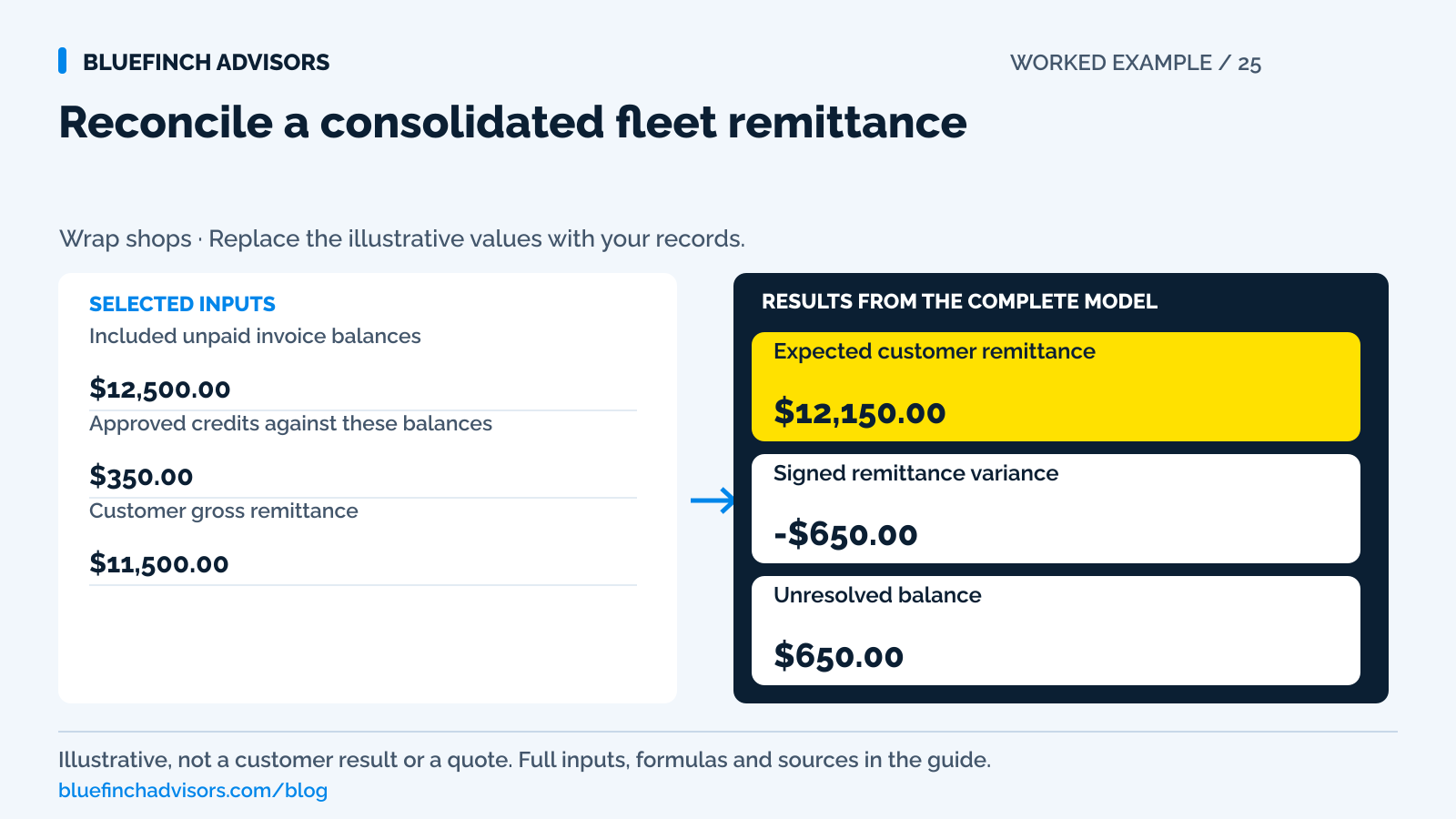
Included unpaid invoice balances Sum of remaining balances after deposits, for invoices included in this remittance. | $12,500.00 |
Approved credits against these balances Only credits not already deducted from the entered invoice balances. | $350.00 |
Customer gross remittance What the buyer paid before card fees, reserves, or bank deductions. | $11,500.00 |
Example results
| Measure | Result |
|---|---|
Expected customer remittance Included balances less approved unapplied credits. | $12,150.00 |
Signed remittance variance Negative is a short-payment; positive is an overpayment. | -$650.00 |
Unresolved balance Positive remains to collect or resolve; negative is customer overpayment. | $650.00 |
Calculation detail
| Measure | Result |
|---|---|
| Starting open balances | $12,500.00 |
| Approved credit adjustment | $350.00 |
Model assumptions
- Starting values are examples, not market benchmarks or payment quotes.
- Use one currency and a consistent before-tax basis. Work out taxes and program-specific adjustments separately.
Read alongside these results
- Do not enter the net bank payout as the customer payment.
- If approved credits exceed the included balances, review the scope before treating the result as a refund instruction.
Download this worked example (CSV). Use the interactive version to export your own inputs and results.
Download infographic (PNG) · Download vector (SVG) · Link to the source and methodology

The short version
- Match the customer's gross payment to invoice balances before checking bank funding.
- Subtract approved credit notes, not unexplained deductions in a remittance email.
- Leave short-payments open until another collection or formal credit resolves them.
The fleet account sends one payment for several completed vehicles. Its remittance lists invoice numbers, a discount, and a deduction for a panel it says needs attention. The bank deposit is smaller again because of processor fees. If the shop marks every invoice paid and calls the difference fees, it loses both the collection issue and the actual payment cost.
First match the customer's gross payment to the invoices and credits it covers. Then match that payment to the processor payout. This guide handles the first check and explains how it differs from the second. Keep using the per-vehicle deposit ledger and each vehicle's scope and payment allocation.
Use with this guide
Maintain the per-vehicle ledger
Use correct invoice balances before combining them into one remittance.
Set fleet tender expectations
Agree on payment method and price before the next purchase order.
Audit processor costs separately
Keep collection shortages out of the processing-rate calculation.
Fleet wrap invoice portals: resolve rejected submissions
Resolve a rejected fleet-wrap invoice upload before chasing payment. Use the portal exception sheet to track required fields, approved corrections and acceptance.
Browse the complete vehicle wrap guides and worksheets.
The buyer's payment and the bank deposit are different amounts
A card payment can be fully paid by the customer while the shop receives a smaller payout after fees or other adjustments. A customer can also genuinely pay less than the invoice. These situations need different follow-up. Processor deductions belong in the payout reconciliation, while a buyer's unexplained discount belongs in the customer account. Start with the transaction's gross amount or the ACH remittance amount, not a bank entry whose composition has not been checked.
Stripe's payout reconciliation documentation associates transactions with a payout and separates settled activity from balances still pending. Its partial-payment documentation separately tracks what remains on an invoice. Those are provider-specific reporting features, but they illustrate the distinction the shop needs in any system. Ask the provider which report identifies gross customer payment and which shows the net amount funded to the bank. A single paid status cannot safely stand in for both.
Sources for this section: Stripe: payout reconciliation reports · Stripe: partial invoice payments and overpayments
Use the invoice allocation supplied with the payment
Use the invoice numbers and vehicle identifiers the buyer supplied. A transfer received Friday may pay last month's vehicles and exclude a van delivered Thursday. Do not allocate it across every job that happened to finish that week. Record the remaining balance on each selected invoice after its deposit was applied, and confirm that no payment is already posted from another source. This prevents a familiar duplicate: a deposit in the job ledger plus the same deposit subtracted again from the remittance.
Where the buyer sends no allocation detail, request it before silently choosing which old invoice to close. The owner may authorize a temporary unapplied-cash status while the detail is obtained. Keep a named follow-up owner and a date so unapplied money does not become a permanent suspense balance. A clean total is useful, but it cannot show whether the right vehicle was credited unless the underlying allocation is also correct.
A $350 credit still leaves a $650 short-payment
The illustrative remittance covers $12,500 of unpaid invoice balances. The shop has approved a separate $350 credit that has not yet been deducted from those balances. Expected payment is $12,150. The customer's gross payment is $11,500, leaving a signed variance of negative $650 and an unresolved balance of $650. That difference should stay visible while the billing contact explains or pays it.
If the processor then deposits $11,140 after $360 of documented deductions, the customer short-payment remains $650. The additional $360 belongs to the separate processor reconciliation. Do not replace the $11,500 calculator input with $11,140; doing so turns two different issues into a misleading $1,010 customer shortage. Conversely, if the buyer paid $12,300, the positive $150 variance would need an overpayment allocation or refund review, not extra sales revenue.
A remittance deduction is a claim, not an approved credit
A buyer may deduct for a missed appointment, a damaged panel, a purchasing discount, or a vehicle it believes was not completed. Ask for the invoice and basis of the deduction. Match it to the approved terms and job record, then issue a credit only if the shop accepts the adjustment or is otherwise required to make it. This keeps the customer conversation factual: the shop can acknowledge the disputed item without pretending it has accepted every amount in the remittance.
Keep a correction, a goodwill allowance, and an early-payment discount distinct. Each has a different reason and a different opportunity to prevent recurrence. If the buyer has legitimately earned a discount, honor the agreed terms and show the credit. If it applied an unagreed deduction, send the outstanding balance with the original supporting documents. Changing the original vehicle price after payment arrives can obscure both the dispute and the performance of the account.
Resolve price-basis disagreements before the next rollout
A short-payment can begin with the wrong price on a purchase order. If the buyer approved a lower cash price and later pays by a corporate credit card, staff need the actual program's disclosed terms and a corrected approval before charging a different amount. Do not assume ACH is free or that a rewards card always qualifies for one treatment. Compare the written fees and the accepted customer price, then document the chosen tender.
Dual pricing and cash discounts should not be described as though they were identical to surcharges. Mastercard's surcharge permissions do not include debit or prepaid cards, and Visa publishes separate disclosure and notification guidance. Neither source authorizes inventing a late collection charge because accounts payable chose the wrong method. Repair the quote and purchase-order handoff for the next order; handle the existing difference under the terms that the customer actually received.
Sources for this section: Mastercard: merchant surcharge rules and debit exclusions · Visa: merchant fees, rules, and surcharge disclosure
Resolve customer short-payments separately from payout differences
For the customer side, save the allocation, approved credit notes, gross payment reference, remaining balance, and the person responsible for resolution. For funding, save the payout reference and its deductions. If the account receives a later $650 catch-up payment, apply it to the open balance rather than creating a new sale. If a credit resolves it, retain the reason and approval. Either route should explain why the receivable is now zero.
Use the next consolidated remittance as a small operating test. Have the person who prepared the invoice list hand it to someone who did not prepare it and ask them to reproduce the balance. Review differences before the month closes. This calculator cannot choose an allocation, validate a buyer's deduction, or recognize revenue. It gives the team a signed control total that makes those unresolved decisions hard to overlook.
Questions business owners ask
Should we enter the amount that hit the bank?
Only if it equals the customer's gross remittance with no combined deductions or other payments. Otherwise use the gross customer amount and reconcile the payout separately.
Can we deduct a disputed panel amount before issuing a credit note?
Keep it as an unresolved customer deduction until the amount is accepted or otherwise resolved. The calculator's credit input is for approved credits not already included in the starting balances.
What if the payment exceeds the selected invoices?
The positive variance stays visible. Check for missing invoices or an intended prepayment, then allocate or refund under the actual agreement and provider process.
Primary sources
BlueFinch last reviewed these sources on October 2, 2026. Payment rules and state requirements can change.
- Stripe: payout reconciliation reports
- Stripe: partial invoice payments and overpayments
- Mastercard: merchant surcharge rules and debit exclusions
- Visa: merchant fees, rules, and surcharge disclosure
Use this page for general business information. It is not legal, tax, or accounting advice.