Check purchasing approval headroom
Compare the proposed fleet wrap charge with the purchasing amount still approved by the buyer.
Use the interactive tool without signing up. It runs in your browser: enter your numbers, save a comparison, download results or print a working copy. Your numbers are not sent to BlueFinch.
Illustrative example inputs
These starting values show how the math works. They are not industry averages, customer results or a quote.
| Input | Example value |
|---|---|
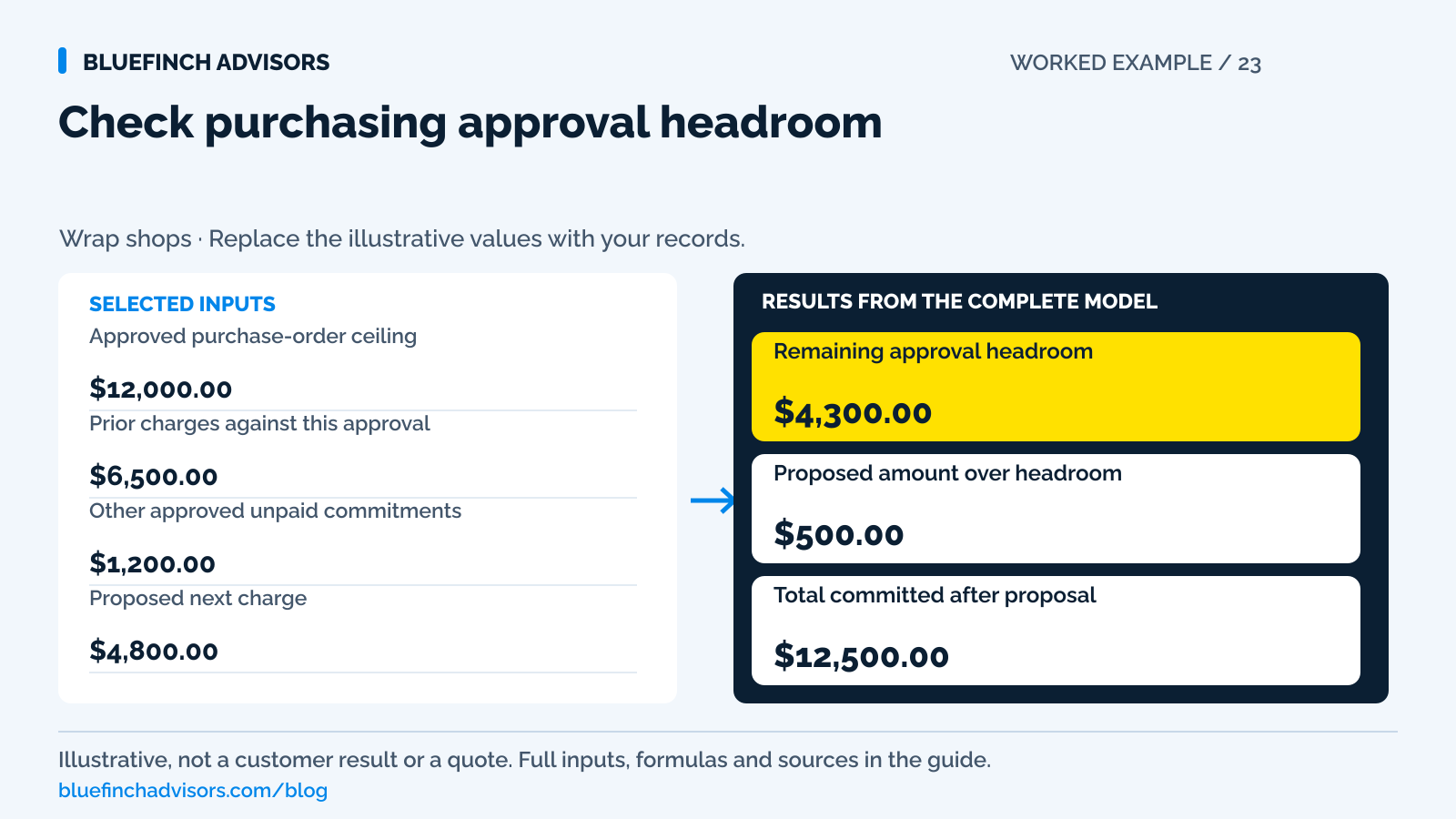
Approved purchase-order ceiling Current written spending ceiling for this scope, excluding tax in this example. | $12,000.00 |
Prior charges against this approval Charges already assigned to this same approval; exclude unrelated orders. | $6,500.00 |
Other approved unpaid commitments Work reserving headroom that is not included in the proposed charge. | $1,200.00 |
Proposed next charge Amount to request using the customer's selected, approved price basis. | $4,800.00 |
Example results
| Measure | Result |
|---|---|
Remaining approval headroom Signed balance after prior charges and separate commitments. | $4,300.00 |
Proposed amount over headroom Positive means additional approval is needed; negative means unused headroom remains. | $500.00 |
Total committed after proposal Compare this total with the written purchasing ceiling. | $12,500.00 |
Calculation detail
| Measure | Result |
|---|---|
| Prior charges | $6,500.00 |
| Separate open commitments | $1,200.00 |
Model assumptions
- Starting values are examples, not market benchmarks or payment quotes.
- Use one currency and a consistent before-tax basis. Work out taxes and program-specific adjustments separately.
Read alongside these results
- This checks commercial approval, not issuer credit availability or legal authority.
- Never use the result to divide a purchase into transactions that evade the buyer's controls.
Download this worked example (CSV). Use the interactive version to export your own inputs and results.
Download infographic (PNG) · Download vector (SVG) · Link to the source and methodology

The short version
- Check purchasing limits and card authorization as separate records.
- Include existing approved commitments when calculating room for the next charge.
- Request approval for an over-limit proposal instead of splitting it to bypass controls.
The fleet manager approves the artwork. The employee collecting the van has a company card. The card terminal says approved. None of those facts tells you whether the latest charge fits the buyer's purchasing authority. A wrap shop can have a technically successful payment and still face an accounts-payable objection because the invoice exceeds the purchase order or includes an unapproved addition.
Before requesting payment, check how much purchasing approval remains, especially as a fleet order grows. Subtract earlier charges and other committed work from the approval ceiling. The result can flag a need for a revised PO or documented exception. It doesn't authorize a smaller charge or compare payment-method costs.
Use with this guide
Compare fleet payment methods
Evaluate actual cost, timing, and record requirements after purchasing approval is clear.
Allocate fleet deposits by vehicle
Track the scope and payment share attached to each unit.
Keep design and payment evidence
Connect proof approval to the current invoice.
Browse the complete vehicle wrap guides and worksheets.
Identify who can approve the purchase and change its amount
A useful account file identifies the buyer, the person authorized to change scope, the invoice recipient, and the person who can arrange payment. Those may be four different people. Ask whether the purchase order covers the entire rollout or a single vehicle, whether freight and removal are included, and whether the limit includes tax. Put those answers next to the actual approval document. A name in a CRM field is not a substitute for the buyer's written instructions.
Government buyers make this distinction explicit. GSA SmartPay training directs cardholders to their program or contracting officials for purchasing amounts, documentation, and approvals. That is evidence about the federal program, not a universal rule for private fleets. For a private customer, obtain its own policy. The operational lesson carries over: payment capability does not establish permission to buy every additional item the shop can deliver.
Sources for this section: GSA SmartPay: purchase-card limits and purchasing approvals
A $4,800 request can exceed a $12,000 approval
The illustrative order has a $12,000 purchasing ceiling. The shop has already charged $6,500. Another $1,200 of approved work remains committed and is not in the next invoice. Available headroom is therefore $12,000 minus $6,500 minus $1,200, or $4,300. A proposed $4,800 charge exceeds that amount by $500. Total charges and commitments would reach $12,500 if the proposal proceeds.
The right question is whether the customer approves the additional $500 and the revised total. Charging $4,300 now does not settle the remaining commercial issue. Nor should staff create a second invoice simply to fit a cardholder's limit. Preserve the complete purchase and ask the buyer which approved purchasing route it wants to use. If the $1,200 commitment is canceled, retain that cancellation before releasing its headroom. Otherwise two employees can spend the same remaining approval.
Make the selected payment price fit the approval
If the quote offers a regular card price and a lower cash price, ask which amount the buyer used when issuing the purchase order. An approval based on one price cannot silently become approval for the other. Show the selected tender, agreed project amount, already paid amount, and remaining request before collection. Do not append an unexplained processing line because the buyer brings a rewards card at pickup.
Dual pricing, a cash discount, and a credit-card surcharge are different program structures. Visa describes advance acquirer notification for surcharging, and Mastercard excludes debit and prepaid from its surcharge permissions. Those are not instructions to calculate every dual price from a surcharge percentage. Have the processor confirm the shop's actual program, remote-payment support, and disclosures. A corporate-looking card is not enough to determine its funding type or the permitted treatment.
Sources for this section: Visa: merchant fees, rules, and surcharge disclosure · Mastercard: merchant surcharge rules and debit exclusions
Do not treat an authorization hold as collected money
The buyer may ask the shop to authorize the card while paperwork catches up. Check whether the configured payment flow supports that use and what expiration applies. Stripe's authorization documentation distinguishes holding funds from capturing them and explains that an expired uncaptured authorization is released. That makes an authorization a time-limited payment state, not an open-ended promise covering several weeks of production.
Record approval status and payment status in separate fields. The production manager needs to know whether scope is released; accounting needs to know whether a transaction was captured and funded. If the company changes cards after authorization, do not assume the first hold was canceled. Check the provider record, communicate any outstanding hold, and issue a fresh request through the approved flow. This prevents a paperwork delay from becoming a duplicate-payment complaint.
Sources for this section: Stripe: separate authorization and capture
Send accounts payable the current PO, scope and payment details
Before collecting, send the current purchase-order number, vehicle or unit identifiers, approved proof version, itemized additions, and selected payment price to the billing contact. Show prior payments separately from credits. A deposit applied to this invoice is not a new reduction in the purchase-order ceiling if its original charge was already counted there. Keep a payment-allocation reference so the same deposit is not subtracted twice.
Have one person release the payment request after checking the headroom calculation. Sales can propose a change; production can identify a necessary correction; the account owner resolves the buyer's authorization. Once payment arrives, attach the receipt and status to the same invoice. If the buyer short-pays, leave the difference open with an explanation until a credit or additional payment resolves it. A card approval code does not explain a missing purchase-order revision.
Use the next fleet order to test the handoff
Choose one live order with a forthcoming addition and fill in the four inputs from documents, not memory. Ask the billing contact to confirm the resulting approved total before anyone enters a card. Where several departments place work against one ceiling, identify the owner of the master commitment list. The calculator only sees the amounts entered; an unreported commitment makes its headroom look larger than it is.
Keep tax, currency, disputed charges, and canceled work on consistent terms. The model excludes payment fees because the correct customer amount must already be established under the approved program. It does not determine procurement compliance, guarantee collection, or approve credit terms. Its value is narrower: the shop sees the approval gap while the buyer can still fix it, before a completed vehicle becomes a last-minute argument about who agreed to pay.
Questions business owners ask
Does a successful company-card charge prove the purchase was authorized?
It proves the payment received issuer approval at that moment. The buyer's purchasing authority, scope approval, and purchase-order ceiling remain separate records.
Should deposits reduce the ceiling twice when applied to the final invoice?
No. Count each charge once. Applying an existing deposit to an invoice changes the invoice balance, not the amount originally collected against the purchasing approval.
Can this calculator tell us how much to split across cards?
No. It identifies an approval gap. Any permitted split tender needs buyer approval and processor support; it must not be used to bypass purchasing limits.
Primary sources
BlueFinch last reviewed these sources on October 2, 2026. Payment rules and state requirements can change.
- GSA SmartPay: purchase-card limits and purchasing approvals
- Visa: merchant fees, rules, and surcharge disclosure
- Mastercard: merchant surcharge rules and debit exclusions
- Stripe: separate authorization and capture
Use this page for general business information. It is not legal, tax, or accounting advice.