Rebuild the expected clinic card payout
Match one identified payout using its new card collections, refunds, fees, held amounts and released funds.
Use the interactive tool without signing up. It runs in your browser: enter your numbers, save a comparison, download results or print a working copy. Your numbers are not sent to BlueFinch.
Illustrative example inputs
These starting values show how the math works. They are not industry averages, customer results or a quote.
| Input | Example value |
|---|---|
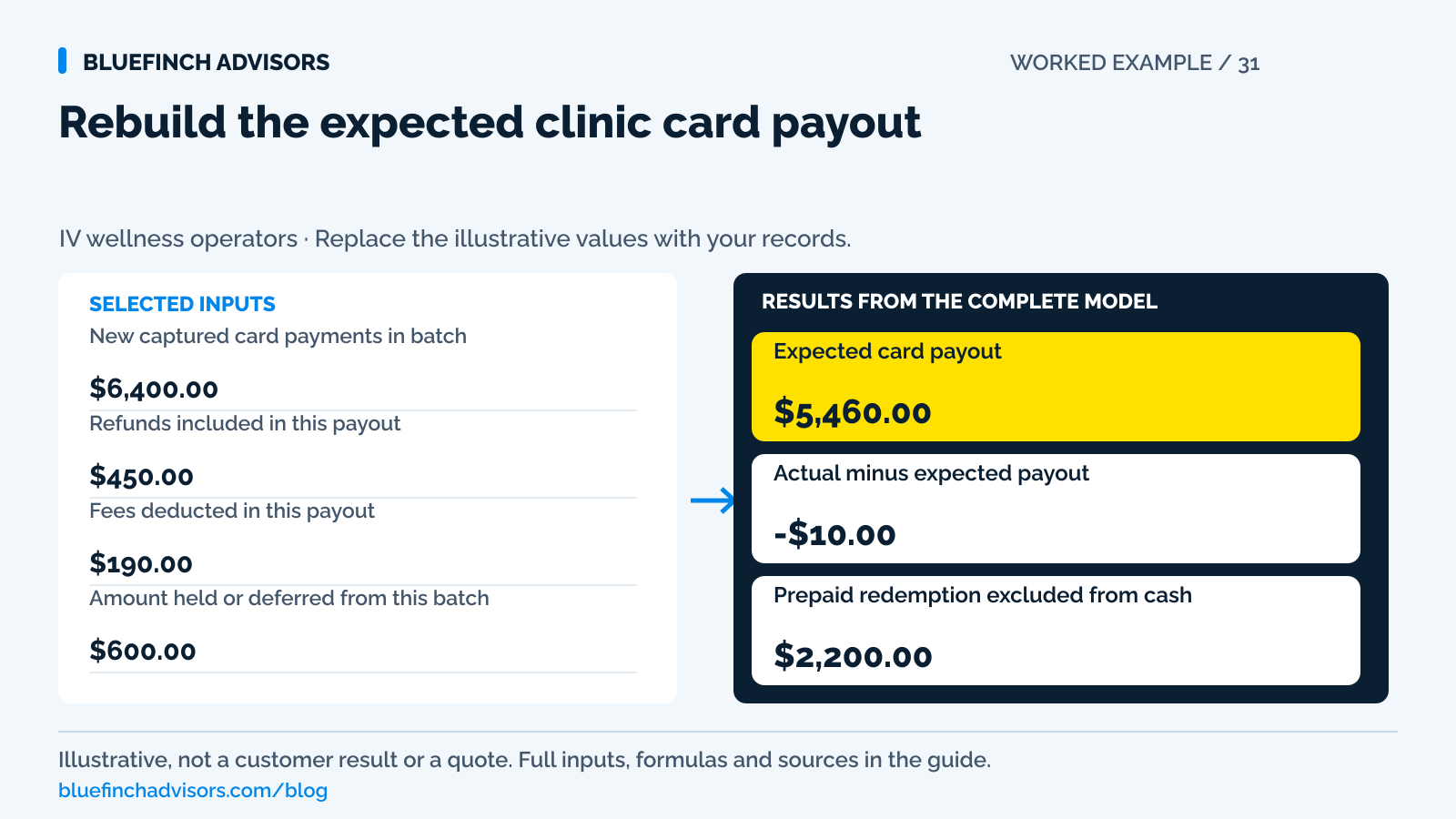
New captured card payments in batch Exclude prepaid redemptions, cash, and merely authorized payments. | $6,400.00 |
Refunds included in this payout Use the processor's included transactions, even if the original sale was earlier. | $450.00 |
Fees deducted in this payout Actual deductions assigned to this batch. | $190.00 |
Amount held or deferred from this batch Documented amount not included in the payout. | $600.00 |
Prior held amounts released into payout Verified release included in this payout. | $300.00 |
Actual matching bank deposit Match by payout reference and currency, not by appointment date. | $5,450.00 |
Prepaid value redeemed that day Shown separately; no new card payment assumed. | $2,200.00 |
Example results
| Measure | Result |
|---|---|
Expected card payout New card payments less included refunds, fees, and holds plus releases. | $5,460.00 |
Actual minus expected payout A signed difference requiring investigation. | -$10.00 |
Prepaid redemption excluded from cash Activity against existing value, not a new card collection. | $2,200.00 |
Calculation detail
| Measure | Result |
|---|---|
| Card payments after refunds | $5,950.00 |
| Net hold or deferral | $300.00 |
| Processor deductions | $190.00 |
Model assumptions
- Illustrative single-payout reconciliation in one currency.
- Only processor-confirmed batch components belong in the model. A reserve hold is not assumed for every account.
Read alongside these results
- This is not a clinical, revenue-recognition, or tax calculation.
- A correct total does not prove every individual payment was assigned to the right client.
Download this worked example (CSV). Use the interactive version to export your own inputs and results.
Download infographic (PNG) · Download vector (SVG) · Link to the source and methodology


The short version
- A prepaid redemption can pay for an appointment without bringing in new cash.
- Match a net bank payout to the transactions and adjustments it actually includes.
- Leave clinical information out of ordinary payment reconciliation exports.
The clinic's completed appointments total more than the card batch. Some clients used prepaid balances, one paid cash, and a refund reduced the next payout. The difference is not necessarily missing money. It needs a bridge that shows exactly which amounts belong in each report.
This guide covers payment operations only. It makes no claim about IV treatment benefits, suitability, safety, staffing permissions, ownership structures, or clinical standards. Those decisions remain with the clinic's qualified advisers and professionals. The tool uses a fictional settled batch, not a clinic benchmark.
Use with this guide
Wellness payment mix
Separate new collections from prepaid use.
Processing rate audit
Compare actual fees with the correct settled-card denominator.
Payment integration scorecard
Test how the appointment, tender, and settlement records connect.
Browse the complete wellness center guides and worksheets.
Use three totals with three labels
The appointment or service report describes activity recorded by the clinic. The payment report describes new collections and other tender applications. The processor report describes the charges and balance movements assigned to a payout. They may cover different dates and should not be expected to match without adjustments.
A package redemption illustrates the distinction. Square documents a workflow in which prepaid value applies to a booking and a zero-dollar remaining transaction is recorded. No new card payment is required for the covered amount. The appointment can be complete while the card report correctly shows no new money.
Set the report cutoff, time zone, location, and currency before comparing totals. A late-evening capture can belong to the next settlement batch even though staff include the visit in today's close. Save the exact report filters with the close so the next manager can reproduce the numbers.
Sources for this section: Square: package purchase, redemption, and refund workflows
Separate new collections from value already paid
Use distinct tender categories for new card payments, cash, approved bank payments, gift value, package redemption, and member credits. An internal other-payment button should not become a place to hide unresolved differences. Require enough reference detail to identify what actually funded the appointment.
If a client uses prepaid value and authorizes a new add-on, record the two parts. The new card charge belongs in the batch. The redeemed value reduces the relevant prepaid ledger. Do not count the full appointment value in new card volume and then count the add-on again.
At the daily close, trace a small sample from appointment reference to tender and processor transaction. Include one split-tender payment and one prepaid redemption. The goal is not to review clinical decisions. It is to verify that the payment system records the approved commercial amount once.
Sources for this section: Square: package purchase, redemption, and refund workflows
The batch should produce a $5,460 deposit
The fictional batch contains $6,400 of new captured card payments. It includes $450 of refunds and $190 of fees. A documented $600 remains held or deferred, while $300 from an earlier held amount is released into this payout.
The expected deposit is $6,400 less $450, $190, and $600, plus $300: $5,460. The bank shows $5,450 for the matching payout reference. Actual minus expected is negative $10. Check the payout detail for a missing deduction, a wrong input, or another supported explanation.
The day also had $2,200 of prepaid redemption. It does not increase the expected card payout. Adding it would create a false $2,210 shortage. A visit-value report is useful for operating activity, but it is not a substitute for the batch detail used to explain a bank deposit.
Let the payout reference define the matching set
Stripe's payout reconciliation links automatic payouts to their underlying balance transactions, including charges, refunds, and fees. Its guidance also notes that manual payouts require the merchant to reconcile them against transaction history. Use the equivalent rule for your provider and payout type.
Do not select refunds solely by today's appointment date. A refund from last month's sale may reduce this week's payout. Conversely, a refund approved today may not yet be part of the payout you are matching. The processor's included activity defines this calculation.
A held amount should have a documented source and status. Do not label an unexplained shortage a reserve because the numbers would then balance. Stripe's balance report distinguishes available, pending, and reserved funds where applicable. Those categories can help identify timing differences without inventing an expense.
Sources for this section: Stripe: matching transactions to automatic payouts · Stripe: balance reporting and available versus pending funds
Keep the payment close narrow
Use appointment or account references that authorized staff can resolve in the proper system. An ordinary payment reconciliation export does not need diagnoses, treatment details, or free-text clinical notes. Keep the working file limited to the commercial fields needed for the match.
HHS explains that HIPAA coverage depends on the entity and its activities, and protected information can include payment for health care. Do not assume that a cash-pay label answers every privacy question. Have the clinic's privacy adviser determine applicable requirements and the role of each software provider.
Processor support should receive the transaction references and problem description needed to investigate. If someone asks for clinical records to solve a simple payout discrepancy, route that request through the clinic's approved disclosure process rather than attaching the full chart.
Sources for this section: HHS: Privacy Rule coverage and protected payment information
A new payment program must survive the daily close
Before changing to dual pricing, test the full transaction record for ordinary card payment, debit, wallet, prepaid redemption, and split tender. The posted price, authorized amount, receipt, and settlement should agree with the approved program. A prettier checkout screen is not enough.
Visa's guidance distinguishes cash/card price displays from checkout surcharges and excludes Visa debit and prepaid cards from surcharging. Do not use a generic card category to apply credit-only treatment to every payment. Ask the provider how the underlying card type and any program adjustment appear in exported records.
The next action is to take one completed payout and rebuild it from its actual detail. Then use those records to compare retained costs under any proposal. Eligible-credit pricing alone cannot explain debit, monthly, software, refund, and other expenses that the clinic may still pay.
Sources for this section: Visa: U.S. merchant surcharging and displayed-price distinctions
Questions business owners ask
Does this tool evaluate an IV service's profitability or safety?
No. It reconciles a card payout. Clinical decisions and full business profitability are outside its scope.
Why does a prepaid visit not increase the payout?
The original purchase created the collection. Redemption uses that existing value rather than creating another card payment.
Should I enter a reserve if the bank deposit is lower?
Only when the processor confirms the held or deferred amount. Do not invent a reserve entry to force a match.
Primary sources
BlueFinch last reviewed these sources on October 2, 2026. Payment rules and state requirements can change.
- Square: package purchase, redemption, and refund workflows
- Stripe: matching transactions to automatic payouts
- Stripe: balance reporting and available versus pending funds
- HHS: Privacy Rule coverage and protected payment information
- Visa: U.S. merchant surcharging and displayed-price distinctions
Use this page for general business information. It is not legal, tax, or accounting advice.