Reconcile the card-tip clearing balance
Start with unpaid card tips, add settled tips and apply authorized reversals and completed payouts. Compare the balance with the payout file.
Use the interactive tool without signing up. It runs in your browser: enter your numbers, save a comparison, download results or print a working copy. Your numbers are not sent to BlueFinch.
Illustrative example inputs
These starting values show how the math works. They are not industry averages, customer results or a quote.
| Input | Example value |
|---|---|
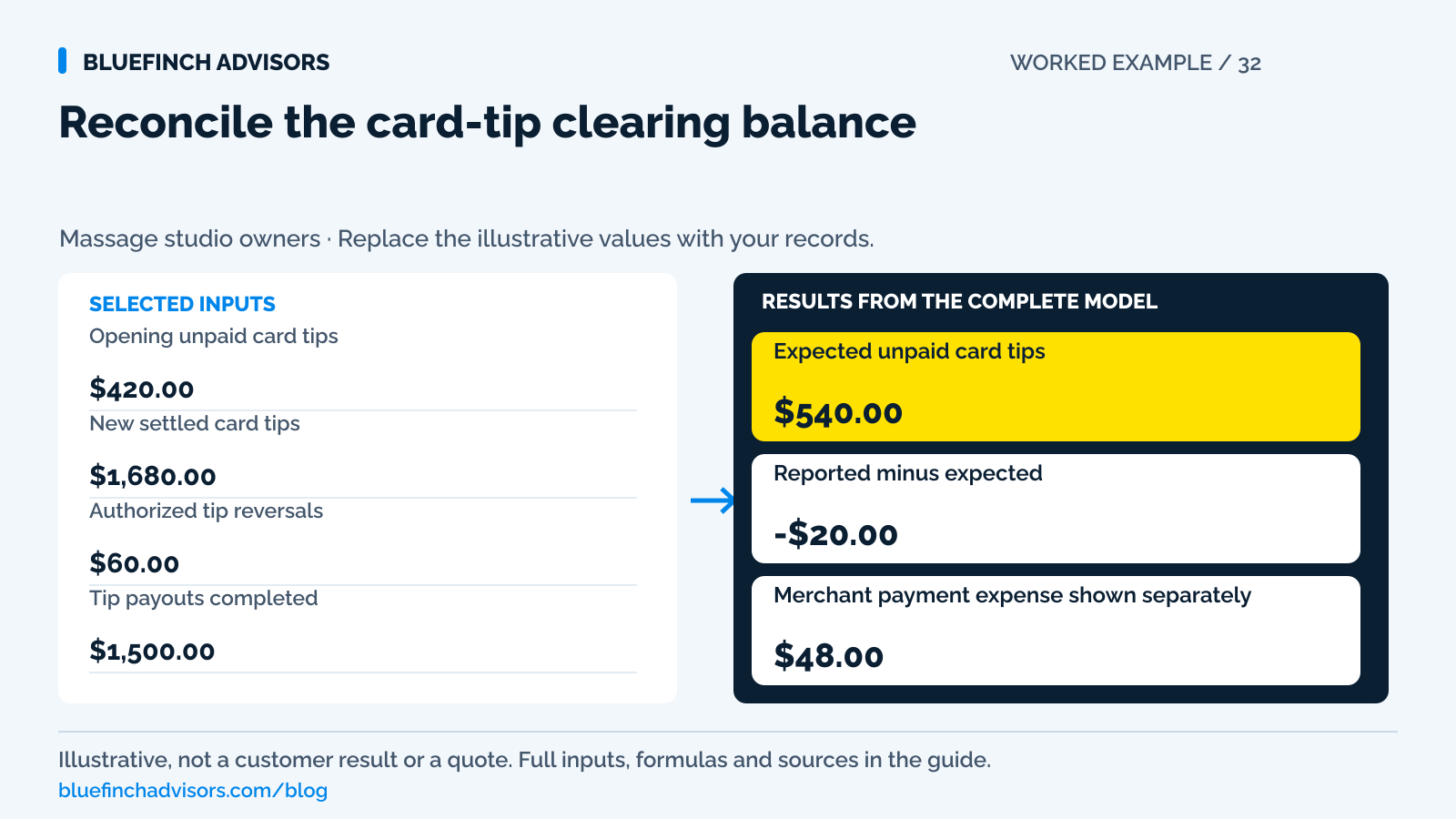
Opening unpaid card tips Previously collected and not yet paid under the approved allocation. | $420.00 |
New settled card tips Tips attached to completed settled transactions, not proposed screen amounts. | $1,680.00 |
Authorized tip reversals Verified adjustments under applicable rules; not guessed deductions. | $60.00 |
Tip payouts completed Completed payouts recorded once. | $1,500.00 |
Closing unpaid amount in payout file The current assigned liability total, not gross service revenue. | $520.00 |
Merchant payment costs on this tip cohort Shown separately; this tool never subtracts them from staff tips. | $48.00 |
Example results
| Measure | Result |
|---|---|
Expected unpaid card tips Opening unpaid plus collected, less approved reversals and completed payouts. | $540.00 |
Reported minus expected A signed reconciliation exception. | -$20.00 |
Merchant payment expense shown separately Not automatically deducted from the tip balance. | $48.00 |
Calculation detail
| Measure | Result |
|---|---|
| Tips available before payout | $2,040.00 |
| Completed payouts | $1,500.00 |
| Recorded unpaid balance | $520.00 |
Model assumptions
- Fictional reconciliation values. Payroll and tip-distribution rules must be approved independently.
- Cash tips paid directly to practitioners are excluded from this card-tip clearing example.
Read alongside these results
- A service refund does not automatically establish whether or how a tip must be reversed.
- This worksheet does not authorize retaining tips or passing payment fees to workers.
Download this worked example (CSV). Use the interactive version to export your own inputs and results.
Download infographic (PNG) · Download vector (SVG) · Link to the source and methodology


The short version
- Check the assigned tip recipient separately from the person who processed payment.
- Record settled tips, authorized reversals and completed payouts separately.
- Don't automatically subtract merchant payment fees from amounts owed to staff.
The front desk checks out several massage appointments at once. One client adds a tip after the session, another pays with a gift card and tips by card, and a third payment is refunded. The card batch contains all the money, but it does not by itself tell you what remains payable to each practitioner.
This is a payment reconciliation guide. It does not determine tip ownership, pooling, wage deductions, payroll treatment, employment status, or taxes. Establish those rules with the studio's appropriate advisers. Then use a ledger that can prove the approved allocation was collected and paid once.
Use with this guide
Wellness payment-cost audit
Reconcile all card charges and retained costs.
Wellness software scorecard
Test receptionist and practitioner tip assignment separately.
Wellness payment mix
Separate prepaid redemption from new card collections.
Massage studio processing: sessions, packages and tips
Model massage payment costs across session collections, prepaid packages and card tips. Keep package liability and therapist payout separate from processing.
Massage refunds with tips: reconcile the approved allocation
Reconcile an approved massage payment refund across service and tip components. Use the allocation sheet without prescribing wage policy or assuming tip recovery.
Browse the complete wellness center guides and worksheets.
Start with settled tips, not the checkout suggestion
A suggested tip on a screen is not collected money. Use the settled transaction amount and its tip field. If the workflow allows a later tip adjustment, confirm that it was submitted and settled within the provider's supported process. Do not assume a signed receipt automatically updated the payment.
Square's guidance describes settling payments with tips and viewing unsettled transactions. It also notes that, by default, tips are attributed to the team member who processed the payment. That is an important software behavior for a massage studio where a receptionist handles checkout for several practitioners.
Check the assignment process in your own system. The payment operator, service provider, approved tip recipient, and payroll recipient may be different fields. Preserve each needed reference instead of changing the original cashier field to force a desired payout report.
Sources for this section: Square: settling payments and recording tips
Separate the tip promise from service revenue
Record the original payment reference, service appointment, collected tip, assignment, adjustment, and payout batch. The ledger should show why each amount is payable under the studio's approved arrangement. Do not rely on a handwritten shift total that cannot be traced back to transactions.
Gift-card redemption deserves a specific test. The client may use prepaid value for the session and authorize a new card payment only for the tip or an add-on. Count only the new card payment in processing volume. The session's retail price should not become an extra card sale merely because it appears on the appointment receipt.
Cash tips handed directly to a practitioner belong in whatever reporting process your advisers require, but they are not funds held in this particular card-tip clearing account. Adding them here without a matching payout route can create an apparent amount owed that the studio never collected.
Sources for this section: Square: gift card activity, outstanding balances, and inter-location reporting
The recorded unpaid tip balance is $20 too low
Start with $420 of unpaid card tips. Add $1,680 collected in settled card transactions and subtract $60 of authorized reversals. That leaves $2,040 before payouts. Completed payouts of $1,500 leave an expected unpaid balance of $540.
The payout file records $520 as still unpaid. Reported minus expected is negative $20, so the recorded unpaid liability is $20 lower than the reconstructed balance. This does not establish that completed payouts were $20 short. The next action is to locate the missing or differently assigned transaction, not to add a general adjustment with no explanation.
The studio also paid $48 of merchant payment expense attributable to this cohort. The tool displays it separately. Subtracting it from $540 would produce a different balance, but the calculator does not authorize that deduction. Payment expense and the amount owed under applicable tip rules are different questions.
Do not infer a tip reversal from a service refund
A manager may approve a service refund without deciding that a previously paid gratuity should be reversed. Confirm the specific approved remedy and applicable requirements. Record a tip reversal only when it is supported, rather than mechanically reducing tips by the same percentage as refunded service revenue.
A processor refund can also remain pending or fail. Stripe's refund documentation distinguishes available-balance funding and refund status. The payment team should verify what actually happened before creating a payroll adjustment or issuing a second repayment through another route.
If the practitioner has already been paid, send the issue through the studio's approved payroll or management process. Do not use a payment reconciliation sheet to invent a clawback. Keep the original payout and any later authorized adjustment visible instead of overwriting the history.
Sources for this section: Stripe: refund funding, destinations, and refund status
Check gratuities when changing the payment program
A dual-pricing change affects more than the service-price screen. Test what base the tip suggestions use, how the final total is displayed, and what the receipt separates. Do not assume a percentage suggestion is calculated on the same amount before and after a configuration change.
Ask the provider how the approved program handles a card-paid gratuity, a gift-funded service, and a mixed-tender checkout. Visa distinguishes displayed cash/card pricing from a checkout surcharge and prohibits surcharging Visa debit and prepaid transactions. Selecting credit for a debit card does not change its type, and wallet use does not establish credit eligibility.
Keep the studio's retained costs in the comparison: debit acceptance, monthly fees, software, and any costs on tipped transactions that remain under the actual account terms. A quoted zero eligible-credit rate is not a complete tip-payment cost model. Do not change practitioner payouts to make a sales proposal appear cheaper.
Sources for this section: Visa: U.S. merchant surcharging and displayed-price distinctions
Close the assignment gap before payroll
Choose a cutoff that leaves time for corrections before the payout file is finalized. Export settled tips by payment reference, compare assigned amounts by practitioner, and match the total to the clearing calculation. Explain unassigned tips in a short exception list with a named owner.
Reconcile the processor payout separately. A bank deposit may combine service payments, tips, refunds, and fees. Stripe's payout reconciliation shows the transactions behind an automatic payout. Use the equivalent report from your provider. Matching only the bank total to a tip report cannot prove either is correct.
Before changing software, run a demonstration with two practitioners, one receptionist, a gift-funded session, a late tip, and an approved refund. The next step is to compare the resulting assignment report with the settlement report. The studio should be able to explain every tip without opening a clinical note.
Sources for this section: Stripe: matching transactions to automatic payouts
Questions business owners ask
Does this calculate payroll or taxes?
No. It reconciles payment collection and approved payouts. Payroll, tax, pooling, and wage rules remain with the studio's advisers.
Why show payment fees separately?
They are merchant costs, but that does not establish that they may be deducted from tips. The separate display prevents an unsupported deduction.
Should I use the cashier or practitioner for assignment?
Use the studio's approved allocation and keep the software's actual cashier reference. Verify how the system maps those distinct roles.
Primary sources
BlueFinch last reviewed these sources on October 2, 2026. Payment rules and state requirements can change.
- Square: settling payments and recording tips
- Square: gift card activity, outstanding balances, and inter-location reporting
- Stripe: refund funding, destinations, and refund status
- Visa: U.S. merchant surcharging and displayed-price distinctions
- Stripe: matching transactions to automatic payouts
Use this page for general business information. It is not legal, tax, or accounting advice.