Reconcile a two-location clearing balance
A positive balance means A owes B. Deduct completed payments from A to B and add completed payments from B to A.
Use the interactive tool without signing up. It runs in your browser: enter your numbers, save a comparison, download results or print a working copy. Your numbers are not sent to BlueFinch.
Illustrative example inputs
These starting values show how the math works. They are not industry averages, customer results or a quote.
| Input | Example value |
|---|---|
Opening balance A owes B Signed balance. Negative means B owed A at the opening cutoff. | $1,200.00 |
B redeems value originally loaded at A Approved transfer basis, using the same value convention throughout. | $4,800.00 |
A redeems value originally loaded at B Reciprocal redemptions reducing the amount A owes B. | $1,900.00 |
Internal settlements A paid B Completed cash payments from A to B within the period. Enter a nonnegative amount. | $3,000.00 |
Internal settlements B paid A Completed cash payments from B to A within the period. Enter a nonnegative amount; these increase the signed A-to-B balance. | $0.00 |
Reported closing balance A owes B Signed system balance at the same cutoff. | $1,000.00 |
Example results
| Measure | Result |
|---|---|
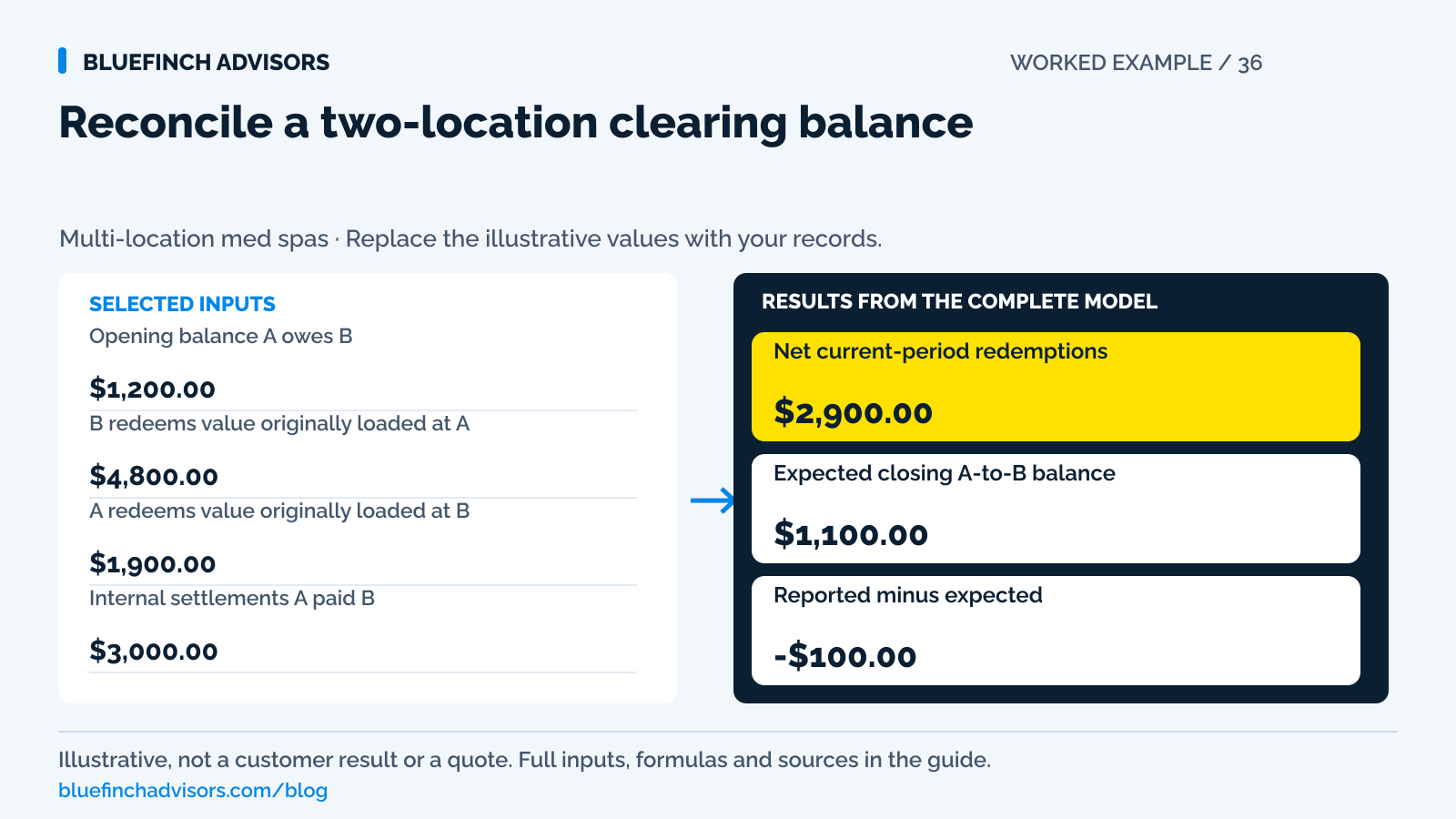
Net current-period redemptions Positive means current activity adds to A's obligation to B. | $2,900.00 |
Expected closing A-to-B balance Positive means A owes B; negative means B owes A. Payments in either direction are included. | $1,100.00 |
Reported minus expected Investigate any difference rather than writing it off. | -$100.00 |
Calculation detail
| Measure | Result |
|---|---|
| Value redeemed by B for A | $4,800.00 |
| Value redeemed by A for B | $1,900.00 |
| Completed cash payments A to B | $3,000.00 |
| Completed cash payments B to A | $0.00 |
Model assumptions
- Fictional two-location agreement settling on the entered redemption-value basis.
- This is an operating reconciliation, not approval for intercompany transfers or a prescribed accounting entry.
Read alongside these results
- Discounted gift cards may require separate paid-value and face-value treatment under your approved agreement.
- A transfer of customer value between records is not necessarily an internal bank payment.
Download this worked example (CSV). Use the interactive version to export your own inputs and results.
Download infographic (PNG) · Download vector (SVG) · Link to the source and methodology


The short version
- Track client value, amounts owed between locations and bank settlement separately.
- Use the same positive and negative signs for redemptions in both directions.
- Get the required authorization before transferring funds between separate legal entities.
Location A sells a gift card. The client later books at Location B, where staff provide the appointment and use the gift value. A group-wide sales report may look correct while A keeps the original cash and B absorbs the delivery cost. The operating question is how the locations reconcile that handoff.
The tool illustrates a two-location clearing agreement that management has already approved. It does not decide legal ownership, professional fee arrangements, intercompany accounting, or tax treatment. If the locations are separate entities, obtain the appropriate agreement and advice before moving funds. The arithmetic alone is not authorization.
Use with this guide
Med spa fee audit
Keep internal settlements out of new card volume.
Multi-system payment test
Test location references, reversals, and exports.
Package transaction records
Retain the original purchase and later redemption evidence.
Browse the complete medical spa guides and worksheets.
Define the clearing basis before comparing locations
Decide which entity issued the prepaid value, which locations may accept it, and how the approved arrangement allocates proceeds and fulfillment. The internal basis might use face value, an allocated paid amount, or another reviewed method. This article does not choose among those policies.
Square's gift-card report identifies inter-location payables and receivables. It explains that the loading location receives funds upfront and the redeeming location is owed value from that location. That reporting is useful evidence of the handoff, but it does not replace your agreements or establish the correct legal flow for separately owned practices.
Document the basis in a short operating note that the managers can find. Include how promotions, refunds, corrected redemptions, and canceled appointments affect clearing. If one branch assumes face value while another uses discounted purchase value, both can produce plausible totals that never match.
Sources for this section: Square: gift card activity, outstanding balances, and inter-location reporting
Carry the original reference through the second location
For every cross-location redemption, retain the prepaid record ID, loading location, original sale reference, redemption location, redeemed amount, and date. The client-facing identifier should be masked where appropriate. Do not copy full payment credentials into an internal clearing workbook.
Square's gift-card history can show purchase location, balance, activity, and related receipts. Use comparable detail in your own system. A summary labeled gift cards is insufficient when the managers need to determine which location owns a disputed entry.
Keep a restored booking credit distinct from a bank refund. If Location B cancels an appointment and restores the gift value, the original redemption may need a reversing clearing entry under your approved method. Without that reversal, A could pay B for service that was never delivered while the client still holds the original value.
Sources for this section: Square: gift card transaction and transfer history
A should owe B $1,100 at the closing cutoff
The sample starts with A owing B $1,200. During the month, B redeems $4,800 of value originally loaded at A. A redeems $1,900 of value loaded at B. Current-period net activity is therefore $2,900 in B's favor.
Add the $1,200 opening balance and subtract $3,000 that A already paid B. B paid A nothing in this example. Expected closing balance is $1,100 owed by A to B. The system reports $1,000, so reported minus expected is negative $100. That means the reported obligation is $100 lower than the reconstructed obligation.
Payments in the reverse direction use the separate B-paid-A input. If B owes A $1,200 at the opening cutoff, enter negative $1,200. With no redemptions and no payment from A, a $1,200 payment from B to A adds back to that signed balance and closes it at zero. Enter each payment as a nonnegative amount in its actual direction.
Investigate a difference using transaction detail. A redemption reversed in one branch but not the other, a payment posted on different dates, or a discounted-value convention can produce the difference. Do not solve it by charging the client another amount. The problem is an internal reconciliation unless the client transaction itself proves otherwise.
Do not turn internal settlement into another sale
The original customer payment was collected once. The internal payment settles the locations' approved allocation. It is not another treatment purchase by the client. Keep it out of new card-sales volume and out of the effective-rate denominator used to compare processors.
Likewise, the redeeming branch may have service activity with no new card payment. That is not a processing failure. Reconcile treatment or retail activity to prepaid consumption, then reconcile actual card collections to processor settlement. These are different bridges and should not be forced into one daily number.
When the group uses multiple merchant accounts, keep each processor balance separate. Stripe's payout reconciliation, for example, matches transactions to an automatic payout within the relevant account. A bank deposit does not automatically explain which branch fulfilled prepaid value that originated elsewhere.
Sources for this section: Stripe: matching transactions to automatic payouts
Test mixed-location pricing before clients find the gap
Suppose A sold value under an older price program and B now uses dual pricing. Test whether B applies the agreed prepaid value correctly, displays any new balance before authorization, and identifies the tender used for that balance. A wallet payment at B must not be treated as credit without the underlying card classification.
A surcharge program and a displayed cash/card price program are not interchangeable. Visa's U.S. guidance prohibits surcharging Visa debit and prepaid cards. Have the acquirer confirm location-specific setup and the handling of redemptions, residual charges, and refunds. Do not use an internal clearing dispute as a reason to invent a checkout fee.
A zero eligible-credit rate at B does not remove the payment cost originally incurred at A or the group's monthly account expenses. Compare the full group economics, while retaining enough detail to see whether one location is funding another's fulfillment under the approved arrangement.
Sources for this section: Visa: U.S. merchant surcharging and displayed-price distinctions
Have both managers sign off on one exception file
Use the same time zone and closing date. Export reciprocal detail before making adjustments, and identify any entries created after the cutoff. Both locations should work from the same frozen file so one manager is not reconciling yesterday's balance against the other's live dashboard.
Assign unresolved entries to a named person with the specific evidence needed. A missing original receipt goes to the loading location. An unexplained reversal goes to the redeeming location. A settlement mismatch goes to the bank or accounting owner. Keep those responsibilities visible until the item closes.
The next action is to trace one cross-location sale, redemption, reversal, and internal payment. Then run the full-period calculation. If the group is changing systems, make those four cases part of migration acceptance rather than assuming the combined client balance proves the location clearing is correct.
Sources for this section: Square: gift card transaction and transfer history
Questions business owners ask
What does a negative closing balance mean?
Under this sign convention it means B owes A. Preserve the sign and confirm the underlying entries.
Can locations settle using face value automatically?
Only if that is the approved basis. Discounted sales and different entity arrangements can require a different method.
Is this the same as reconciling total unused gift value?
No. This tracks obligations between locations after cross-location activity. The client-value rollforward remains a separate reconciliation.
Primary sources
BlueFinch last reviewed these sources on October 2, 2026. Payment rules and state requirements can change.
- Square: gift card activity, outstanding balances, and inter-location reporting
- Square: gift card transaction and transfer history
- Stripe: matching transactions to automatic payouts
- Visa: U.S. merchant surcharging and displayed-price distinctions
Use this page for general business information. It is not legal, tax, or accounting advice.