Allocate an approved mixed-package refund
Apply the original package-to-standalone price ratio to used value, then deduct successful prior refunds from the refundable amount.
Use the interactive tool without signing up. It runs in your browser: enter your numbers, save a comparison, download results or print a working copy. Your numbers are not sent to BlueFinch.
Illustrative example inputs
These starting values show how the math works. They are not industry averages, customer results or a quote.
| Input | Example value |
|---|---|
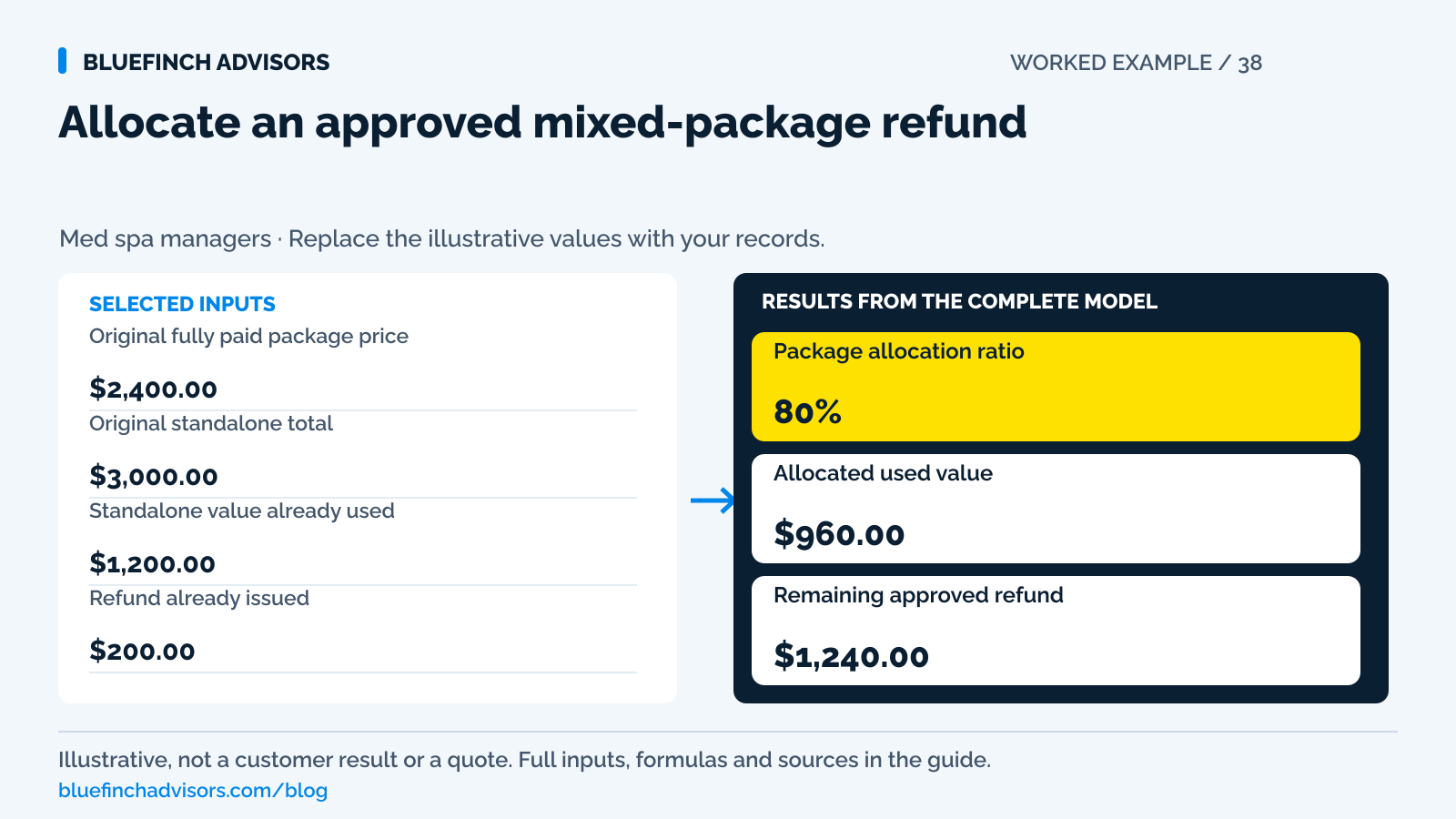
Original fully paid package price Enter the full original selling price paid before tax, not a deposit or installment total for an unpaid package. | $2,400.00 |
Original standalone total Prices documented when this illustrative allocation was agreed. | $3,000.00 |
Standalone value already used Use the same original price schedule, not today's menu. | $1,200.00 |
Refund already issued Successful refunds against this package, not pending requests. | $200.00 |
Original merchant payment cost Actual amount retained by the payment provider in this scenario. | $72.00 |
Example results
| Measure | Result |
|---|---|
Package allocation ratio Package paid divided by original standalone total. | 80% |
Allocated used value Used standalone value times the package ratio. | $960.00 |
Remaining approved refund Signed result. A negative balance requires review. | $1,240.00 |
Merchant cash retained after fees After completing the modeled refund; before service costs. | $888.00 |
Calculation detail
| Measure | Result |
|---|---|
| Total refund under this method | $1,440.00 |
| Refund already issued | $200.00 |
| Original merchant payment cost | $72.00 |
Model assumptions
- This fictional proportional method must match the approved policy before use. The full original package selling price must have been collected.
- No tax, penalty, expiration, credit-card surcharge refund, or clinical eligibility decision is modeled.
Read alongside these results
- If used value exceeds the original total or prior refunds exceed the entitlement, investigate the source records.
- A processor's refund capability does not determine the customer's refund rights.
Download this worked example (CSV). Use the interactive version to export your own inputs and results.
Download infographic (PNG) · Download vector (SVG) · Link to the source and methodology


The short version
- Choose the calculation only after confirming the approved refund policy.
- Check the allocation for mixed services rather than assuming every session has equal value.
- Show merchant processing expense separately from the approved client refund.
A client paid in full for a package containing services with different standalone prices. Some were delivered. Others will not be used. The manager has approved a partial refund. Dividing the package by the number of appointments would be easy, but it may not match what the client bought.
The worksheet on this page illustrates one proportional allocation method for a fully paid package. It is not a refund policy, an accounting standard, a clinical judgment, or a statement of what the practice may legally retain. Confirm the applicable agreement and approved remedy first. Deposits and unpaid installment plans need a separate reconciliation of used value, collections, and the revised unpaid balance.
Use with this guide
Package redemption records
Rebuild the services used before approving an allocation.
Package payment evidence
Keep the original terms and resolution attached to the transaction.
Financing and payment methods
Check who must process an adjustment when a third party funded the package.
Browse the complete medical spa guides and worksheets.
Approve the remedy before opening the calculator
Document why the refund has been approved, which unused components are affected, and who authorized the resolution. A service concern may need separate clinical handling. The payment worksheet should not determine whether another procedure is suitable or whether a clinical obligation has been met.
Locate the terms accepted at purchase. If those terms are unclear, resolve that ambiguity with the practice's appropriate advisers rather than selecting the method that produces the smallest refund. A mathematical allocation can be internally consistent and still be the wrong policy for the transaction.
Square supports both item-based and amount-based package refunds. That software flexibility does not choose your allocation for you. Before staff enter an amount, they need an approved answer in dollars and a record of how it was reached.
Sources for this section: Square: package purchase, redemption, and refund workflows
Freeze the original price basis
The sample uses a $3,000 standalone total discounted to a $2,400 package. The ratio is 80%. Every included component receives that same proportional reduction for this illustration. If one component had an original standalone value of $500, its allocated package value would be $400.
Use the prices documented at sale. Substituting a higher current menu price for used services can shrink the refund after the fact. If the agreement instead specifies a different allocation or a particular treatment of package discounts, this model may not apply. Do not retrofit the example to replace that agreement.
List components, quantities purchased, quantities used, and allocated values. A visit count alone can be misleading when the package combines different services, retail items, or consultation credits. Keep a delivered retail item separate from a service that was canceled before delivery, even if both appeared on one receipt.
Worked refund: $1,240 remains to issue
The fictional client paid the full $2,400 package price against an original standalone total of $3,000. Used services have $1,200 of original standalone value. Multiply $1,200 by 80% to allocate $960 of the package payment to those services. The modeled total refund is therefore $2,400 less $960, or $1,440.
A successful $200 refund has already been issued. The remaining amount is $1,240. After both refunds, the practice retains $960 of client money. If the original payment provider retains $72 of processing expense, the practice retains $888 after that payment cost and before the costs of the delivered services.
The $72 does not automatically reduce the $1,240 owed under this example. It is the merchant's expense unless an independently valid agreement and applicable requirements establish a different result. Showing it separately avoids a common error: quietly making the customer fund an expense that the approved refund calculation did not include.
Sources for this section: Stripe: refund funding, destinations, and refund status
Match the money action with the entitlement action
Retrieve the original transaction rather than creating an unrelated credit. Check whether the previous $200 refund succeeded, remains pending, or failed. A request in an email is not a completed refund. Record the new refund reference and its status, then reconcile it to the processor report.
Next adjust the package entitlement according to the approved resolution. A refund of unused components must not leave those components redeemable accidentally. Conversely, a canceled booking that restores a session should not remove the entire package. Read the software's exact refund behavior and verify the resulting balance.
The separation is especially important where a membership fee is involved. Phorest specifically notes that refunding a membership payment does not automatically update the benefit balance or membership status. Your system may behave differently, but the acceptance test is the same: confirm both the money and the remaining promise.
Sources for this section: Phorest: refunds, freezes, membership status, and benefit balances · Square: package purchase, redemption, and refund workflows
Refund under the original payment record
If the practice changed processors or introduced dual pricing after the package sale, retain the old transaction amount, tender, receipt, and price disclosure. Do not reconstruct the client's original payment from today's menu. A new payment program does not rewrite what was previously authorized.
Where the original transaction included a permitted credit-card surcharge, ask the acquirer how its refund must be calculated and reported. Where the practice used posted cash and card prices, preserve that pricing record instead of describing the difference as a generic fee. The worksheet excludes those program-specific adjustments so they cannot be silently guessed.
Visa's guidance distinguishes a posted-price discount arrangement from a surcharge and excludes Visa debit and prepaid cards from surcharging. Test refunds for credit, debit, mixed tender, and gift value before a new system goes live. A wallet payment still needs its underlying payment type correctly identified.
Sources for this section: Visa: U.S. merchant surcharging and displayed-price distinctions
Give exceptions a named owner
Escalate a package with missing original prices, disputed usage, financing proceeds, multiple gift balances, or a refund larger than the original charge. These cases need a supported route, not an override by whoever happens to be at the desk. Stripe, for example, limits total refunds on a charge to its original amount and directs refunds to the original payment method.
For a package that is not fully paid, first allocate used value from the full agreed package selling price, then reconcile successful collections, completed refunds, and the revised unpaid balance. Do not enter deposit cash or installments collected in place of the full package price. This calculator cannot determine whether future installments should stop or whether a financing provider needs a separate adjustment.
Keep a short customer-facing explanation: original payment, agreed used-value allocation, previous refund, remaining refund, and expected processing status. Avoid promising a bank posting date you cannot control. The next action is to attach that explanation to the approved resolution and check that the entitlement balance matches it.
Sources for this section: Stripe: refund funding, destinations, and refund status
Questions business owners ask
Can I simply divide by the number of appointments?
Only when that method matches the approved terms and the components are appropriately treated as equal. Mixed services often need a more explicit allocation.
Does the calculator decide what is legally refundable?
No. It executes one clearly labeled illustrative allocation after the policy and remedy are approved, and only when the full original package price was paid. For a deposit or unpaid installment plan, keep the full agreed price as the allocation basis and separately reconcile used value, collections, completed refunds, and the revised unpaid balance.
Why show payment fees if they do not reduce the refund?
They affect the practice's retained cash and processor comparison. Keeping them separate avoids confusing merchant expense with client entitlement.
Primary sources
BlueFinch last reviewed these sources on October 2, 2026. Payment rules and state requirements can change.
- Square: package purchase, redemption, and refund workflows
- Stripe: refund funding, destinations, and refund status
- Phorest: refunds, freezes, membership status, and benefit balances
- Visa: U.S. merchant surcharging and displayed-price distinctions
Use this page for general business information. It is not legal, tax, or accounting advice.