Check voucher contribution before expansion
Calculate initial campaign contribution, then the number of later paid visits needed to cover any shortfall.
Use the interactive tool without signing up. It runs in your browser: enter your numbers, save a comparison, download results or print a working copy. Your numbers are not sent to BlueFinch.
Illustrative example inputs
These starting values show how the math works. They are not industry averages, customer results or a quote.
| Input | Example value |
|---|---|
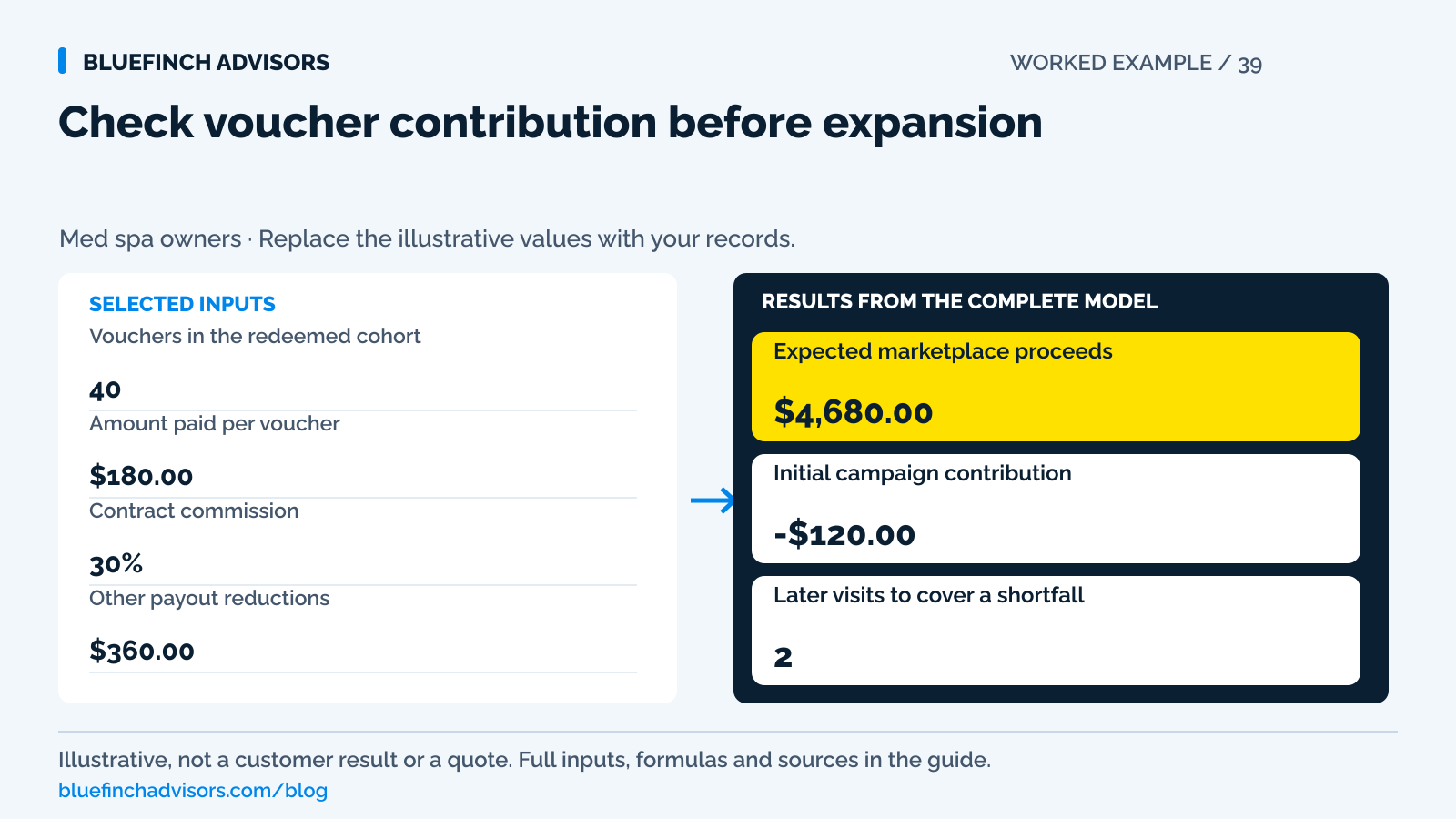
Vouchers in the redeemed cohort Use completed, validated redemptions. | 40 |
Amount paid per voucher Use the actual campaign price for this cohort. | $180.00 |
Contract commission Your signed rate, not a platform-wide assumption. | 30% |
Other payout reductions Cohort-attributable promotions or adjustments not already in price or commission. | $360.00 |
Delivery cost per redemption Approved service delivery costs plus included consumables and labor. | $105.00 |
Campaign administration cost Setup, booking support, reconciliation, and related campaign costs. | $600.00 |
Contribution per later paid visit Observed contribution after that visit's own delivery and payment costs. | $90.00 |
Example results
| Measure | Result |
|---|---|
Expected marketplace proceeds Before the practice's delivery and administration costs. | $4,680.00 |
Initial campaign contribution Negative amounts remain visible. | -$120.00 |
Later visits to cover a shortfall Zero means the entered initial contribution is not negative. | 2 |
Calculation detail
| Measure | Result |
|---|---|
| Voucher customer spending | $7,200.00 |
| Negotiated commission | $2,160.00 |
| Delivery plus administration | $4,800.00 |
Model assumptions
- All defaults are fictional. The model uses one price and one commission for a defined cohort.
- Only attributable adjustments belong here; a payment-period deduction may relate to another sales cohort.
Read alongside these results
- Later visits are a recovery requirement, not a forecast or promise of retention.
- Do not add another card-processing fee to marketplace proceeds unless the actual agreement imposes one.
Download this worked example (CSV). Use the interactive version to export your own inputs and results.
Download infographic (PNG) · Download vector (SVG) · Link to the source and methodology


The short version
- Use your signed commission and actual deductions, not an assumed marketplace rate.
- Track redemption, payout processing and bank arrival on their own dates.
- Show a delivery loss without covering it up with hoped-for repeat purchases.
A voucher campaign brings appointments to an open afternoon. The marketplace dashboard shows a large sales total, but the practice receives less after commission and promotional adjustments. Staff still have to deliver the promised offer. The useful decision is whether that redeemed business contributes enough to justify its costs and capacity.
This guide is a commercial worksheet, not advice on which treatments to advertise. Clinical eligibility, advertising rules, professional fee restrictions, and the offer itself need the practice's appropriate review. Every number on this page is an illustration, not a Groupon quote or an industry benchmark.
Use with this guide
Payment cost and treatment contribution
Separate card expense from the cost of delivering an appointment.
Capacity calculator
Check the hours already promised before adding promotional demand.
Med spa payment channel map
Keep marketplace redemption separate from new direct payments.
Browse the complete medical spa guides and worksheets.
Read the offer economics before the marketing pitch
Groupon's merchant pricing page says commission is agreed before launch and is not a universal fixed percentage. Use the signed agreement for the specific offering, including any campaign-level variations. A remembered 50% rule or a salesperson's verbal estimate is not a sufficient input.
Identify the amount paid, promotional value, included service, voucher cap, appointment restrictions, and refund responsibilities. Groupon's merchant terms define these separately and prohibit inconsistent extra fees or conditions. The practice should approve the full offer before customers see it, including the operational capacity required to honor sold vouchers.
Keep this review separate from clinical suitability. A voucher must not become pressure to provide a service that the authorized professional considers unsuitable. Your commercial model should have a documented route for an approved alternative or refund when that issue arises, without this article prescribing the clinical decision.
Sources for this section: Groupon: negotiated merchant commission and campaign pricing · Groupon: merchant terms and voucher conditions
Follow redemption through to the bank
The platform's sales date is not necessarily the practice's cash date. Groupon describes redemption as the trigger for payment and distinguishes the processing date in Merchant Center from bank arrival. A fully booked week can therefore require labor and supplies before the corresponding proceeds are available.
Export voucher IDs, redemption dates, payment references, and deductions. Match a payout to the vouchers it contains. When a promotional deduction appears in a different period from the eventual redemption proceeds, do not assume that week's net payment measures the profit on that week's delivered services.
Use two views: a cohort view for campaign economics and a dated cash view for funding. The calculator is the cohort view. If you use a deduction that belongs to another cohort, its conclusion will be wrong even if the arithmetic is correct. Keep unresolved deductions in an exception list until their origin is confirmed.
Sources for this section: Groupon: redemption, payout timing, and promotional adjustments
Forty redemptions leave a $120 shortfall
The sample has 40 redeemed vouchers at $180 each, so customers spent $7,200. A fictional 30% commission is $2,160. Subtract $360 of additional cohort-attributable payout reductions. Expected marketplace proceeds are $4,680.
Delivery costs are $105 per redemption, or $4,200 for the cohort. Add $600 of campaign administration and the total is $4,800. Initial contribution is negative $120. This figure excludes overhead that does not change with the campaign, so it is not the practice's full accounting profit.
At an observed $90 contribution per later paid visit, two additional visits would be needed to cover the shortfall: $120 divided by $90 is 1.33, rounded up to two whole visits. That does not mean two visits will occur. It tells you what must happen before the campaign has recovered its modeled cost.
An open room and a displaced appointment are different
A voucher visit using time that would otherwise sit empty has a different opportunity cost from one replacing a full-price booking. Track where the redemptions actually land. A promotion intended for quiet weekdays can consume the most requested evening slots unless the approved offer and booking system handle availability clearly.
Do not add an entire full-price sale as a cost on every voucher. Estimate displaced contribution only where there is credible evidence that another paying appointment could have used that capacity. If that amount matters, include it in campaign administration or run a separate comparison and label the choice.
Staff time also extends beyond the appointment. Questions about eligibility, voucher validation, rescheduling, and payout exceptions may consume manager time. Measure that work during a small campaign before scaling. It is better to enter a documented $600 of administration than assume that marketplace bookings manage themselves.
Sources for this section: Groupon: merchant terms and voucher conditions
Keep voucher redemption out of new card volume
The customer already paid the marketplace for the voucher. Do not treat its face value as another card transaction at your terminal. Record the redemption using the supported tender or package workflow and tie it to the platform reference. A separately authorized add-on is a new sale and needs its own clear price.
If the practice offers dual pricing, confirm how the published program applies to that new add-on without contradicting the voucher's terms. An undisclosed fee at redemption is not a substitute for pricing the campaign correctly. Visa's guidance makes the posted-price versus surcharge distinction explicit and does not permit surcharging Visa debit or prepaid cards.
A processing change may reduce costs on the practice's direct card sales while doing nothing to the marketplace commission. Present those savings separately. Otherwise a proposal can appear to improve campaign economics by claiming savings on card volume the practice never processed.
Sources for this section: Visa: U.S. merchant surcharging and displayed-price distinctions · Groupon: merchant terms and voucher conditions
Set the stop or expand rule before launch
Choose a capped cohort that your approved schedule can deliver. Define the records needed to judge it: proceeds by voucher, completed visits, delivery cost, administration time, customer complaints, and later voluntary paid visits. Do not call a contact list retained revenue.
Use a follow-up window that is long enough for the next relevant purchase but short enough to support a decision. Count only settled, non-refunded repeat purchases and subtract their actual fulfillment and payment costs. Keep repeat purchases attributable to existing clients separate from newly acquired clients if acquisition is the campaign's purpose.
At the review date, compare actual contribution with the launch estimate and explain each major difference. A profitable small cohort does not prove unlimited capacity. Expand only after confirming that the next cohort can be served under the same cost and availability assumptions.
Sources for this section: Groupon: redemption, payout timing, and promotional adjustments
Questions business owners ask
Should I assume Groupon takes half?
No. Its current merchant pricing materials describe a negotiated rate. Use your executed campaign terms.
Can a negative campaign still be intentional?
Possibly, if the practice knowingly budgets acquisition cost and measures the outcome. The worksheet makes the shortfall explicit. It does not predict future loyalty.
Why not use the bank deposit alone?
A deposit can combine different cohorts and adjustments. Trace it to voucher-level activity before deciding which campaign earned or lost money.
Primary sources
BlueFinch last reviewed these sources on October 2, 2026. Payment rules and state requirements can change.
- Groupon: negotiated merchant commission and campaign pricing
- Groupon: merchant terms and voucher conditions
- Groupon: redemption, payout timing, and promotional adjustments
- Visa: U.S. merchant surcharging and displayed-price distinctions
Use this page for general business information. It is not legal, tax, or accounting advice.