Allocate a discounted package refund
For a fully paid package, allocate the canceled component proportionally, then subtract valid agreed retained value and earlier refunds.
Use the interactive tool without signing up. It runs in your browser: enter your numbers, save a comparison, download results or print a working copy. Your numbers are not sent to BlueFinch.
Illustrative example inputs
These starting values show how the math works. They are not industry averages, customer results or a quote.
| Input | Example value |
|---|---|
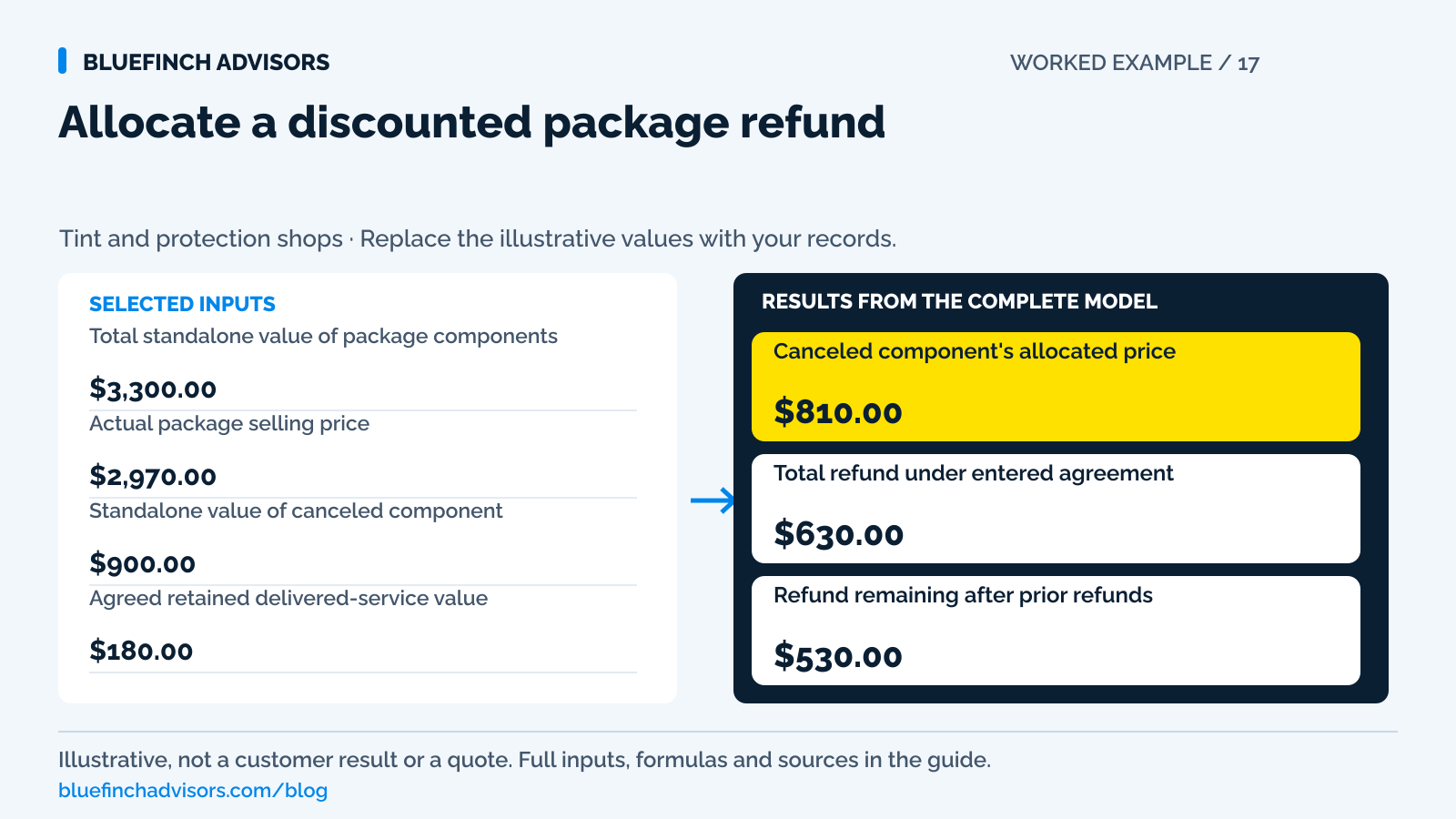
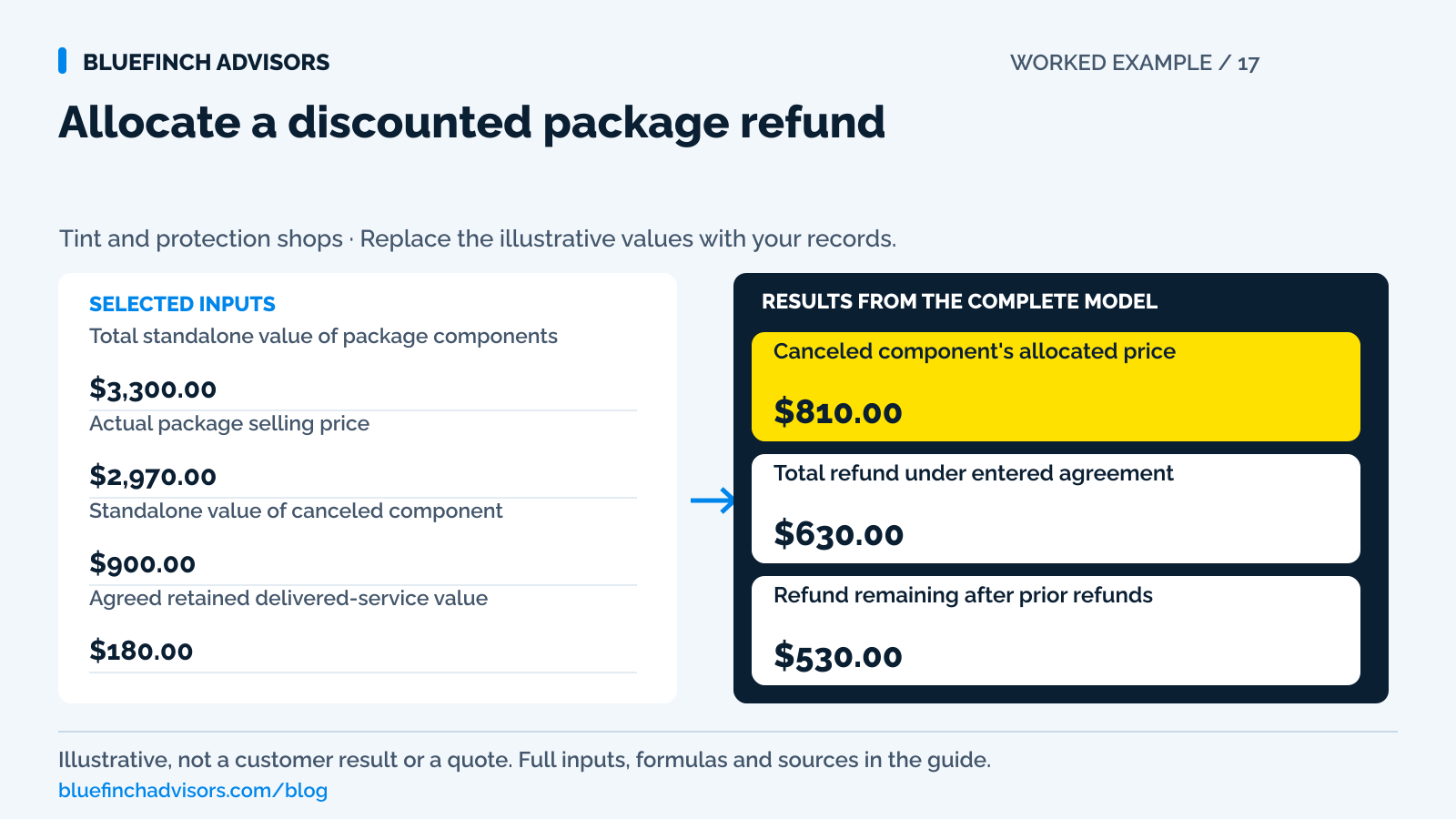
Total standalone value of package components Sum of the component prices used for the agreed allocation. | $3,300.00 |
Actual package selling price Full agreed before-tax selling price, fully collected before cancellation. Never enter only a deposit or installment here. | $2,970.00 |
Standalone value of canceled component Must be part of the entered standalone total. | $900.00 |
Agreed retained delivered-service value Only a valid disclosed amount for work actually retained; not an invented cancellation penalty. | $180.00 |
Completed refunds for this component Money already returned against this same allocation. | $100.00 |
Example results
| Measure | Result |
|---|---|
Canceled component's allocated price Standalone component price times the package-to-standalone ratio. | $810.00 |
Total refund under entered agreement Allocated value less valid agreed retained service. | $630.00 |
Refund remaining after prior refunds Negative indicates an over-refund or inconsistent inputs to investigate. | $530.00 |
Calculation detail
| Measure | Result |
|---|---|
| Package allocation factor | 90% |
| Prior completed component refunds | $100.00 |
Model assumptions
- Starting values are examples, not market benchmarks or payment quotes.
- Use one currency and a consistent before-tax basis. Work out taxes and program-specific adjustments separately.
- The full package selling price was paid before cancellation; prior refunds relate only to the component being modeled.
- For deposits or installments, reconcile the revised agreed total against actual net payments to find the unpaid balance or overpayment. These cash-refund outputs do not apply, and the selling-price input must never be replaced with deposit cash.
Read alongside these results
- A zero standalone total makes allocation unavailable. The removed component must not exceed the total.
- This model does not decide refund entitlement, tax adjustments, surcharge reversal, or whether a retained amount is enforceable.
Download this worked example (CSV). Use the interactive version to export your own inputs and results.
Download infographic (PNG) · Download vector (SVG) · Link to the source and methodology

The short version
- Use the agreed package allocation and establish it before sale if one isn't already set.
- Refund the full standalone price from a discounted bundle only if that's the actual agreement.
- Check earlier refunds and the original payment method before sending more money.
A customer buys and fully pays for paint protection film, tint, and coating together, then cancels the coating before it is applied. The package was discounted. Refunding the coating's full standalone price may erase more than its share of the sale; refusing any refund because the bundle changed may conflict with the agreement. The shop needs a defensible allocation, not a convenient number chosen after the cancellation.
This cash-refund model applies only to a package paid in full before the component cancellation. It uses proportional allocation across published component prices when that approach is agreed and appropriate; it is not a universal refund policy. If only a deposit or installments were paid, reconcile the revised agreed package total against actual net payments to determine the unpaid balance or overpayment instead. Never substitute the deposit for the full selling-price input. Explicit contractual component prices or applicable customer rights may require another allocation.
Use with this guide
Track the whole package
Keep service delivery and the revised balance on one record.
Plan PPF cash commitments
Separate material spending from the customer's refund rights.
Keep the remedy evidence
Preserve product, invoice, and refund records after the package changes.
PPF kit returns: reconcile supplier credit and card costs
Reconcile a returned PPF kit from supplier credit to customer correction. Use the ledger to keep retained processing costs and refund status separate.
Browse the complete window tint guides and worksheets.
Explain the component allocation before selling the package
A package invoice should identify what is included, what is optional, and how a partial cancellation will be handled. If proportional allocation is the policy, explain it with the component prices and package total before sale. If each component already has a specific discounted line price, use those actual lines instead. An owner should not choose whichever allocation leaves the smallest refund after the customer asks to remove a service.
Keep the allocation separate from service eligibility and warranty. PPF, automotive tint, and coating are different products and promises. 3M publishes separate warranty resources for its film categories, while XPEL's warranty information is product-specific. Neither manufacturer's material establishes the shop's package refund formula. The commercial allocation belongs in the shop's agreement, and the installed products need their own accurate coverage and care records.
Sources for this section: 3M: separate warranty resources for wrap, PPF, and window film · XPEL: warranty claims, approval, and product-specific coverage
The sample leaves $530 still to refund
The illustrative standalone values are $1,800 for film, $900 for coating, and $600 for tint, totaling $3,300. The customer bought the package for $2,970 and paid that full amount before cancellation. The proportional factor is $2,970 divided by $3,300, or 90%. The canceled coating component therefore carries $810 of the package price. This preserves the same proportional discount across the components rather than treating one as fully priced after the sale.
The example assumes the parties have validly agreed that $180 of delivered preparation remains payable and belongs to this component. The resulting total refund is $810 minus $180, or $630. If $100 has already been refunded against that same component, $530 remains. The calculator does not validate the $180 retention. If no such retention is appropriate, enter zero; the total refund becomes $810 and the remaining refund after the earlier $100 becomes $710.
Verify delivered service before retaining part of its price
Buying coating product, reserving a bay, or paying a technician does not automatically establish an amount the customer must forfeit. Identify the actual agreed service that remains delivered and its agreed treatment when the package changes. If preparation benefits the PPF that remains installed, check whether that work was already priced in the film component. Charging it again against the canceled coating would reduce the refund twice for one activity.
Keep documentation of the partial completion and the customer's revised choice. A signed acceptance of completed film does not automatically waive rights concerning unperformed coating. Where the refund entitlement is disputed, resolve the terms before presenting the calculator as authority. Its job is to make arithmetic consistent after the policy decision, not to generate a policy from sunk cost. That distinction is especially important when the customer paid the entire bundle in advance.
Refund the actual sale, including its approved price structure
Use the full package selling price that the customer paid under the selected price basis, not a deposit amount. If a dual-priced package had a regular card price and lower cash price, do not allocate from one total and refund against the other. Mixed-tender packages need a documented allocation across the original payments. The provider should explain the supported refund flow and any required treatment of program-specific adjustments. This before-tax model deliberately leaves those rules outside the arithmetic.
A credit-card surcharge is not the same as dual pricing or a cash discount. Mastercard excludes debit and prepaid from surcharge permissions, and the shop must follow its actual approved program when reversing a transaction. Do not assume the original merchant processing fee is returned or that the customer may automatically be charged for it. Stripe's documentation says its original processing fees are not returned; a merchant's cost and the customer's refund entitlement remain separate questions.
Sources for this section: Mastercard: merchant surcharge rules and debit exclusions · Stripe: refund destinations, partial refunds, and refund status
Check earlier refunds and disputes before sending another one
Retrieve the original payment, any partial refunds, and their statuses. A refund requested yesterday may still be pending, so subtracting only completed refunds in the worksheet does not mean staff should send the same amount again. Maintain a separate pending-refund hold and follow the existing reference to completion or failure. The customer should receive a clear explanation of the total remedy and what has already been initiated.
Stripe documents that refunds return to the original payment method and that multiple partial refunds cannot exceed the original charge. Its dispute guidance also notes that partially refunded payments can still be disputed. If a dispute is open, ask the provider how to avoid duplicate reimbursement rather than independently refunding and accepting the same disputed amount. Save the component allocation and revised invoice with the refund reference so the next employee can reconstruct the calculation.
Sources for this section: Stripe: refund destinations, partial refunds, and refund status · Stripe: payment policies, shipping records, and dispute prevention
Keep the remaining services and warranties intact
Issue a revised itemized record showing the components still delivered, the component removed, the agreed refund, and the payment status. Do not erase the original package receipt. The customer may need it to identify the installed product and its original date. If removing coating changes care instructions or another product's requirements, have the responsible installer review the actual manufacturer guidance rather than assuming the financial adjustment is the only consequence.
For the next package sold, test one cancellation scenario before publishing the terms. Ask whether staff can reproduce the same answer from the invoice without choosing a new policy at the counter. This calculator works only when the reference total and removed component are valid and consistently priced. Zero reference value produces no allocation; a negative remaining refund flags an inconsistency. Resolve those inputs before returning money, then close the customer communication and provider status together.
Sources for this section: XPEL: product-specific coating and film care
Questions business owners ask
Can this cash-refund calculator be used when only a deposit was paid?
No. It assumes the package was paid in full. For a $2,970 package with only $500 paid, a valid $630 package reduction leaves a $2,340 revised price and $1,840 unpaid, not a $630 cash refund. Reconcile the revised agreed total against actual net payments in the package balance worksheet. Never replace the full selling-price input with deposit cash.
Must every PPF package use proportional refunds?
No. Use the actual agreement and applicable customer rights. Proportional allocation is one transparent method when it was agreed and fits the transaction.
Can we deduct the full cost of coating supplies we bought?
Not automatically. The retained value must have a valid basis under the agreement and applicable requirements. Buying supplies alone does not establish customer liability.
What does a negative remaining refund mean?
The entered prior refunds and retained amount exceed the allocated component value. Check for duplicate refunds, a wrong allocation, or a policy mismatch rather than treating the result as a new charge.
Primary sources
BlueFinch last reviewed these sources on October 2, 2026. Payment rules and state requirements can change.
- 3M: separate warranty resources for wrap, PPF, and window film
- XPEL: warranty claims, approval, and product-specific coverage
- Mastercard: merchant surcharge rules and debit exclusions
- Stripe: refund destinations, partial refunds, and refund status
- Stripe: payment policies, shipping records, and dispute prevention
- XPEL: product-specific coating and film care
Use this page for general business information. It is not legal, tax, or accounting advice.