Audit wallet funding classification
Check confirmed debit/prepaid volume, unknown wallet volume and the sample uniform charge needing review.
Use the interactive tool without signing up. It runs in your browser: enter your numbers, save a comparison, download results or print a working copy. Your numbers are not sent to BlueFinch.
Illustrative example inputs
These starting values show how the math works. They are not industry averages, customer results or a quote.
| Input | Example value |
|---|---|
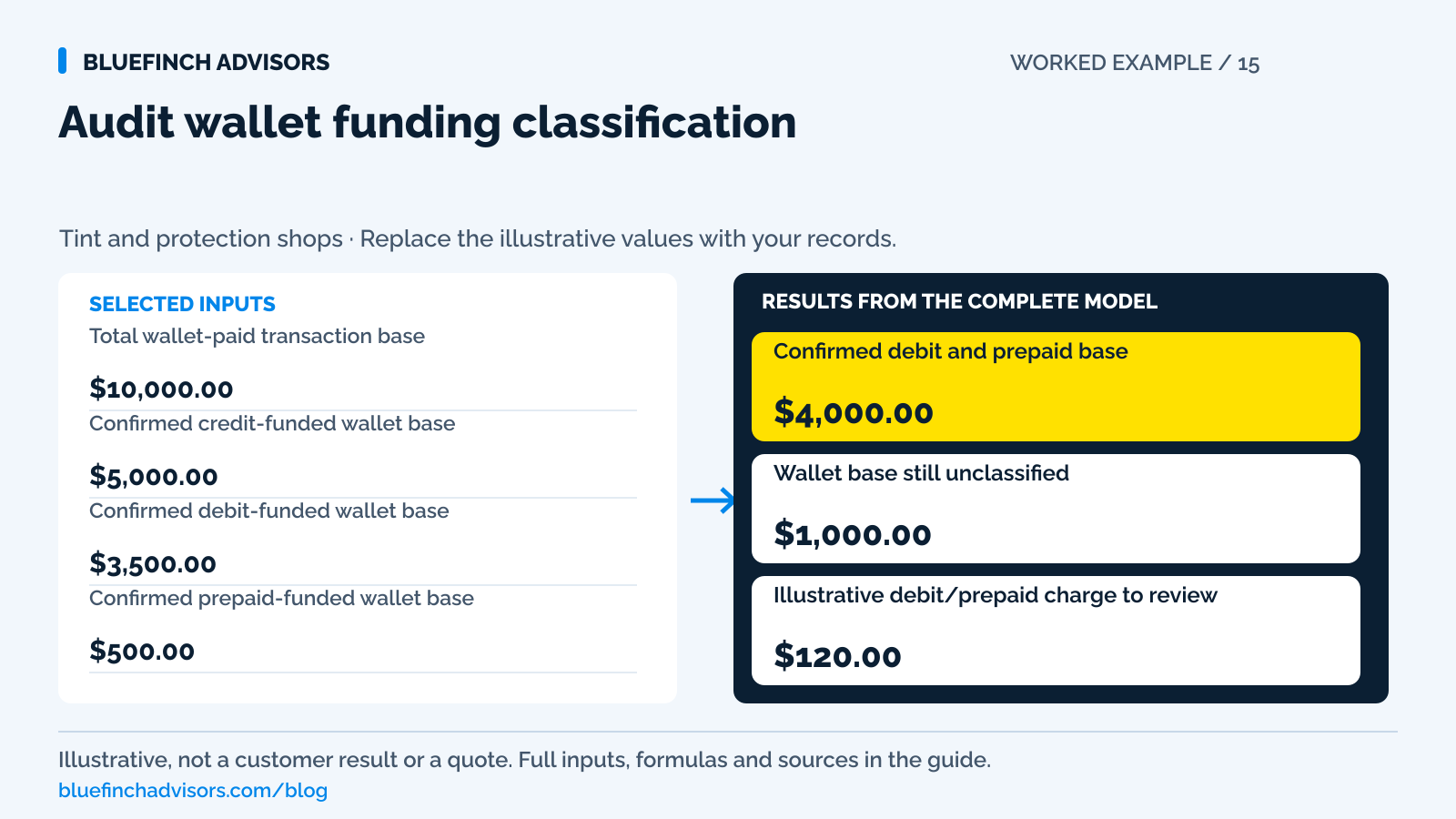
Total wallet-paid transaction base Same-period base amounts before the suspect added fee. | $10,000.00 |
Confirmed credit-funded wallet base Provider-classified credit transactions only. | $5,000.00 |
Confirmed debit-funded wallet base Debit remains debit even without a PIN. | $3,500.00 |
Confirmed prepaid-funded wallet base Keep prepaid distinct from credit. | $500.00 |
Uniform added fee being audited Historical or hypothetical fee percentage applied to these base amounts; not an approved rate. | 3% |
Example results
| Measure | Result |
|---|---|
Confirmed debit and prepaid base These amounts are not eligible under the cited Mastercard credit-surcharge permission. | $4,000.00 |
Wallet base still unclassified Negative means classification totals overlap or exceed the batch. | $1,000.00 |
Illustrative debit/prepaid charge to review Assumes the entered uniform fee was added to every confirmed debit/prepaid base amount. | $120.00 |
Calculation detail
| Measure | Result |
|---|---|
| Confirmed credit base | $5,000.00 |
| Charge on unclassified base to investigate | $30.00 |
Model assumptions
- Starting values are examples, not market benchmarks or payment quotes.
- Use one currency and a consistent before-tax basis. Work out taxes and program-specific adjustments separately.
Read alongside these results
- The fee input is an audit assumption, not a surcharge recommendation or cap.
- Use actual transaction-level fees when available. Different rates, rounding, refunds, or tax bases can change the exact remediation total.
Download this worked example (CSV). Use the interactive version to export your own inputs and results.
Download infographic (PNG) · Download vector (SVG) · Link to the source and methodology

The short version
- A wallet name doesn't tell you whether the card is credit, debit or prepaid.
- Keep unknown card types separate while the provider classifies them.
- Investigate the configuration with this audit; don't use it as a universal dual-price formula.
A customer taps a phone to pay for tint. The receipt says Apple Pay, and the cashier treats it as credit because no PIN was requested. That assumption can put a debit-funded transaction into a credit-only surcharge flow. It can also distort the owner's estimate of how much volume is eligible for a proposed payment program.
Use the provider's underlying card classification to check wallet transactions. The worksheet separates confirmed debit and prepaid from credit and unknown volume. If one uniform fee was incorrectly added to confirmed debit and prepaid payments, it estimates the charge needing review. It doesn't determine the legal refund, approve a surcharge rate or calculate dual prices.
Use with this guide
Map wallet presentation across channels
Check that the counter and online flows use the same approved rules.
Recalculate the true payment mix
Keep eligible credit volume separate from other card costs.
Test the configured price program
Verify tender classification, disclosure, receipts, and refunds before launch.
Browse the complete window tint guides and worksheets.
Check your own costs: calculate your effective processing rate or upload a merchant statement for analysis.
The customer chooses a card inside the wallet
Apple's payment instructions explain how a customer can switch from the default card to another card before authorizing a purchase. The shop therefore cannot infer funding type from the Apple Pay button, a phone, or a watch. The payment network and provider receive information about the underlying credential through the supported flow. Staff should use the terminal's approved classification rather than asking whether the customer considers the payment credit.
The same operational question applies to other supported wallets: which underlying funding type is being presented, and how does this merchant configuration treat it? A wallet is not a universal fee category. Neither the absence of a PIN nor a contactless symbol turns debit or prepaid into credit. Ask the provider to identify the reporting field and explain any unknown classification instead of relying on the cashier's guess.
Sources for this section: Apple: choosing the payment card used in Apple Pay
Start by identifying the actual price program
A credit-card surcharge adds a charge under a specific program. A cash discount reduces an established price under its own structure. Dual pricing presents applicable prices before the customer's choice. Those descriptions are not interchangeable permission slips. The owner should be able to show the written program, customer-facing price display, supported channels, and how each funding type is configured.
Mastercard's published surcharge rules exclude Debit Mastercard and Mastercard prepaid cards. Visa separately publishes merchant surcharge guidance and notification requirements. These sources do not authorize treating all wallet payments as credit or using a surcharge cap to calculate every dual-priced quote. Applicable rules and account configuration still need review. This audit asks a narrower factual question: what underlying volume was present, and what was charged on it under the configuration being investigated?
Sources for this section: Mastercard: merchant surcharge rules and debit exclusions · Visa: merchant fees, rules, and surcharge disclosure
The sample finds $4,000 of debit/prepaid and $120 to review
The illustrative batch contains $10,000 of wallet-paid base amounts. The provider confirms $5,000 as credit, $3,500 as debit, and $500 as prepaid. Confirmed debit and prepaid total $4,000. Subtracting all classified amounts from the batch leaves $1,000 unresolved. Do not assume that unresolved $1,000 is credit simply because it is not yet marked debit in the report.
If a uniform 3% added fee was applied to every transaction, the charge on confirmed debit and prepaid base amounts would be $120. Another $30 would be attached to the unresolved base and needs classification before drawing a conclusion. The 3% is an illustrative historical audit input, not an approved rate or recommended surcharge. Exact remediation should use the real transaction fees, their rounding, refunds, and applicable rules rather than refunding this aggregate estimate blindly.
Request the wallet method and underlying card type in separate fields
Request the transaction identifier, date, base amount, added fee if any, tender presentation, funding classification, status, and refund references. Avoid exports containing unnecessary sensitive card information. The same underlying card can appear differently across physical and wallet presentation, so use provider-supported references to reconcile it. Your accounting system's broad card label may not contain enough detail to test the program.
Reconcile the export total to the selected batch before classifying it. If debit, prepaid, credit, and unknown totals overlap, the worksheet can produce a negative unknown amount; that is a data problem, not negative payment volume. Confirm whether the source reports gross sales, net refunds, or settlement amounts. Use one basis throughout so a refunded deposit is not counted as a fresh negative credit transaction that masks an incorrectly charged wallet debit sale.
Sources for this section: Stripe: payout reconciliation reports
Correct the configuration before projecting savings
If the provider confirms a classification or fee error, have it correct the approved configuration and explain the remediation path. Test supported credit, debit, and prepaid wallet scenarios in its test environment or an approved controlled process. Check what the customer sees before authorization, what the receipt shows, and how a partial refund behaves. Do not collect real customer fees merely to experiment with the terminal.
Recalculate any savings proposal using the verified eligible credit volume, not the entire wallet total. An offer with a 0% merchant credit-card rate for eligible configured transactions can still leave debit, monthly, gateway, and other account-specific costs. If unknown wallet transactions are material, obtain better classification before making the projection. The practical cost of an unverified assumption can include both overstated savings and customer corrections, neither of which appears in a headline rate.
Keep any customer correction attached to the original transaction
Identify each affected payment and the exact amount to reverse under the provider-approved remedy. Do not issue a cash payment solely because the customer used a phone. Stripe's refund documentation routes refunds to the original payment method and explains that issuers usually handle replacement-card situations. The shop's actual provider should confirm its wallet refund process and the references customers can use to trace a delayed return.
Keep a remediation list showing the original transaction, classification finding, approved correction, refund status, and customer communication. Review an additional representative batch after the configuration change to confirm the problem stopped. This worksheet cannot certify compliance or infer funding type from a wallet brand. It can keep the unresolved amount visible and stop an unsupported assumption from flowing into customer pricing, refund decisions, and the next processing proposal.
Sources for this section: Stripe: refund destinations, partial refunds, and refund status
Questions business owners ask
Does choosing credit on a terminal turn wallet debit into credit?
No. Presentation and verification choices do not change the underlying funding type. Use the provider's approved classification and applicable program rules.
Is the 3% example a permitted surcharge rate?
No. It is only the uniform fee being audited in the example. The permitted structure and amount depend on the actual program, network rules, account terms, and applicable requirements.
Should all unknown wallet transactions be refunded?
Not from this calculator alone. Obtain classification and actual fee details, then follow the provider-approved remedy for the affected transactions.
Primary sources
BlueFinch last reviewed these sources on October 2, 2026. Payment rules and state requirements can change.
- Apple: choosing the payment card used in Apple Pay
- Mastercard: merchant surcharge rules and debit exclusions
- Visa: merchant fees, rules, and surcharge disclosure
- Stripe: payout reconciliation reports
- Stripe: refund destinations, partial refunds, and refund status
Use this page for general business information. It is not legal, tax, or accounting advice.