Work out who funds the wrap remake
Check replacement-work costs separately from confirmed warranty recovery and an independently approved customer contribution.
Use the interactive tool without signing up. It runs in your browser: enter your numbers, save a comparison, download results or print a working copy. Your numbers are not sent to BlueFinch.
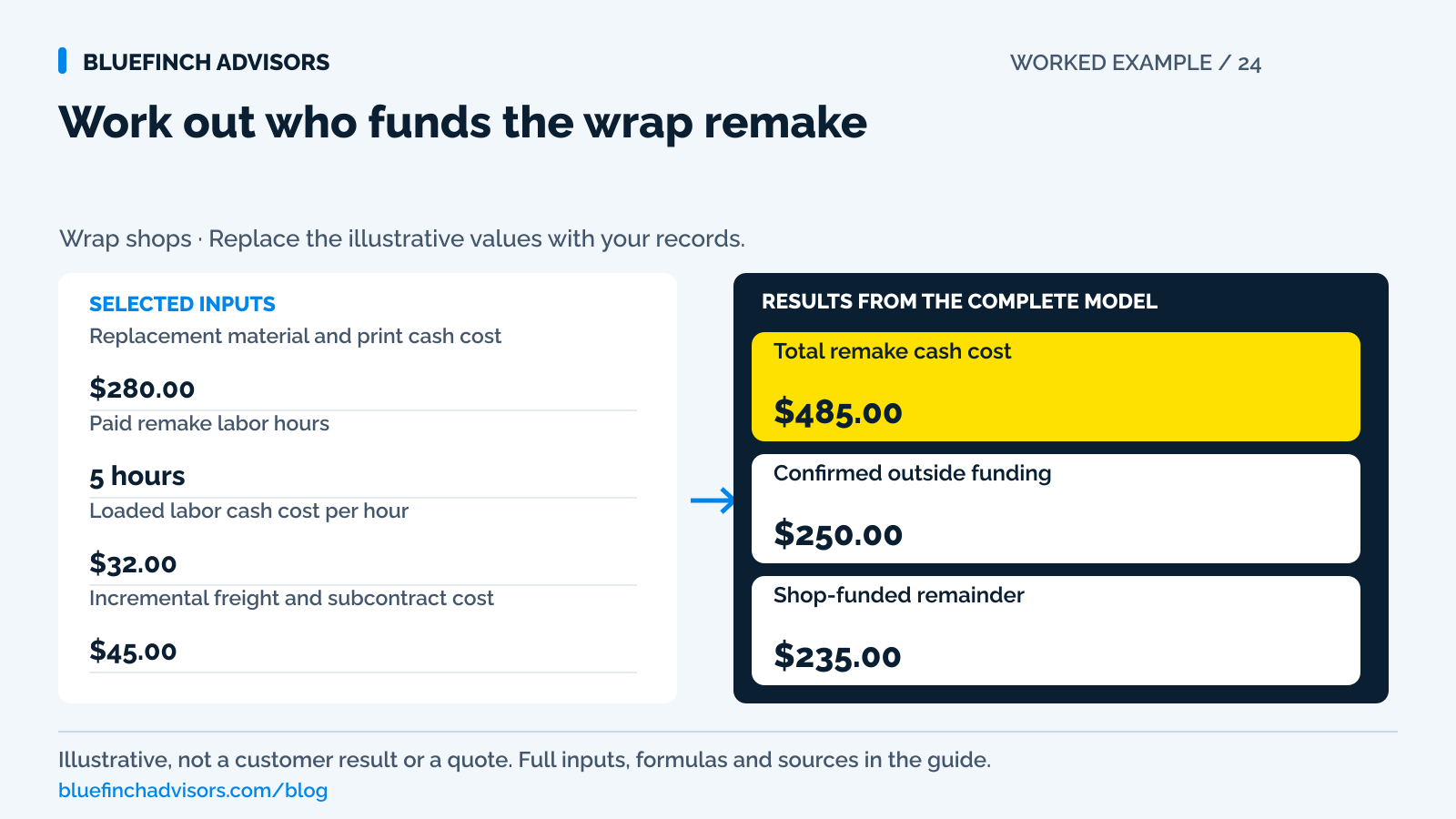
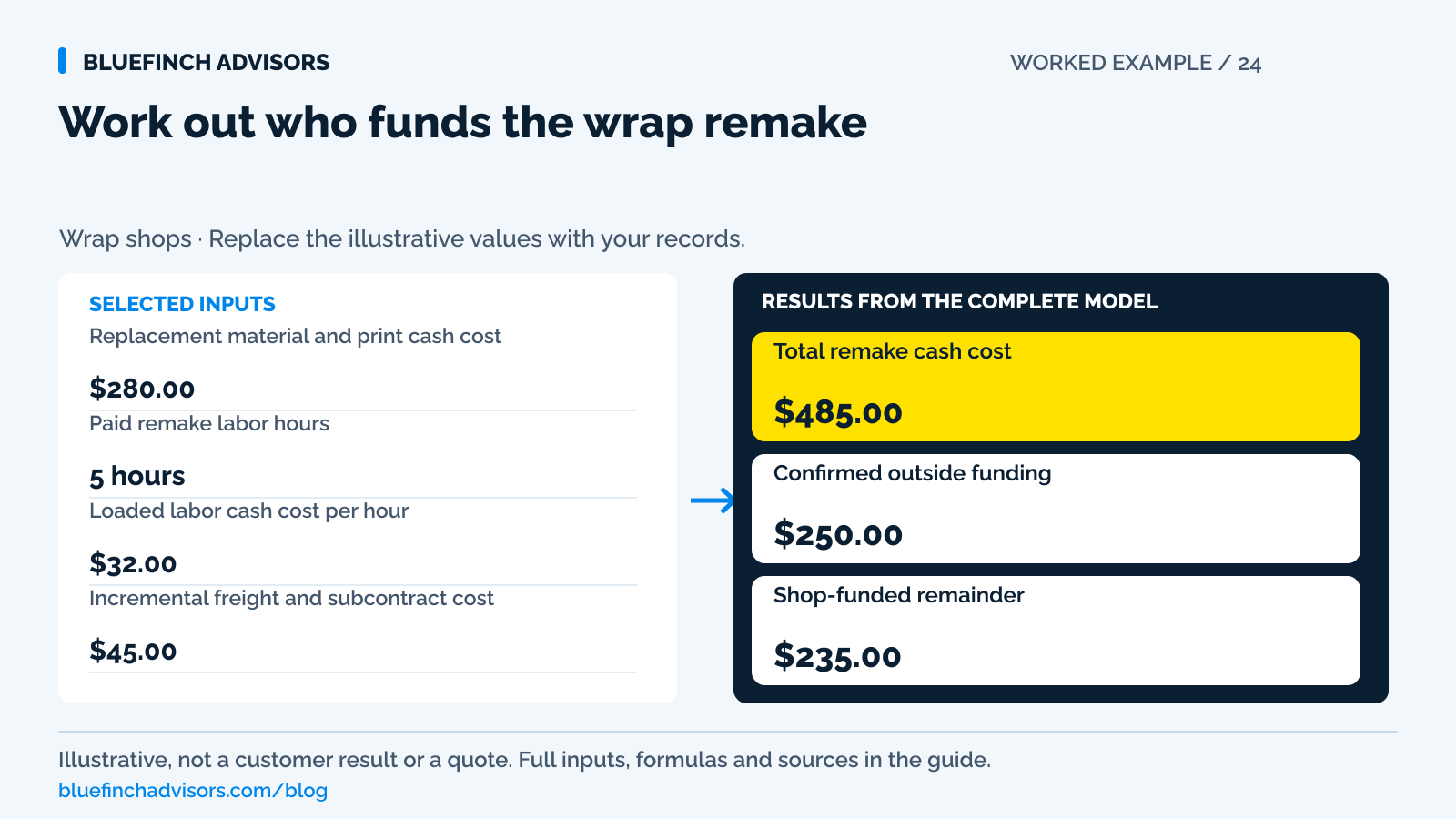
Illustrative example inputs
These starting values show how the math works. They are not industry averages, customer results or a quote.
| Input | Example value |
|---|---|
Replacement material and print cash cost Incremental cash consumed by the remake; exclude reusable inventory not consumed. | $280.00 |
Paid remake labor hours Include removal and preparation where applicable. | 5 hours |
Loaded labor cash cost per hour Use cost, not the retail selling rate. | $32.00 |
Incremental freight and subcontract cost Costs caused by this remake. | $45.00 |
Confirmed recovery available Approved supplier credit or reimbursement usable in this cash period; exclude pending claims. | $100.00 |
Approved customer contribution collected Only money collected for separately authorized customer responsibility or added scope. | $150.00 |
Example results
| Measure | Result |
|---|---|
Total remake cash cost Cost before recoveries or customer contributions. | $485.00 |
Confirmed outside funding Available recovery plus collected customer contribution. | $250.00 |
Shop-funded remainder Signed result; a negative value calls for review of over-recovery or scope. | $235.00 |
Calculation detail
| Measure | Result |
|---|---|
| Loaded remake labor | $160.00 |
| Confirmed warranty recovery | $100.00 |
Model assumptions
- Starting values are examples, not market benchmarks or payment quotes.
- Use one currency and a consistent before-tax basis. Work out taxes and program-specific adjustments separately.
Read alongside these results
- This measures incremental cash cost, not lost sales, legal fault, or accounting warranty expense.
- An approved customer invoice is not collected funding until payment succeeds and is available.
Download this worked example (CSV). Use the interactive version to export your own inputs and results.
Download infographic (PNG) · Download vector (SVG) · Link to the source and methodology

The short version
- Identify why the panel needs remaking before requesting payment.
- Track confirmed recovery separately from claims awaiting a decision.
- Separate a paid customer upgrade from work correcting the original job.
A panel returns to production, but remake is not a payment category. The original artwork may contain a customer-approved number that later changed. The print may have failed. An installer may have damaged the panel. The customer may choose a larger graphic while a warranty issue is being fixed. Each event sends the cost to a different place, even when the same technician uses the same film.
Calculate the full cash cost and what the shop must fund after confirmed recovery and collected, approved customer payments. Decide and document fault, warranty coverage and legal liability separately; the worksheet doesn't settle them. Use the numbers to schedule work and collect only what the customer authorized.
Use with this guide
Review the original proof record
Identify whether the remake changes or corrects the approved work.
Plan repeated replacement panels
Estimate material layout separately from cost responsibility.
Keep refund terms explicit
Document the commercial remedy before returning money.
Browse the complete vehicle wrap guides and worksheets.
Record the reason for the remake and each charge
Start with the failed or changed item, the original proof, production date, installation photos, and the customer's description. Then record the working classification: production correction, installation correction, product claim, customer-requested change, outside damage, or unresolved. Do not force an unresolved complaint into customer damage just to create an invoice. A disputed classification needs an owner and a review date, while the customer's concerns still need a timely response.
The same job can contain more than one cause. A replacement door panel might correct a print defect while a new telephone number is a separately requested artwork change. Put the correction and the elective change on different lines. This preserves a fair explanation if the manufacturer approves only material, if the customer declines the upgrade, or if the shop decides to absorb a small amount for goodwill. One undifferentiated remake charge cannot explain those decisions.
Read the remedy before counting a reimbursement
Manufacturer support is product-specific. 3M maintains separate wrap, PPF, and window-film warranty resources. XPEL's warranty information requires claim documentation and formal approval before covered work begins; its general claim guidance says labor coverage depends on the product and situation. Those sources support checking the actual installed product and approval path, not assuming every manufacturer's warranty pays the shop's retail labor rate.
Track a claim through submitted, requested information, approved, credited, and received or usable. Only the final usable amount belongs in the calculator's current funding input. A $400 claim with no decision cannot pay this week's labor. If a supplier offers a material credit instead of cash, ask whether it reduces a purchase the shop would otherwise make during the same period. Future purchasing power is useful, but it should not be disguised as money available for payroll today.
Sources for this section: 3M: separate warranty resources for wrap, PPF, and window film · XPEL: warranty claims, approval, and product-specific coverage
The $485 remake leaves $235 for the shop to fund
The illustrative remake consumes $280 in material and print, five paid hours at $32, and $45 of extra freight. Labor costs $160, so the full incremental cash cost is $485. A confirmed $100 recovery and $150 already collected for a separately approved customer change provide $250. The shop-funded remainder is $235. That is a cash planning result, not proof that the shop caused $235 of damage.
Change the recovery to zero while a claim is pending and the current funding need rises to $335. If the customer's $150 has merely been invoiced, remove it until collected and the need reaches $485. This is why a remake can appear inexpensive in a job-cost report while still straining the bank account. Keep expected recoveries in a separate forecast column so management sees the upside without spending it prematurely.
Give the customer a separate approval for anything chargeable
Describe the optional new work, its price, and whether accepting it changes the remedy schedule. A customer who agrees to bring the vehicle back has not necessarily agreed to pay for the visit. When a shop offers dual pricing, show the applicable regular card and lower cash prices for the genuinely chargeable work before collection. A zero-dollar correction should not acquire a processing line just because a terminal receipt is being created.
For a credit-card surcharge, follow the approved program rather than applying a generic percentage to the remake. Mastercard excludes debit and prepaid from surcharge permissions. The customer's choice of a wallet does not remove that distinction. If the shop has an eligible 0% merchant credit-card configuration, monthly, debit, and other account-specific costs can still remain. Those costs belong in the owner's economics; they do not establish that the customer owes an undisclosed correction fee.
Sources for this section: Mastercard: merchant surcharge rules and debit exclusions
Do not pay twice through a refund and a correction
Sometimes the agreed resolution includes both a partial refund and replacement work. Write down exactly what each covers. Refunding the original panel charge does not automatically cancel a separately agreed replacement, and completing the replacement does not automatically withdraw a refund already promised. The customer record should show the resolution, approval date, refund reference, and completion record together. That prevents the front desk and production manager from independently issuing competing remedies.
Stripe's refund documentation distinguishes the refund request from its eventual status and routes refunds to the original payment method. A failed or pending refund needs follow-up, not a second untracked payment from the cash drawer. Its dispute guidance also warns that a partially refunded payment can still be disputed. Do not promise that a goodwill refund closes every possible claim; concentrate on documenting and completing the remedy that was agreed.
Sources for this section: Stripe: refund destinations, partial refunds, and refund status · Stripe: payment policies, shipping records, and dispute prevention
Record actual remake costs and reconcile the recovery
When the vehicle leaves, enter actual material, hours, freight, and any outside cost. Reconcile those amounts with supplier credits and customer collections. If the recovery differs from the estimate, keep the estimate for comparison and record the difference. The purpose is to learn whether the recurring problem is artwork, print quality, handling, installation, or incomplete intake. A single monthly remake total hides the part of the process that needs attention.
Review the next five completed remakes using the same categories. Separate the cash-funded remainder from lost bay capacity and from retail revenue forgone; adding all three without a defined model can count one loss twice. This worksheet deliberately leaves opportunity cost outside its result. Once the causes and cash costs are clear, the owner can choose better proof checks, supplier discussions, or scheduling buffers with evidence instead of treating every return visit as an unavoidable discount.
Questions business owners ask
Can a pending manufacturer claim reduce this week's funding need?
Not in this cash model. Enter only recovery available in the period. Track a pending claim separately and update the model when its amount and timing are confirmed.
Is the labor input our posted hourly rate?
No. Use loaded incremental labor cost. A customer selling price belongs in an independently approved charge, not in the cost of the correction.
Why can the shop-funded result be negative?
Entered recoveries and contributions can exceed the entered costs. Review whether they cover other scope, represent a legitimate selling margin, or contain duplicate amounts before closing the record.
Primary sources
BlueFinch last reviewed these sources on October 2, 2026. Payment rules and state requirements can change.
- 3M: separate warranty resources for wrap, PPF, and window film
- XPEL: warranty claims, approval, and product-specific coverage
- Mastercard: merchant surcharge rules and debit exclusions
- Stripe: refund destinations, partial refunds, and refund status
- Stripe: payment policies, shipping records, and dispute prevention
Use this page for general business information. It is not legal, tax, or accounting advice.