Model a reserve-related cash gap
Check expected receipts after reserves and separate delays against spending due before later funds are released.
Use the interactive tool without signing up. It runs in your browser: enter your numbers, save a comparison, download results or print a working copy. Your numbers are not sent to BlueFinch.
Illustrative example inputs
These starting values show how the math works. They are not industry averages, customer results or a quote.
| Input | Example value |
|---|---|
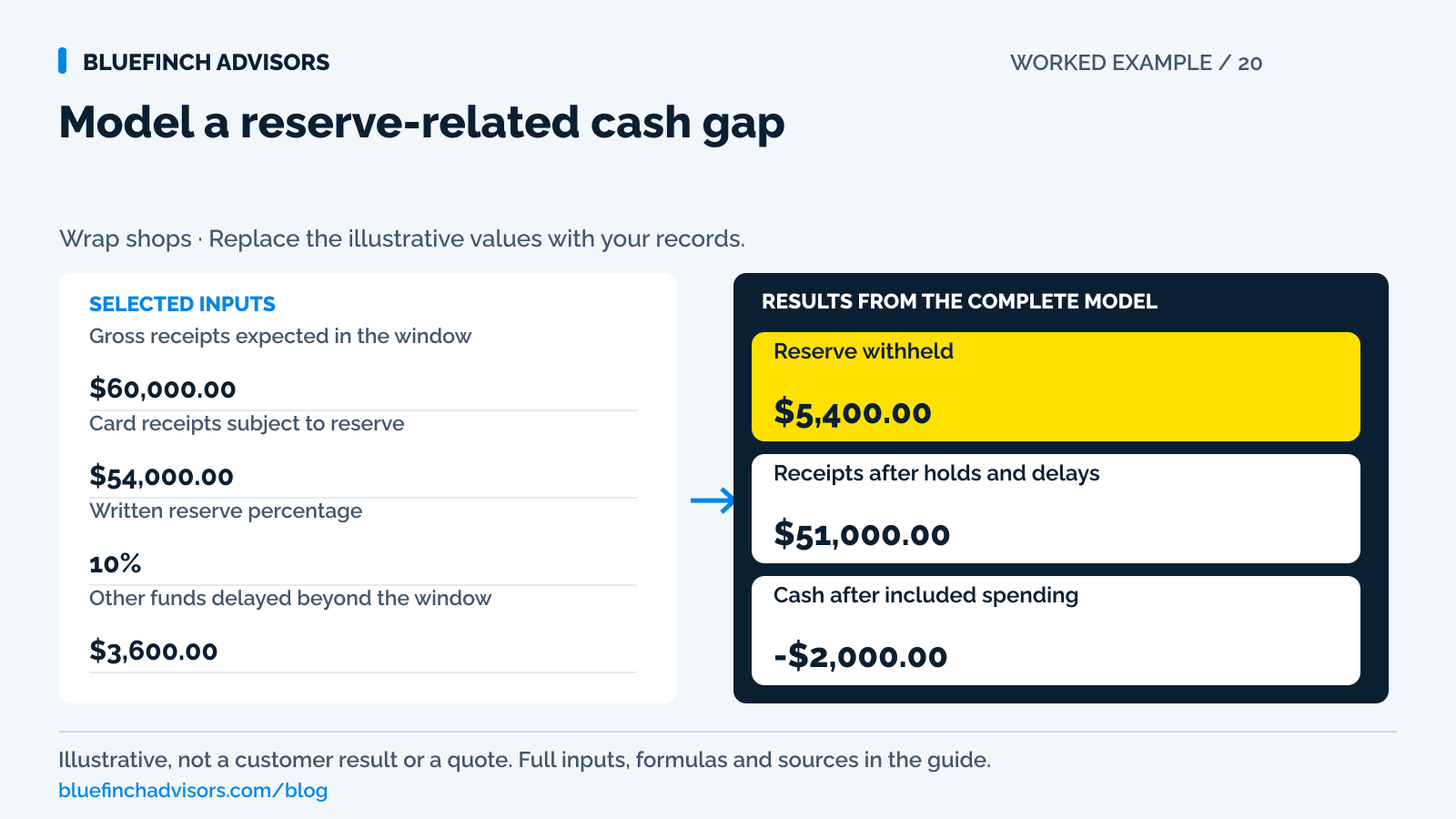
Gross receipts expected in the window All modeled receipts before holds, delays, processing fees, and other outflows. | $60,000.00 |
Card receipts subject to reserve Reserve-bearing subset of the gross receipts in this same window. | $54,000.00 |
Written reserve percentage Actual contractual percentage or a labeled stress-test assumption. | 10% |
Other funds delayed beyond the window Exclude reserve dollars and processing fees. Enter only separate timing delays. | $3,600.00 |
Cash spending due in the window All outflows in this period, including processing fees and other payout deductions. Keep fees out of reserve and delay amounts, and count each outflow once. | $53,000.00 |
Example results
| Measure | Result |
|---|---|
Reserve withheld Modeled cohort volume multiplied by the entered reserve percentage. | $5,400.00 |
Receipts after holds and delays Before fees and other included outflows, not a net bank deposit. | $51,000.00 |
Cash after included spending Negative is a funding gap; opening bank cash is excluded. | -$2,000.00 |
Calculation detail
| Measure | Result |
|---|---|
| Separate delayed receipts | $3,600.00 |
| Total unavailable receipts | $9,000.00 |
Model assumptions
- Starting values are examples, not market benchmarks or payment quotes.
- Use one currency and a consistent before-tax basis. Work out taxes and program-specific adjustments separately.
Read alongside these results
- Reserve-bearing card receipts must be a subset of the entered gross receipts; review inputs if they exceed the total.
- Include processing fees and other payout deductions in cash spending, not in reserve withholding or delayed receipts. Count each outflow once.
- Exclude anticipated reserve releases unless confirmed in the modeled receipts. This is not a rolling-reserve forecast or lending recommendation.
Download this worked example (CSV). Use the interactive version to export your own inputs and results.
Download infographic (PNG) · Download vector (SVG) · Link to the source and methodology

The short version
- Track processor reserves, payout delays and card authorization holds separately.
- Count unavailable money once and check the written release terms.
- A lower processing rate doesn't release withheld money sooner.
A busy wrap month can show plenty of paid invoices while the bank account cannot cover the next material order. Sometimes the cause is a reserve in the merchant agreement. Sometimes a payout is delayed or a payment was only authorized. The owner needs to identify which money is unavailable, for how long, and whether the next production commitments still fit.
Choose one collection period. Enter gross receipts, the portion subject to reserves, separately delayed funds and spending due in that period to see what remains. This doesn't predict that your wrap shop will face a reserve. Use your account documents; a processor's published example explains a concept, not the terms offered to your business.
Use with this guide
Put payments and spending on dates
Use a project timeline for the actual deposit and material commitments.
Separate fees from unavailable cash
Audit processing charges without treating reserves as permanently lost fees.
Review wrap deposit timing
Check how early commitments relate to customer collections.
Browse the complete vehicle wrap guides and worksheets.
Identify whether it's a card hold, reserve or payout delay
A card authorization reserves buying capacity on the customer's payment method but has not necessarily become a captured payment. A processor reserve withholds merchant funds under an account arrangement. A payout delay postpones money otherwise expected to reach the bank. Staff may call all three a hold. That shorthand becomes costly when the owner assumes a screenshot of an approved card means the film supplier can be paid today.
Stripe's manual-capture documentation describes expiring authorizations, while its rolling-reserve explanation describes a percentage withheld and later released according to an agreement. The latter is not the same thing as a processing fee: the amount may later become available subject to the terms and other obligations. Ask for the exact status and affected amount, then obtain the governing document. Do not troubleshoot a reserve by repeatedly charging a customer whose original payment already succeeded.
Sources for this section: Stripe: separate authorization and capture · Stripe: how rolling reserves withhold and release funds
Match receipts and spending to the same dates
Choose the date range in which the supplier and payroll obligations fall. List the gross receipts that would otherwise fund that period, the card-volume cohort producing the reserve deduction, any separately delayed receipts, and confirmed releases. A reserve deduction based on earlier sales can affect a later payout, but the worksheet must reflect that exact relationship. If the same withheld funds appear in two inputs, the gap is overstated.
Keep the account's reserve percentage, holding period, cap if any, release conditions, and review contact alongside the worksheet. Do not borrow a typical percentage from a search result. Stripe's discussion shows that reserve arrangements vary, including capped and upfront structures. This model only calculates percentage withholding for one cohort. A fixed reserve or complicated release schedule requires a different timeline, not a creative reinterpretation of these inputs.
Sources for this section: Stripe: how rolling reserves withhold and release funds
The sample leaves a $2,000 gap before opening cash
In the illustrative scenario, $60,000 of gross receipts are expected in the planning window. Of those receipts, $54,000 are subject to a 10% reserve, withholding $5,400. Another $3,600 is separately delayed beyond the window. Total unavailable receipts are $9,000. The remaining $51,000 is before included outflows, not a net bank deposit. The $53,000 spending input includes film, labor, all processing fees payable or deducted in this window, and other modeled outflows. Subtracting that total produces a negative $2,000 result. Fees belong in spending, not in the reserve or delay amounts, so each cost is counted once.
The $54,000 reserve-bearing amount is part of the $60,000 total, not an additional source of receipts. The $3,600 delay excludes the already counted reserve dollars. Opening unrestricted bank cash could cover the sample gap, but this calculator does not include it. Nor does the negative result prove the business is unprofitable. It identifies a timing shortfall requiring a specific funding or scheduling decision. If the reserve-bearing input exceeds total receipts, reconcile the inputs before relying on the result.
Change the funding plan without charging the customer twice
First ask the processor what documentation is needed and when the decision or release is expected. A deposit-heavy production business should be ready to explain delivery timing, signed scope, approved proofs, refund terms, and completed orders. Keep the inquiry tied to transaction references and the merchant agreement. Do not promise customers that a bank will release funds on a date the provider has not confirmed.
Then compare production commitments with actual liquidity. The owner may delay a discretionary stock order, adjust a future payment schedule with customer consent, or use an existing approved funding arrangement. Do not rerun the same paid card or ask the buyer to send a second payment as though the first never happened. If an actual transaction failed, handle it through the provider's documented retry path and communicate its status clearly before requesting replacement tender.
Sources for this section: Stripe: payout reconciliation reports
Review settlement terms alongside the payment program
A proposal showing a lower merchant credit-card rate does not establish how quickly money reaches the shop or whether reserves apply. Ask about account-specific funding timing, review triggers, reserve language, refunds, debit cost, and monthly charges. Compare those terms with the deposit-to-installation interval. The practical question is how much usable money the shop receives before committing materials, not merely which percentage appears largest on the first page.
When considering dual pricing, keep the customer price decision separate from funding availability. A disclosed regular card price and lower cash price do not convert withheld money into cash. Surcharge rules are another separate subject; Mastercard excludes debit and prepaid, and Visa provides its own notification guidance. Never apply a late fee to an already paid customer because the processor held the merchant's funds. The buyer fulfilled the payment request even if the merchant's settlement is delayed.
Sources for this section: Mastercard: merchant surcharge rules and debit exclusions · Visa: merchant fees, rules, and surcharge disclosure
Match released reserve funds to their original withholding
When funds become available, match the release to the original withheld cohort and confirm any deductions. A payout containing current sales and older reserve releases can look unusually large. Record the components so the owner does not mistake the return of earlier money for a sudden improvement in current job margin. Where reports lag, mark the release provisional until the account record supports it.
Repeat the calculation only when receipts, dates, spending, or written terms change. This is a cash-window check, not an accounting close or an estimate of the processor's risk model. If the gap persists despite confirmed releases, examine customer collection timing and production commitments separately. The next useful action is to reconcile one upcoming funding window to its actual payout and supplier schedule, with each unavailable dollar explained once.
Sources for this section: Stripe: payout reconciliation reports
Questions business owners ask
Is a reserve an extra processing fee?
Not necessarily. It is withheld money governed by the account terms and may later be released. Fees, reserves, refunds, and timing adjustments need separate classifications.
Can a zero eligible credit-card merchant rate prevent holds?
No. Pricing and risk or funding terms are separate. Monthly, debit, and other fees can remain, and the written settlement arrangement still controls availability.
Why does the model exclude opening bank cash?
It isolates whether the entered receipts fund the entered obligations. Compare the resulting gap with genuinely unrestricted cash separately, without using money already committed to other jobs.
Primary sources
BlueFinch last reviewed these sources on October 2, 2026. Payment rules and state requirements can change.
- Stripe: separate authorization and capture
- Stripe: how rolling reserves withhold and release funds
- Stripe: payout reconciliation reports
- Mastercard: merchant surcharge rules and debit exclusions
- Visa: merchant fees, rules, and surcharge disclosure
Use this page for general business information. It is not legal, tax, or accounting advice.