Compare film prepayment savings and available cash
Calculate the discounted payment and simple carrying cost, then check for a shortage after protecting existing commitments.
Use the interactive tool without signing up. It runs in your browser: enter your numbers, save a comparison, download results or print a working copy. Your numbers are not sent to BlueFinch.
Illustrative example inputs
These starting values show how the math works. They are not industry averages, customer results or a quote.
| Input | Example value |
|---|---|
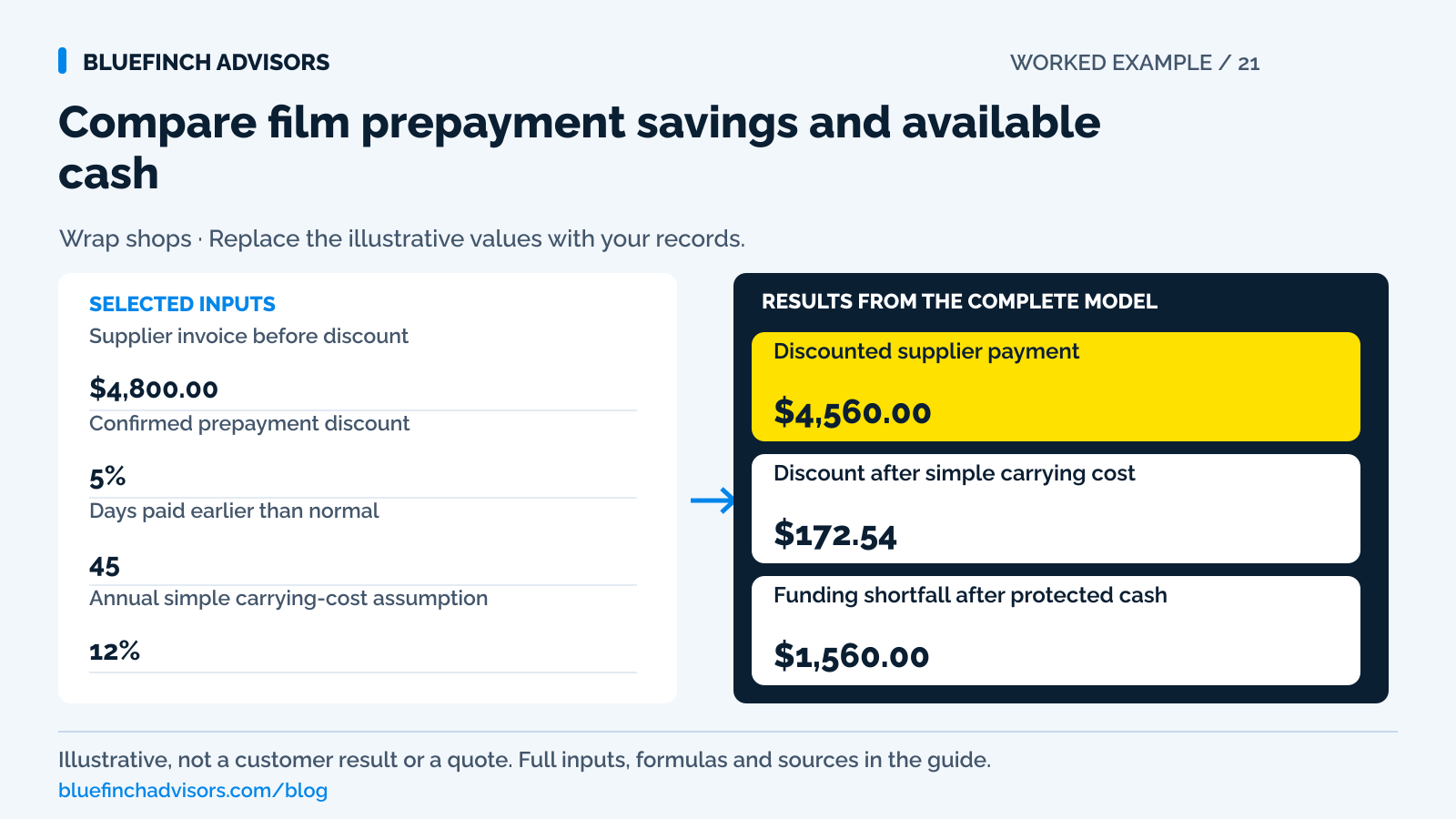
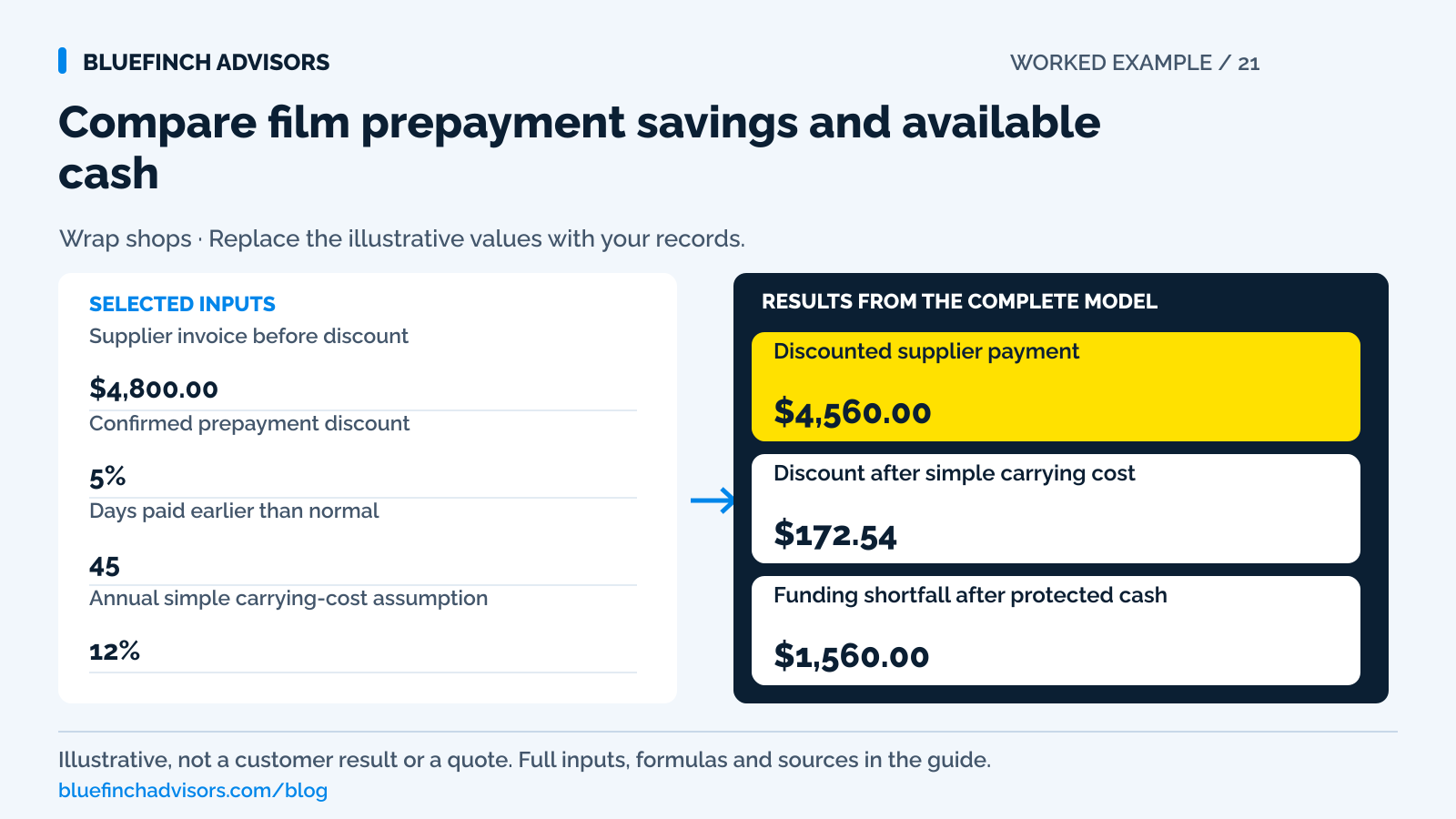
Supplier invoice before discount Comparable film order with consistent freight and tax treatment. | $4,800.00 |
Confirmed prepayment discount Discount actually available under the supplier's written terms. | 5% |
Days paid earlier than normal Incremental cash commitment period, not the product's entire shelf life. | 45 |
Annual simple carrying-cost assumption Illustrative financing or cash-cost assumption; use your own documented basis. | 12% |
Cash available before protected commitments Unrestricted business cash relevant to this decision. | $5,000.00 |
Cash allocated to other approved commitments Amounts needed elsewhere that must not be spent on this purchase. | $2,000.00 |
Example results
| Measure | Result |
|---|---|
Discounted supplier payment Invoice less confirmed supplier discount. | $4,560.00 |
Discount after simple carrying cost Does not include storage, spoilage, financing fees, or uncertain resale value. | $172.54 |
Funding shortfall after protected cash Positive means the proposed payment exceeds available unallocated cash. | $1,560.00 |
Calculation detail
| Measure | Result |
|---|---|
| Gross supplier discount | $240.00 |
| Simple carrying cost | $67.46 |
| Cash after protected commitments | $3,000.00 |
Model assumptions
- Starting values are examples, not market benchmarks or payment quotes.
- Use one currency and a consistent before-tax basis. Work out taxes and program-specific adjustments separately.
Read alongside these results
- This is a purchasing comparison, not a loan quote, investment return, tax treatment, or legal deposit-allocation rule.
- Use actual stock requirements and supplier terms; a positive saving does not resolve a funding shortfall.
Download this worked example (CSV). Use the interactive version to export your own inputs and results.
Download infographic (PNG) · Download vector (SVG) · Link to the source and methodology

The short version
- Check that the discounted stock and payment terms suit the work you need to do.
- Subtract cash protected for existing jobs before deciding what's available.
- Compare the discount with stated carrying costs, without treating uncertain future sales as funding.
A supplier offers a discount if the shop prepays a larger film order. The bank balance appears to cover it, but some of that money came from customers whose vehicles still need labor, freight, or different materials. The question is not simply whether five percent is a good discount. It is whether the purchase saves money on stock the shop will actually use and leaves enough cash to finish work already sold.
Use this guide to review the purchase, not to lay out cuts or decide how deposits must be held. The owner sets protected cash for existing commitments and checks legal or contractual restrictions separately. The worksheet compares a sample supplier discount with simple carrying cost and available cash.
Use with this guide
Check the material quantity first
Separate full-roll purchasing from the film consumed by repeated panels.
Review each job's funding dates
Identify obligations that need protection before the next collection.
Revisit future payment schedules
Make deposit timing support the commitments agreed with customers.
Browse the complete vehicle wrap guides and worksheets.
Compare the same usable stock and the same payment terms
Write down the product, finish, quantities, lot requirements, shipping dates, freight, return conditions, and the ordinary payment date. A discount on a larger order is not directly comparable with a smaller just-in-time order if half the extra stock has no identified use. Before discussing payment, have production confirm which booked jobs need the material and when. The existing film roll planner addresses repeated panel layout; this worksheet starts after that quantity decision.
Check the product's handling and warranty information for the actual film. 3M publishes separate warranty resources for its wrap and other automotive film products. Those documents do not guarantee that idle stock will remain suitable for every later project. The owner should not let an attractive supplier price replace a production check on storage, condition, finish matching, and the work actually in the schedule.
Sources for this section: 3M: separate warranty resources for wrap, PPF, and window film
List cash already committed to unfinished jobs
For each open job, list the cash still needed before the next reliable collection: materials not yet bought, labor, outside work, freight, and any agreed refund exposure. The protected-cash input summarizes the commitments the owner wants to preserve in this decision. It is not a claim that all customer deposits are legally restricted or that this worksheet creates a trust account. Apply any actual contract or jurisdictional requirements separately.
A deposit can fund its own job and still be unavailable for a speculative purchase. If two upcoming jobs each require $1,000 before delivery, the same $2,000 cannot also support a stock order without another funding source. Include only collected and available money in cash. A card authorization or a pending processor payout should not be counted as though it were already in the bank; authorization and capture are distinct payment states.
Sources for this section: Stripe: separate authorization and capture
A $240 discount does not solve the $1,560 shortage
The illustrative supplier invoice is $4,800 with a confirmed 5% prepayment discount. The discount is $240 and the payment is $4,560. Paying 45 days early at an assumed 12% annual simple carrying cost produces $4,560 times 0.12 times 45 divided by 365, or $67.46. The modeled discount after that cost is $172.54. This is a sensitivity calculation, not a financing offer or expected investment return.
The shop has $5,000 in the entered cash pool and protects $2,000 for other approved commitments. Only $3,000 remains for the order. The $4,560 payment therefore creates a $1,560 shortfall. Both results matter: the order can show a positive purchasing benefit and still fail the immediate cash check. The owner must change the purchase size, timing, or funding before treating the discount as an available saving.
Include the supplier's actual tender conditions
Ask whether the quoted discount requires a particular payment method and whether the supplier's card price differs. Compare the complete amount and timing, including transfer charges or financing fees where applicable. ACH is not universally free, and a business credit card does not automatically make early payment costless. If a supplier rewards one method, use the actual quote rather than assuming the same discount applies to every tender.
Keep this purchasing comparison separate from the shop's customer-facing dual-pricing program. A lower cash price for customers, a cash discount, and a surcharge have different structures. Mastercard's credit-surcharge permissions exclude debit and prepaid; that boundary does not create a universal formula for either the supplier or the shop. Customer payment prices should remain disclosed and consistent even when the owner's cost of acquiring film changes between jobs.
Sources for this section: Mastercard: merchant surcharge rules and debit exclusions · Visa: merchant fees, rules, and surcharge disclosure
Stress-test the delay that would erase the benefit
Change days paid early to reflect a slower production schedule, then change the carrying-cost assumption if financing terms differ. The simple model increases cost in direct proportion to time. It does not include compounding, minimum interest, annual card fees, storage damage, or the possibility that unused stock never sells. Enter those outside costs in a separate purchasing review rather than implying the displayed net saving includes every risk.
Also test the cash input without expected final balances that have not arrived. One customer's delayed pickup should not make the shop unable to pay another customer's installer. A payment-program proposal promising lower eligible credit-card merchant cost may improve future margin, but it does not justify booking projected savings as cash today. Monthly and other account-specific charges can remain, while receipt timing continues to depend on the actual account configuration.
Record how the order will be funded before approving it
Keep the supplier offer, production quantity check, protected-cash schedule, selected tender, and owner approval together. Assign the purchased stock to inventory or jobs in the shop's existing records without booking the entire purchase as every job's material cost. If a customer cancels later, follow the original agreement and actual refund process; the fact that the shop chose to prepay a bulk order does not itself establish that the customer's deposit is forfeited.
Stripe's refund documentation shows why timing needs its own record: refunds draw on available funds and can remain pending when the balance is insufficient. Verify the equivalent process with the shop's provider. The next useful test is one supplier order reconciled to its actual discount, cash payment, and stock use. That comparison tells the owner whether the prepayment decision delivered the intended benefit without borrowing unnoticed from unfinished jobs.
Sources for this section: Stripe: refund destinations, partial refunds, and refund status
Questions business owners ask
Is protected job cash a legal trust balance?
Not in this tool. It is an operating allocation for existing commitments. Any actual restriction on deposits must be assessed separately under the shop's contracts and applicable rules.
Does a positive net discount mean we should buy?
No. Verify the stock need, return and storage terms, actual financing costs, and available cash. The calculator can show a positive discount benefit alongside a funding shortage.
Should expected final payments be included as cash?
Only if they are genuinely available in the chosen purchasing window. Keep uncertain future collections out of the current cash input and test them separately as a scenario.
Primary sources
BlueFinch last reviewed these sources on October 2, 2026. Payment rules and state requirements can change.
- 3M: separate warranty resources for wrap, PPF, and window film
- Stripe: separate authorization and capture
- Mastercard: merchant surcharge rules and debit exclusions
- Visa: merchant fees, rules, and surcharge disclosure
- Stripe: refund destinations, partial refunds, and refund status
Use this page for general business information. It is not legal, tax, or accounting advice.
Related resources
- 2026 Credit Card Processing Cost Report
- Vehicle Wrap Shop Payment Guide
- Vehicle Wrap Shop Credit Card Processing Calculator
- Vehicle wrap film roll planner: calculate repeated rectangular cuts
- Vehicle Wrap Deposit and Payment Schedule Builder
- Stored cards in a wrap shop: scope approval is not payment consent