Compare an insurer's virtual card with another payment method
Compare the card fee with the offered alternative's fees, extra office time and funding delay.
Use the interactive tool without signing up. It runs in your browser: enter your numbers, save a comparison, download results or print a working copy. Your numbers are not sent to BlueFinch.
Illustrative example inputs
These starting values show how the math works. They are not industry averages, customer results or a quote.
| Input | Example value |
|---|---|
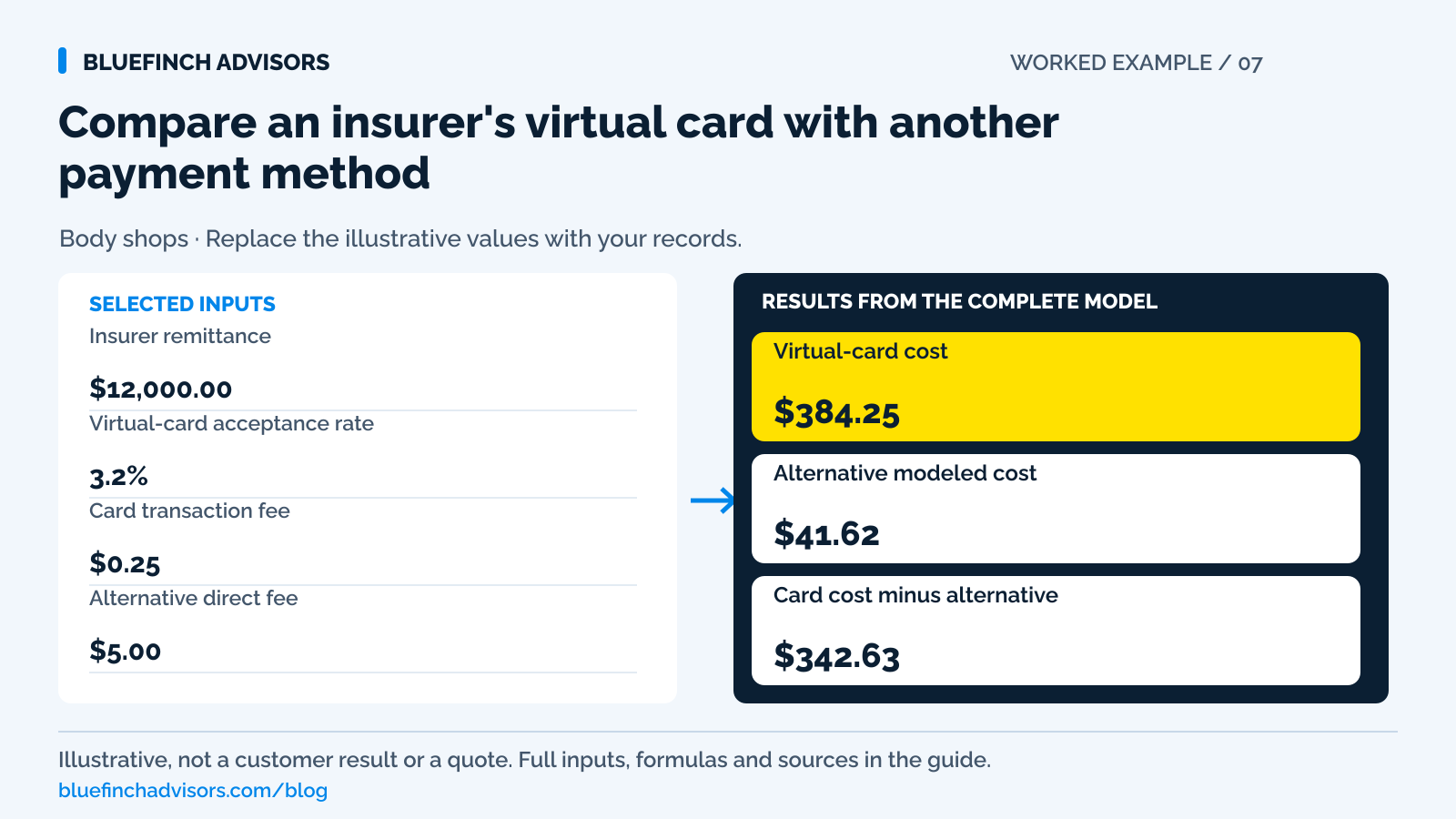
Insurer remittance The same gross amount must be due under both options. | $12,000.00 |
Virtual-card acceptance rate Actual or clearly labeled estimated rate for this entry method. | 3.2% |
Card transaction fee Fixed fee on this one payment. | $0.25 |
Alternative direct fee Bank, provider, or other direct receipt fee. | $5.00 |
Additional handling minutes Incremental work to obtain and reconcile the alternative. | 15 |
Loaded hourly office cost Use a consistent labor-cost estimate. | $36.00 |
Extra days until available funds Relative to the virtual-card funding date. | 7 |
Annual cash-carrying rate Illustrative internal estimate, not a financing quote. | 12% |
Example results
| Measure | Result |
|---|---|
Virtual-card cost Percentage plus one transaction fee. | $384.25 |
Alternative modeled cost Direct fee plus incremental labor and delay cost. | $41.62 |
Card cost minus alternative Positive favors the alternative on entered costs only. | $342.63 |
Calculation detail
| Measure | Result |
|---|---|
| Alternative handling cost | $9.00 |
| Extra waiting cost | $27.62 |
| Net virtual-card proceeds | $11,615.75 |
Model assumptions
- All defaults are illustrative; alternatives and fees must be confirmed with the payer and processor.
- Delay cost uses simple interest on a 365-day basis. The alternative pays the same gross amount.
- The comparison excludes unquantified return, dispute, fraud, and collection risk.
Read alongside these results
- Do not process a virtual card and also request a replacement payment without clear payer instructions.
- This model does not authorize surcharging, changing a deductible, or increasing an insurer remittance.
Download this worked example (CSV). Use the interactive version to export your own inputs and results.
Download infographic (PNG) · Download vector (SVG) · Link to the source and methodology

The short version
- Before charging a virtual card, identify the claim, payment amount and other available methods.
- Use actual account terms to compare net proceeds and waiting costs. ACH and checks aren't always free.
- Don't add insurer-payment expenses to the customer's deductible or an unapproved amount to a limited-use card.
The remittance email says an insurer has paid $12,000. Instead of a bank deposit, it contains instructions for a virtual card. The shop still has to process the payment, absorb the applicable acceptance cost, and match the resulting net deposit to the claim. Calling it insurance money does not remove the merchant-account fee.
Before entering the card, confirm which other payment methods are available and the time and delay involved in switching. Compare the full cost of each offered method, rather than assuming the alternative costs nothing. Keep the claim balance and customer's responsibility unchanged.
Use with this guide
Separate payer from payment method
Identify insurer card dollars without confusing them with customer deductibles.
Check actual acceptance cost
Reconcile the virtual-card estimate with the merchant statement.
Review customer pricing separately
Keep an insurer remittance distinct from the shop's approved customer-payment program.
Insurer virtual cards: track expiry and collection status
Track insurer virtual-card expiry, allowed amounts and collection status. Use the body-shop register to keep an issued card separate from a completed payment.
Insurer cards and partial collections: get written approval
Check whether an insurer card permits a proposed partial collection. Use the approval sheet without assuming payment limits or automatic authorization support.
Browse the complete auto body guides and worksheets.
Check your own costs: calculate your effective processing rate or upload a merchant statement for analysis.
Confirm what the virtual card is paying
Match the remittance to the repair order, claim number, payer, and invoice version. Determine whether it covers the initial estimate, one supplement, several claim items, or a balance after an earlier payment. A card number arriving by email is not enough to establish that the entire repair is paid. Keep the payment instructions separate from any assumption about who owes the remaining amount.
Commerce Bank describes insurance virtual cards as one-time card numbers loaded for a specified payment and discusses both opt-in and opt-out approaches. That source supports asking about the actual enrollment and alternative-payment process. It does not establish that every carrier offers the same options or that a shop can impose any price adjustment it chooses. Use the remittance instructions and the payer's confirmed process for this claim.
Sources for this section: Commerce Bank: Virtual cards for insurance claims payments
Check the rate for this card and entry method
Ask the processor what pricing applies to this virtual card and entry method. A keyed commercial-card payment may not cost the same as a customer tapping a card at pickup. Use the complete percentage and transaction fee applicable to the example, then reconcile the actual statement later. If the quote is a blended estimate, label it that way and test a less favorable rate before making the choice.
Do not add an extra amount to a limited-use card without authorization. Its approved amount may be exact, and an added charge can fail or conflict with the payer arrangement. An approved dual-price program for retail customer payments does not automatically reprice an insurer remittance. Keep the customer deductible unchanged unless the actual claim and lawful agreement establish a different responsibility; processing expense alone does not do so.
Sources for this section: Commerce Bank: Virtual cards for insurance claims payments · Visa: U.S. merchant surcharge questions and answers
Confirm the alternative method and when funds would arrive
Contact the payment issuer through a verified channel and ask whether ACH, a check, or another method is available for this remittance. Confirm the enrollment steps, expected issue date, receipt method, fees, and whether the virtual card must be canceled first. Do not process the card while also requesting a replacement payment without a clear instruction, because both routes can remain active and create a duplicate-payment problem.
Price administrative work as well as direct fees. Ten minutes to request a one-time change is different from setting up a reusable payer profile. A mailed check may require more follow-up, bank handling, or availability time. The OCC notes that deposited checks can be subject to holds and that the deposit agreement matters. An announced check issue date is therefore not necessarily the date usable funds reach the shop.
Sources for this section: Commerce Bank: Virtual cards for insurance claims payments · OCC: Availability of deposited check funds
Compare $384.25 with $41.62, not with zero
For an illustrative $12,000 remittance, assume a virtual-card rate of 3.2% plus $0.25. The direct acceptance cost is $384.25. The offered alternative has a $5 direct fee, requires 15 minutes of staff time at a loaded hourly cost of $36, and makes funds available seven days later. Staff time costs $9. Using an illustrative 12% annual cash-carrying rate, seven days costs $27.62 on a 365-day simple-interest basis.
The alternative's modeled cost is $5 + $9 + $27.62 = $41.62. Its cost advantage is $342.63 before unmodeled risks or work. That is a scenario result, not guaranteed savings. If changing the method creates uncertainty, repeated chasing, or a materially longer delay, update those assumptions. The tool keeps the comparison visible so the owner can decide whether the difference is worth pursuing for this payer.
Keep payment records without copying card credentials
Limit access to payment instructions and follow the approved provider process for entry and retention. The useful accounting record is the claim reference, amount, masked transaction identifier, and payment status. Avoid copying the full card number into estimator notes, a shared spreadsheet, or a general-purpose chat. A convenient search field can become an uncontrolled payment-data store.
PCI SSC specifically prohibits retaining card verification codes after authorization, even if someone gives permission. If a payer's instructions appear to invite printing or saving full payment credentials, reconcile that with the shop's own PCI obligations and processor guidance before retaining them. Keep the remittance record needed to prove allocation without retaining sensitive authentication data that the office does not need for future reconciliation.
Sources for this section: PCI SSC: Card verification code storage
Apply the gross payment to the claim and the fee to expense
If the shop processes the full authorized $12,000 virtual-card payment, the claim payment record should reflect that gross collection under the accounting workflow. The smaller bank payout also reflects processing expense and any other deductions. Do not leave the carrier looking short solely because the deposit is net of the shop's fee. Conversely, do not mark the claim paid when the card has merely been issued and never successfully captured.
Link the card transaction to its payout and attach the remittance allocation. If the payment covers more than one item, document that allocation before closing balances. If a later refund or duplicate payment appears, identify the original route before acting. Stripe's refund documentation illustrates why that history matters: a normal card refund returns to the original payment method rather than an arbitrary new destination. Follow the actual provider's rules for the account.
Sources for this section: Stripe: Refund and cancel payments
Verify the first payment before setting a preferred payer route
One successful alternative payment can justify documenting a preferred route for that payer. Record the contact, enrollment reference, remittance delivery method, expected timing, and exception process. Do not assume the preference applies across every carrier subsidiary, claim administrator, or fleet program. A later payment may arrive through a different issuer with different choices.
Review the first few receipts against the modeled cost and delay. If the alternative saves fees but consistently requires an hour of chasing, price that work. If virtual cards arrive reliably and a replacement check takes much longer than promised, adjust the cash assumptions. The next action is concrete: take one pending remittance, obtain the actual alternatives, enter their costs, and resolve the choice before processing the card or requesting its cancellation.
Sources for this section: Commerce Bank: Virtual cards for insurance claims payments
Questions business owners ask
Is an insurer virtual card automatically free for the body shop?
No. It is processed through the merchant account under the applicable card and entry-method pricing. Confirm the actual fee before comparing it with an alternative.
Can the card fee be added to the vehicle owner's deductible?
Do not treat the shop's acceptance expense as an automatic change to the deductible. Claim responsibility, customer authorization, contract terms, and any approved pricing program are separate questions.
Does the tool assume ACH costs nothing?
No. It includes an editable direct alternative-payment fee, staff handling cost, and the cost of additional waiting time. Other risks and costs must be added to the decision separately.
Primary sources
BlueFinch last reviewed these sources on October 2, 2026. Payment rules and state requirements can change.
- Commerce Bank: Virtual cards for insurance claims payments
- Visa: U.S. merchant surcharge questions and answers
- OCC: Availability of deposited check funds
- PCI SSC: Card verification code storage
- Stripe: Refund and cancel payments
Use this page for general business information. It is not legal, tax, or accounting advice.