Check balances after a paid invoice changes
Check the revised payer allocation, then subtract each payer's prior collections from its own total.
Use the interactive tool without signing up. It runs in your browser: enter your numbers, save a comparison, download results or print a working copy. Your numbers are not sent to BlueFinch.
Illustrative example inputs
These starting values show how the math works. They are not industry averages, customer results or a quote.
| Input | Example value |
|---|---|
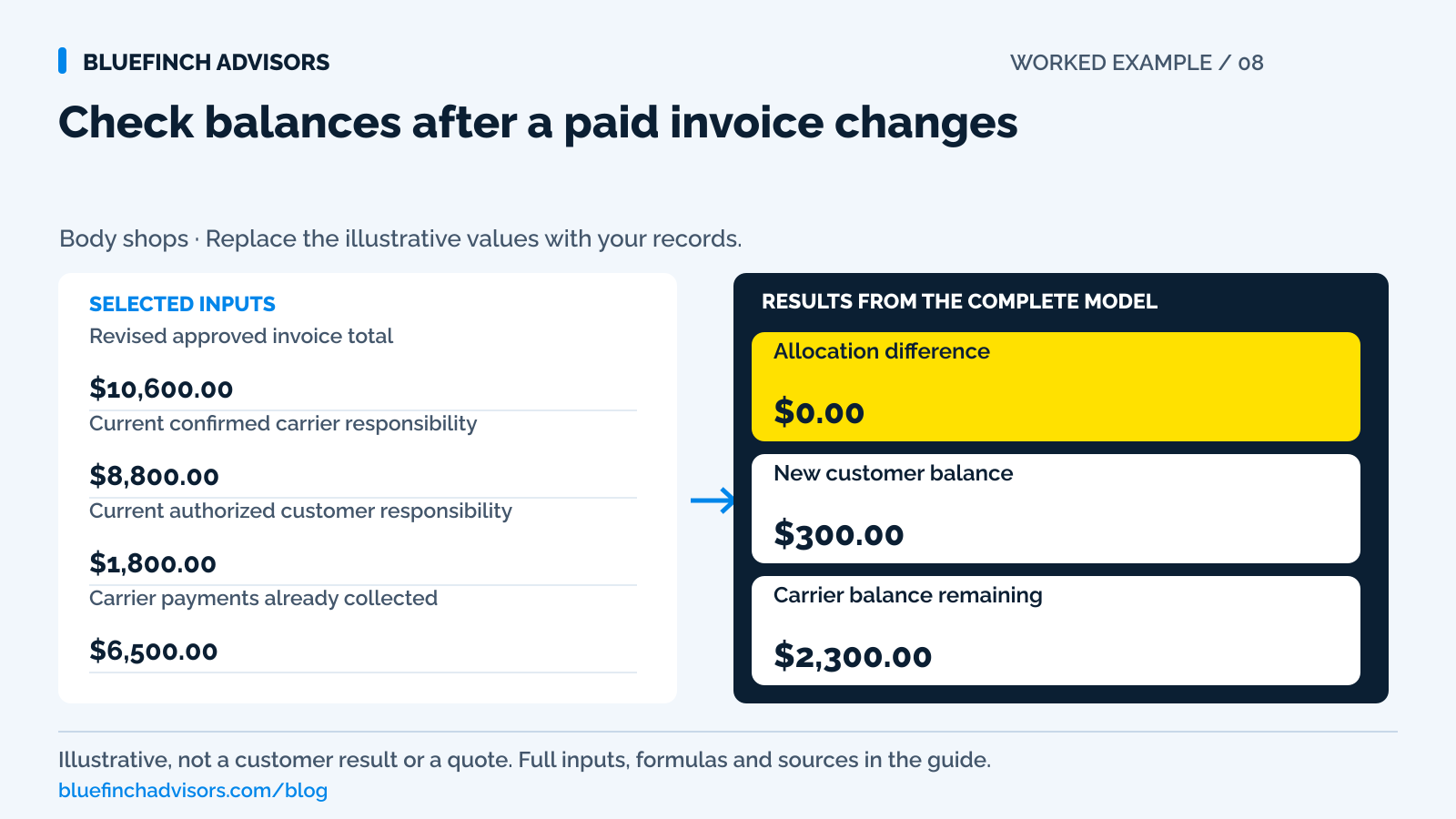
Revised approved invoice total Current version on a consistent tax and pricing basis. | $10,600.00 |
Current confirmed carrier responsibility Total approved carrier allocation, not only the supplement. | $8,800.00 |
Current authorized customer responsibility Total customer allocation supported by the actual agreement. | $1,800.00 |
Carrier payments already collected Exclude pending or duplicate remittances. | $6,500.00 |
Customer payments already collected Net of any completed reversals or refunds. | $1,500.00 |
Example results
| Measure | Result |
|---|---|
Allocation difference Resolve any nonzero amount before using payer balances. | $0.00 |
New customer balance Negative means an overpayment or credit to review. | $300.00 |
Carrier balance remaining Keep this in carrier receivables, not an automatic customer request. | $2,300.00 |
Calculation detail
| Measure | Result |
|---|---|
| Combined confirmed allocation | $10,600.00 |
| Payments already collected | $8,000.00 |
| Total invoice balance | $2,600.00 |
Model assumptions
- All defaults are illustrative. Carrier and customer totals are confirmed allocations, not assumptions about coverage.
- All amounts use the same invoice version and price basis.
- The calculator does not change deductibles or decide repair authorization or vehicle-release rights.
Read alongside these results
- A zero allocation difference does not prove approvals or coverage; verify the supporting records.
- Cancel stale payment requests and check for an existing collection before sending a revised link.
Download this worked example (CSV). Use the interactive version to export your own inputs and results.
Download infographic (PNG) · Download vector (SVG) · Link to the source and methodology

The short version
- Confirm the revised split between payers before collecting a supplement.
- Subtract actual prior customer payments from the customer's newly authorized total.
- Record insurer approval, customer repair consent and successful payment separately.
The customer already paid $1,500. Then the estimate gains a $2,600 supplement. Sending a $2,600 payment request would be wrong if the carrier has approved $2,300 of that increase and only $300 is newly authorized customer-pay work. The supplement amount is a scope change; it is not automatically the customer's new balance.
When an invoice changes after payment, save each version and check the payer allocation again. Keep the original receipt, revised allocation and newly approved customer responsibility together. This guide covers that post-payment change, rather than deductibles generally or the shop's overall card volume.
Use with this guide
Review the original payer buckets
Use the broader deductible and supplement guide when building the initial allocation.
Update the delivery file
Keep revised balances and payment receipts with the release record.
Trace a sublet-driven supplement
Connect a changed sublet operation to its authorization and billing evidence.
Body-shop sublet prepayments: measure the approval gap
Compare body-shop sublet cash due with collected job funds. Use the funding worksheet to keep an approved supplement separate from cash available for a vendor.
Browse the complete auto body guides and worksheets.
Revise the payer allocation and preserve the old receipt
Save the pre-supplement invoice and its payment history. Add the new estimate version, the operations that changed, and the current status of each payer decision. The old receipt still proves the payment it recorded. Replacing it with a receipt showing a new amount would blur what the customer previously paid and make later questions harder to answer.
Progressive explains that additional damage can be found during repairs and that it works with the shop on an updated estimate. That describes its claim process, not a guarantee that every requested operation will be covered. Identify whether each changed amount is approved by the carrier, separately authorized by the customer, or still unresolved. An estimator's expectation of coverage should not be entered as a confirmed payment or a settled payer allocation.
Sources for this section: Progressive: Car repair estimate and payment questions
Keep repair consent separate from the payer's decision
A carrier agreeing to an amount and a customer authorizing work are related but distinct events. Document the applicable repair authorization and any changed customer responsibility. California BAR's guidance expressly addresses changed work, supplementary communications, and third-party estimates. Its requirements are California-specific; shops elsewhere should use their own applicable process rather than treating an insurance approval as a universal substitute for consent.
When responsibility is unresolved, say so in the internal record. Do not label an amount customer-pay simply because a carrier has not answered yet. Also do not represent a pending supplement as paid. The practical control is an allocation check: the revised invoice should equal confirmed carrier responsibility plus confirmed customer responsibility, with any difference clearly flagged for resolution before it is used to generate a payment request.
Sources for this section: California BAR: Write It Right
The new customer link is $300, not $2,600
Start with an $8,000 invoice allocated to $6,500 from the carrier and $1,500 from the customer. Both amounts have been collected. A documented $2,600 supplement brings the invoice to $10,600. In this illustration, the revised approved carrier total is $8,800 and the newly authorized customer total is $1,800. Those allocations add to the revised invoice, so the allocation difference is zero.
The carrier still owes $8,800 - $6,500 = $2,300. The customer still owes $1,800 - $1,500 = $300. The shop should communicate the $300 customer balance with the approval and credit for the earlier payment. Asking the customer for the full $2,600 would confuse carrier receivables with customer responsibility. Asking for $1,800 would ignore money already collected. The example is illustrative and does not change any deductible by assumption.
Retire payment requests that no longer match the invoice
Look for an earlier unpaid text link, email invoice, saved checkout, or printed balance notice. A customer can follow an old link after the office has corrected the internal record. If the system cannot update the amount safely, cancel or expire the obsolete request using its supported process and send one new request with the current version. Retain the old reference so its cancellation can be traced.
The new message should identify the repair order, revised total, customer responsibility, prior payment credit, and amount now requested. If an approved dual-price program applies, use its verified display and tender rules for this newly authorized customer payment. Do not silently recalculate earlier collected payments at today's configuration, and do not apply a customer card-price adjustment to the carrier's $2,300 receivable merely because both amounts came from one supplement.
Sources for this section: Visa: U.S. merchant surcharge questions and answers
Confirm earlier payments before subtracting them
An earlier card approval, a check handed over without required processing steps, or a screenshot saying payment sent may not have the same status as a successful collection. Reconcile the customer payment history with the provider and bank using the shop's normal accounting treatment. Exclude payments that were voided, refunded, reversed, or entered twice. Show pending items as pending instead of using them to erase the customer's balance.
Also check whether someone already collected part of the new amount by phone or at pickup. When the estimator and cashier both act on a supplement, duplicate collection can happen even if each uses a correct invoice version. Assign one person to release the final payment request after reviewing the complete payment history. Record the transaction reference on the repair order as soon as collection succeeds.
Sources for this section: Stripe: Place a hold on a payment method · Stripe: Refund and cancel payments
Treat a negative result as a credit review
The revised allocation can reduce customer responsibility. If the authorized customer total becomes $1,300 after $1,500 was paid, the signed customer balance is negative $200. Leave that value visible. It may represent a refund due, a credit to apply under an agreed arrangement, or an input error. The arithmetic does not determine which remedy is legally or contractually appropriate.
Confirm the change and identify the original payment route before issuing a refund. Stripe's documentation illustrates that a normal card refund returns to the original payment method and may leave the original acceptance fee unrecovered. Keep the revised customer allocation, approval of the correction, refund reference, and final status together. If a dispute is already open or a refund is pending, coordinate through the provider to avoid paying the same correction twice.
Sources for this section: Stripe: Refund and cancel payments
Follow up with the insurer for the insurer's balance
A zero customer balance can coexist with an unpaid carrier supplement. Keep those two statuses distinct in the repair file. The shop's vehicle-release decision depends on its agreements and applicable law; this worksheet does not authorize holding or releasing a vehicle. It simply prevents an insurer receivable from being disguised as an extra customer checkout amount.
Give the carrier balance a claim reference, expected payment route, follow-up date, and owner. After the payment arrives, apply it to the correct invoice version and reconcile any difference. A short payment should reopen the payer review, not trigger an automatic charge to a card on file. Customer authorization for an earlier amount does not answer every later dispute about who is responsible for an unpaid operation.
Sources for this section: Progressive: Car repair estimate and payment questions · California BAR: Write It Right
Keep a short record of what changed and who approved it
A manager reviewing the job should be able to see the original invoice, the supplement, the revised allocation, prior collections, and the remaining balances without opening six unrelated message threads. Keep a short change note: what changed, who approved it, which payer amount changed, and which payment request replaced the old one. This is especially useful when a supplement is resolved after a different advisor takes over the job.
Before the next post-payment supplement goes to a customer, run the allocation check and the prior-payment check. Resolve a nonzero allocation difference first. Then send only the supported customer amount, with the earlier credit visible. The process ends when the revised payer totals reconcile and each outstanding amount has the correct payer, payment reference, and follow-up owner.
Sources for this section: California BAR: Write It Right
Questions business owners ask
Does an approved supplement automatically increase the deductible?
No. Use the policy and confirmed payer allocation. A larger repair total is not, by itself, a new deductible or a new customer payment obligation.
What does a nonzero allocation difference mean?
The revised invoice does not equal the entered carrier and customer totals. Find the missing, overlapping, or unresolved allocation before using the result for collection.
Can the saved card be charged when the carrier pays short?
Do not assume so. Resolve the payer responsibility and obtain whatever customer authorization and payment consent are required for the actual additional charge.
Primary sources
BlueFinch last reviewed these sources on October 2, 2026. Payment rules and state requirements can change.
- Progressive: Car repair estimate and payment questions
- California BAR: Write It Right
- Visa: U.S. merchant surcharge questions and answers
- Stripe: Place a hold on a payment method
- Stripe: Refund and cancel payments
Use this page for general business information. It is not legal, tax, or accounting advice.