Price a measured commercial-film revision
Calculate the revised customer balance from verified area differences and approved access changes.
Use the interactive tool without signing up. It runs in your browser: enter your numbers, save a comparison, download results or print a working copy. Your numbers are not sent to BlueFinch.
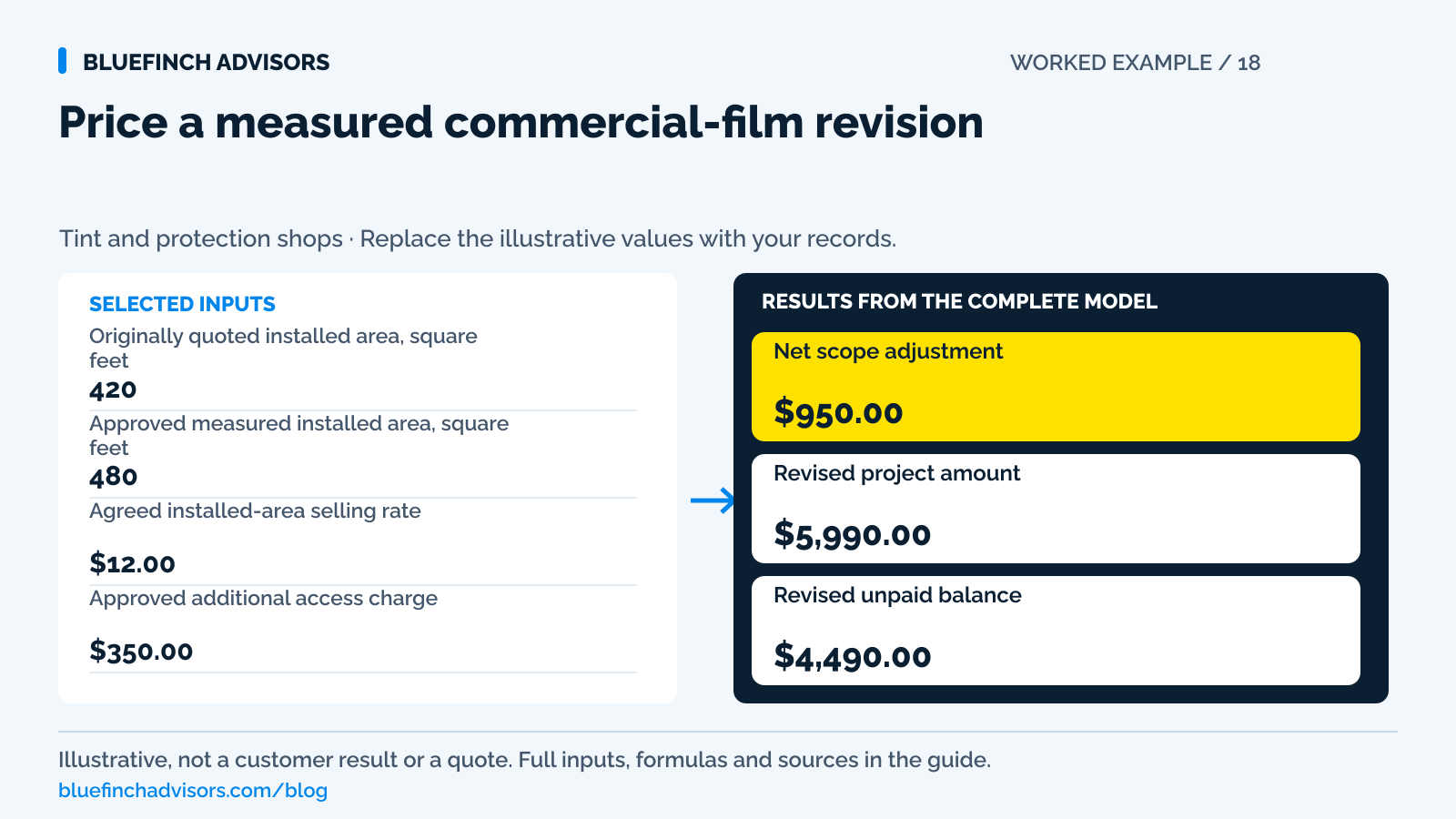
Illustrative example inputs
These starting values show how the math works. They are not industry averages, customer results or a quote.
| Input | Example value |
|---|---|
Originally quoted installed area, square feet Customer-billable glass area, not roll area or waste. | 420 |
Approved measured installed area, square feet Comparable area after agreed inclusions and exclusions. | 480 |
Agreed installed-area selling rate One consistent rate in dollars per square foot. | $12.00 |
Approved additional access charge Incremental lift or access adjustment outside the area rate. | $350.00 |
Separate agreed price credit For example, waived preparation included in the original installed price. Do not credit excluded glass twice. | $120.00 |
Payments already applied Completed payments on this project, net of refunds. | $1,500.00 |
Example results
| Measure | Result |
|---|---|
Net scope adjustment Area change at the agreed rate plus access less other removed scope. | $950.00 |
Revised project amount Assumes the original quote consisted of quoted area times this rate. | $5,990.00 |
Revised unpaid balance Negative reveals an overpayment to review. | $4,490.00 |
Calculation detail
| Measure | Result |
|---|---|
| Original area-based quote | $5,040.00 |
| Area-only adjustment | $720.00 |
Model assumptions
- Starting values are examples, not market benchmarks or payment quotes.
- Use one currency and a consistent before-tax basis. Work out taxes and program-specific adjustments separately.
Read alongside these results
- The original quote must match quoted area times the entered rate. Model complex mixed-rate quotations separately.
- This does not approve film-to-glass compatibility, building access, tax treatment, or a customer's authority to approve work.
Download this worked example (CSV). Use the interactive version to export your own inputs and results.
Download infographic (PNG) · Download vector (SVG) · Link to the source and methodology

The short version
- Measure installed glass area separately from purchased film and cutting waste.
- Approve scope and access revisions before requesting another payment.
- Keep the original quote and apply the original deposit to the revised total once.
The estimate used drawings. The site measure reveals more glass, a few excluded panes, and an access requirement the first visit missed. The customer may already have paid a deposit. Sending a larger progress invoice without a scope explanation makes a measurement correction look like an arbitrary price increase.
Compare the quoted scope with the approved site measurements before collecting a revised amount. This is separate from planning construction milestones or ordering film. The calculator uses one agreed rate for installed area, a separate access adjustment and a credit for removed non-area work. It shows the revised total and balance after earlier payments for you to review.
Use with this guide
Plan commercial-film progress payments
Apply the approved scope to a realistic milestone collection schedule.
Check the revised cash timeline
Put added access and material commitments beside collection dates.
Test revised invoices and credits
Check whether the payment system preserves the current customer balance.
Track a commercial film inquiry from site visit to accepted proposal
A site visit, written proposal and accepted scope are separate records. Count one defined project cohort before interpreting your commercial film pipeline.
Browse the complete window tint guides and worksheets.
Agree which measurement sets the customer's price
Installed glass area, purchased roll area, and cut material are different quantities. Agree which one the quote uses. For an installed-area price, keep a pane schedule with dimensions, quantity, location, and inclusion status. Record whether frames, mullions, unusual shapes, or minimum charges affect the billable calculation. A revised square-foot total should be reproducible from the schedule rather than existing only in the salesperson's calculator.
Separate a measuring correction from a product-selection change. The IWFA explains that suitability on low-emissivity glass depends on the glass construction and film objectives, and it points to manufacturer film-to-glass guidance for thermal considerations. More measured area does not establish that the originally quoted film is suitable everywhere. Have the responsible installer verify the product application before asking the customer to approve a larger bill for an unsuitable scope.
Sources for this section: IWFA: film-to-glass compatibility and window-film FAQs
Keep the original estimate and the site revision side by side
Identify the drawing or estimate version, site-measure date, revised pane schedule, added access work, and removed items. Photographs and room identifiers help the customer's facilities contact understand the difference. A table showing quoted area and verified area is more useful than a single unexplained new total. If the customer supplied measurements, describe the correction factually without turning the payment conversation into a dispute about blame.
Do not automatically charge every difference to the customer. A fixed-price agreement may assign measurement risk differently from an estimate subject to survey. Review what was promised and who can approve a variation. This calculator models a change that the parties agree may be priced; it does not create a right to collect it. Where the contractual position is disputed, pause the affected extra work and resolve the approval with the actual decision maker.
The measured revision adds $950 to the sample project
The illustrative original quote is 420 square feet at $12, totaling $5,040. Approved measured area is 480 square feet. The 60-square-foot increase adds $720. A separately approved access adjustment adds $350, while waived preparation that was included in the original installed price earns an agreed $120 credit. Net change is $720 plus $350 minus $120, or $950. The revised project amount is $5,990.
With $1,500 already paid, the revised unpaid balance is $4,490. That is not automatically the next progress payment; use the agreed payment schedule to decide what is due now. The calculation assumes the original quote was purely area times rate. If the original included other fixed charges or several rates, reproduce those lines separately instead of entering an average that hides a material change. And do not subtract excluded glass again as removed scope after it has already reduced measured area.
Approve the new payment presentation with the new scope
For dual pricing, update the customer-facing regular card and lower cash amounts before sending the revision for acceptance. The scope increase and the payment-price difference should be understandable as separate decisions. If the facilities team approved one amount but accounting intends to use another tender, confirm the actual amount that will be requested. Do not let a stale online link retain the old balance while the estimator emails the new one.
A surcharge setup has different rules from dual pricing or a cash discount. Mastercard excludes debit and prepaid from its surcharge permissions, and Visa's guidance includes advance acquirer notification. The model does not apply those rules as a universal percentage formula. Confirm the approved program, supported remote channel, and applicable requirements with the provider. ACH and other alternatives can carry fees too; the customer should choose from the actual disclosed options.
Sources for this section: Mastercard: merchant surcharge rules and debit exclusions · Visa: merchant fees, rules, and surcharge disclosure
List access costs separately from area charges
A lift, after-hours access, furniture movement, or a restricted work window can change the job even if the glass area stays constant. Price agreed changes on their own lines. An area-rate increase used to hide access cost makes the next comparison difficult: the customer cannot tell whether it is paying for more film, a different product, or a different installation plan. Staff also lose the information needed to schedule the work properly.
Identify who supplies access equipment, who clears the work area, and what happens if the agreed conditions are not available. Those terms belong in the commercial revision, not in an improvised charge at the building entrance. When a customer removes an area, verify whether the access cost actually falls. The calculator permits a negative area adjustment while a positive access adjustment remains; that can be a legitimate result if both changes are explained and approved.
Reconcile the revised balance before the final handover
At completion, compare installed areas with the approved revised pane schedule and note any further agreed exclusions. Apply earlier payments and approved credits once. If the customer overpaid, use the provider's documented refund path and record the status. Stripe's refund documentation, for example, routes money back to the original payment method and distinguishes pending or failed refunds from completed ones. The shop should verify its own provider's equivalent process.
Keep the product and warranty documents with the installed-area record. Manufacturer coverage is not a substitute for a signed change order, and a paid invoice is not evidence that every quoted pane was completed. The next useful step is to take one upcoming measured revision through the entire chain: surveyed scope, customer approval, current payment request, actual installation, and final balance. Any mismatch found there is cheaper to fix than an unexplained bill after the crew has left.
Sources for this section: Stripe: refund destinations, partial refunds, and refund status · 3M: separate warranty resources for wrap, PPF, and window film
Questions business owners ask
Does the calculator include film cutting waste?
No. It uses the customer-billable installed area. Determine material purchasing and waste separately so roll consumption does not silently change an installed-area agreement.
Is the revised unpaid balance the amount due immediately?
Not necessarily. It is the total unpaid project amount. The approved milestone schedule determines the next collection date and amount.
Can we use it with a mixed-film quote?
Only if you calculate each consistent rate group separately and reconcile the fixed charges. A single blended rate can conceal which product or scope actually changed.
Primary sources
BlueFinch last reviewed these sources on October 2, 2026. Payment rules and state requirements can change.
- IWFA: film-to-glass compatibility and window-film FAQs
- Mastercard: merchant surcharge rules and debit exclusions
- Visa: merchant fees, rules, and surcharge disclosure
- Stripe: refund destinations, partial refunds, and refund status
- 3M: separate warranty resources for wrap, PPF, and window film
Use this page for general business information. It is not legal, tax, or accounting advice.
Related resources
- 2026 Credit Card Processing Cost Report
- Window Tint Shop Payment Guide
- Window Tint Shop Credit Card Processing Calculator
- Commercial window film: schedule payments by installation stage
- Tint Booking, POS, and Payment Integration Scorecard
- Tint deposit transfers: keep a rebooking credit ledger that balances