Check cash needed before final event payment
Compare commitments due before the final payment arrives with deposit proceeds available by that cutoff.
Use the interactive tool without signing up. It runs in your browser: enter your numbers, save a comparison, download results or print a working copy. Your numbers are not sent to BlueFinch.
Illustrative example inputs
These starting values show how the math works. They are not industry averages, customer results or a quote.
| Input | Example value |
|---|---|
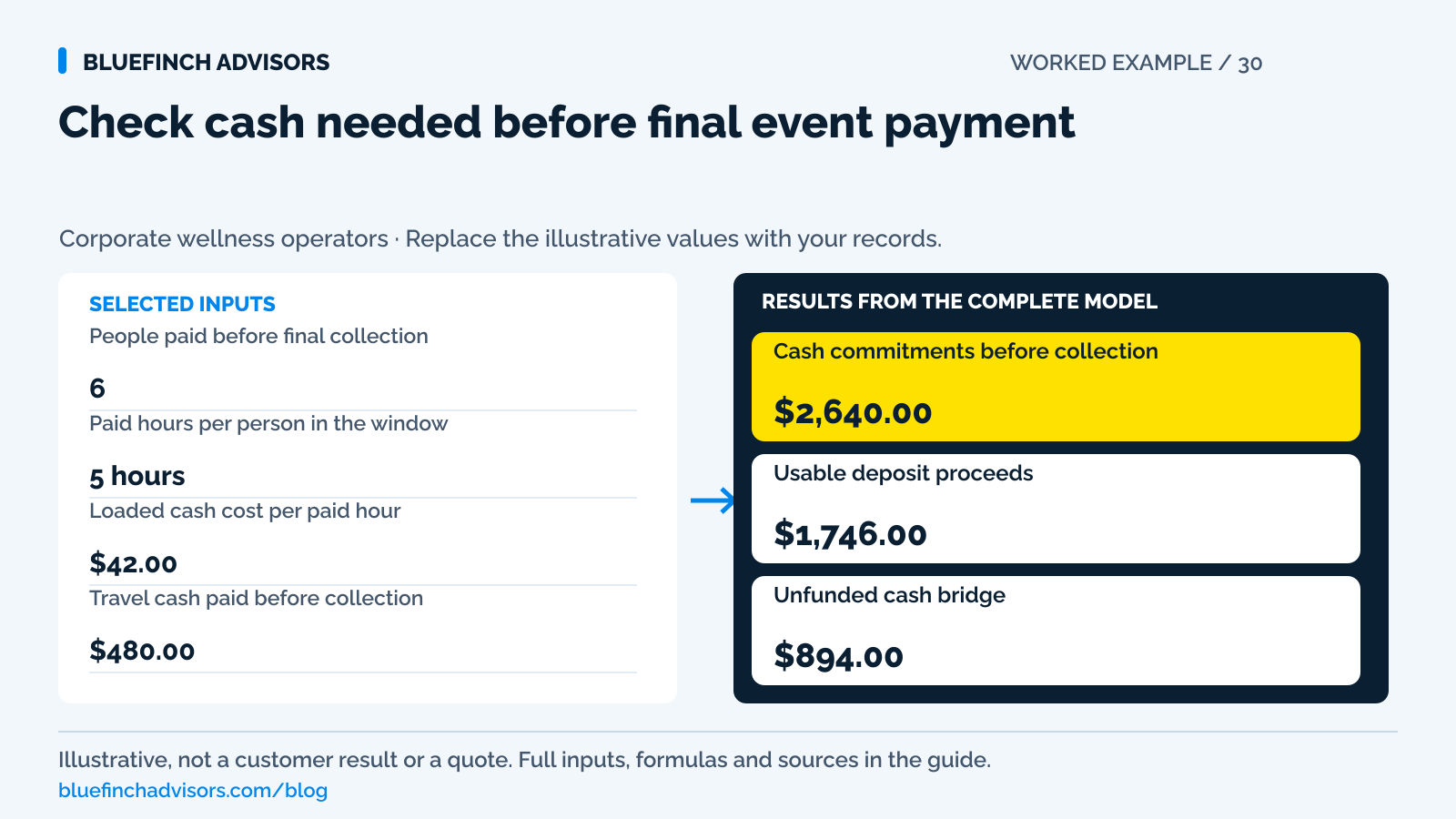
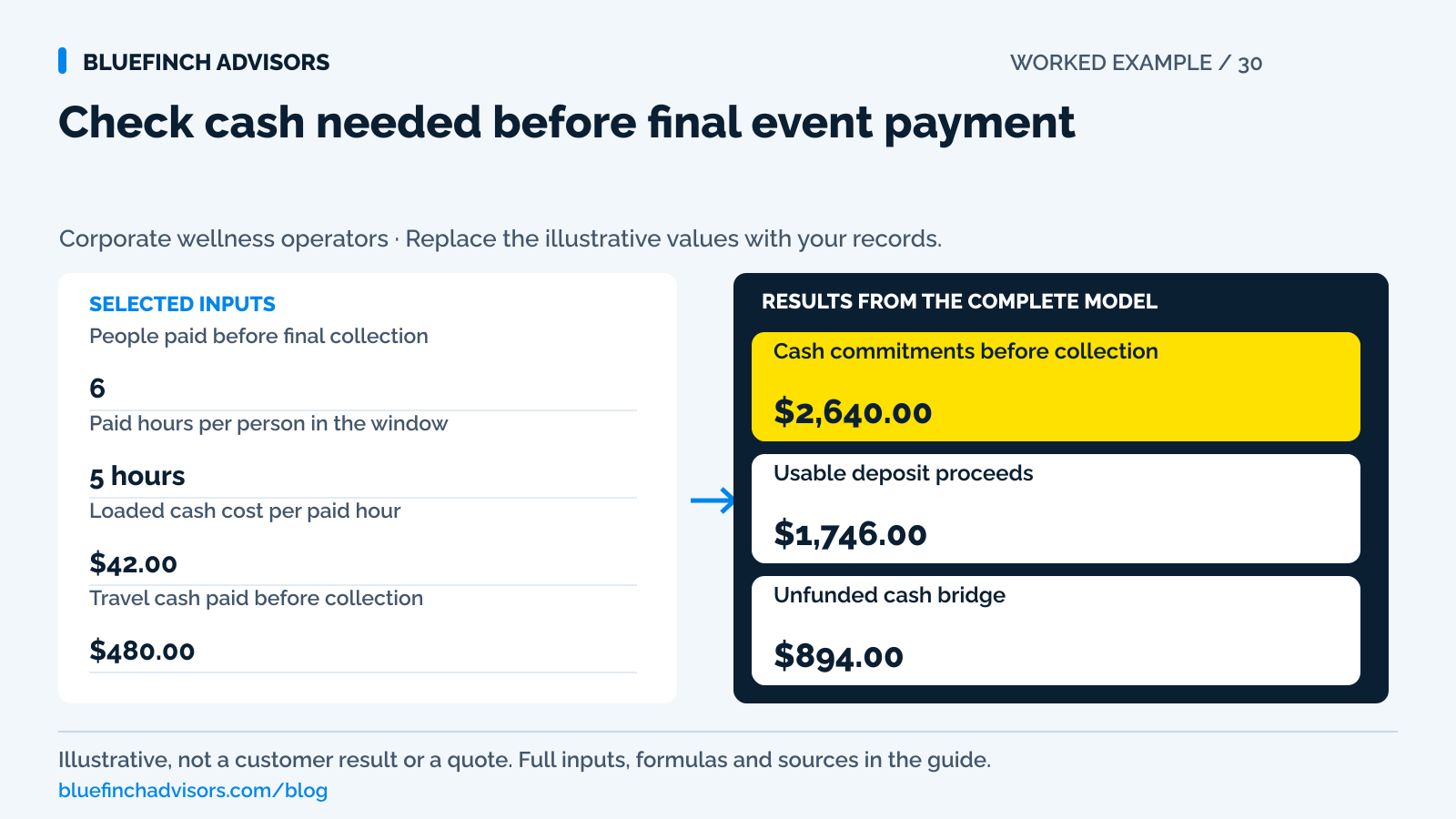
People paid before final collection Only staff whose cash payment falls within this window. | 6 |
Paid hours per person in the window Include authorized setup, travel, delivery, and closeout hours. | 5 hours |
Loaded cash cost per paid hour Use your actual approved cost basis. | $42.00 |
Travel cash paid before collection Transport and other travel payments within the window. | $480.00 |
Supplier cash due before collection Approved event-specific commitments due before the customer's final cash arrives. | $900.00 |
Customer deposit collected Gross payment actually collected, not merely invoiced. | $1,800.00 |
Retained costs on deposit Actual payment costs reducing usable deposit proceeds. | $54.00 |
Example results
| Measure | Result |
|---|---|
Cash commitments before collection Staffing cash plus travel and suppliers due in this window. | $2,640.00 |
Usable deposit proceeds Gross collected deposit less retained payment costs. | $1,746.00 |
Unfunded cash bridge Positive means business cash is needed; negative means deposit proceeds exceed these commitments. | $894.00 |
Calculation detail
| Measure | Result |
|---|---|
| Staff cash | $1,260.00 |
| Travel plus supplier cash | $1,380.00 |
| Deposit payment costs | $54.00 |
Model assumptions
- Illustrative single-cutoff cash model; not a total-event profit statement.
- All entered deposit proceeds are assumed available by the cutoff. Pending funds must be excluded or modeled at a later date.
Read alongside these results
- A deposit balance is not automatically earned profit or legally nonrefundable.
- Re-run for each material payment date; one cutoff cannot reveal every cash trough.
Download this worked example (CSV). Use the interactive version to export your own inputs and results.
Download infographic (PNG) · Download vector (SVG) · Link to the source and methodology


The short version
- Include cash due before final collection; keep later costs in the full event budget.
- Count a deposit only when its proceeds are available under your payment setup.
- Track employer approval, card authorization and bank arrival as separate milestones.
An employer books a wellness event and asks for a final invoice after delivery. The team must be scheduled, travel booked, and some suppliers paid before that invoice clears. The event can be profitable and still require a cash bridge the business has not planned.
This worksheet sizes that bridge at one chosen cutoff. It does not set a universal deposit percentage or decide employment, travel, insurance, or clinical requirements. The event scope and staffing must already be approved. The fictional example focuses on when cash is needed, not on health outcomes or promised employee productivity.
Use with this guide
Corporate ACH versus card comparison
Choose a collection route with realistic costs and timing.
Mobile event payment checklist
Test readers, receipts, and field collection before the event.
Milestone cash-flow planner
Extend the single-cutoff model into a full event timeline.
Browse the complete wellness center guides and worksheets.
Turn the employer booking into a collection schedule
Confirm the employer's legal billing name, event date, approved scope, purchase-order requirement, deposit amount, final invoice milestone, and accounts-payable contact. An enthusiastic coordinator may not control vendor setup or invoice approval. Resolve those handoffs before staffing commitments become difficult to change.
Ask what makes the invoice payable: a signed event completion form, attendance total, purchase order, or other agreed evidence. This is an operating request, not permission to send participant health information to the employer. Keep the invoice description limited to the authorized commercial scope.
Create two dates for each expected payment: the date the buyer must act and the date usable funds are expected. A card approval, a promised check, and a pending ACH are not identical cash positions. Use the actual payment provider and bank timing for the contract you are considering.
Sources for this section: Stripe: balance reporting and available versus pending funds
Budget paid time outside the event itself
A two-hour event can require setup, travel, preparation, and closeout. Use the approved paid hours and cash costs for the people assigned. Do not assume that the owner, coordinator, or practitioner works those additional hours without cost simply because the client never sees them on the program schedule.
Include only cash paid before the chosen collection cutoff in this model. If a supplier invoice is due after the final customer payment, it belongs in the total event economics but not in this particular pre-collection bridge. Keep a dated commitment list so that distinction is visible and reproducible.
Separate costs already paid from costs that are still cancelable. Both can matter to a go/no-go decision, but they create different choices if the employer changes the date. The calculator totals cash exposure. It does not label a customer deposit nonrefundable or authorize retaining it.
The illustrative event needs a $894 bridge
Six people are paid for five hours each at a loaded cash cost of $42 an hour. Staffing cash is $1,260. Add $480 of travel and $900 of supplier cash due before final collection. Total pre-collection commitments are $2,640.
The employer's collected deposit is $1,800. Retained payment costs of $54 leave $1,746 usable. Subtract that amount from $2,640 and the business needs a $894 cash bridge. The result does not say whether the entire event is profitable. The final invoice and later costs are outside this cutoff.
If the deposit has only been authorized and none of it is available, enter zero for both Customer deposit collected and Retained costs on deposit when no payment cost has been incurred. The bridge is then $2,640. If $54 has already been incurred and must be funded in this window, keep that cost at $54 while setting the deposit to zero. The bridge becomes $2,694. That temporary gap is why collection dates deserve as much attention as the stated deposit percentage.
Check whether a ticket platform holds the receipts
Some employer events also use attendee registration or ticketing. If the platform collects money, read its payout schedule before using ticket sales to fund payroll. Eventbrite's documentation describes a default payout sent after the event, with custom schedules available and bank arrival taking additional time. Your actual eligibility and schedule control.
Ticketing fees can also be absorbed by the organizer or charged to attendees under the platform's rules. Eventbrite distinguishes service and payment-processing components. A ticket's advertised price, total buyer payment, and organizer proceeds can therefore differ. Use the amount actually available to the business in the cash plan.
Keep employer-funded attendance separate from individually purchased tickets. A participant checked in under an employer contract is not automatically a new retail sale. Counting both the employer invoice and an internal attendee value as cash would overstate funding.
Sources for this section: Eventbrite: payment processing, fees, and payout timing · Eventbrite: ticketing fees and who pays them
Compare the employer's payment choices before quoting
If the buyer asks to pay by corporate card, price the actual acceptance cost and funding schedule. ACH can also carry bank, gateway, return, or administrative costs. It is not universally free. The best collection route depends on the agreement, the buyer's process, and the cash deadline.
For a dual-pricing proposal, show the approved prices before the buyer authorizes payment and confirm that the invoicing workflow supports them. Do not add a surprise charge after the employer approves a purchase order. Visa distinguishes displayed cash/card pricing from a surcharge, and its surcharge rules exclude debit and prepaid cards.
Keep the merchant's retained costs in the event model even when eligible-credit processing is priced at zero. Monthly software, debit, account fees, and other charges can remain. Allocate only relevant costs here, and use a full monthly audit for the broader provider comparison.
Sources for this section: Visa: U.S. merchant surcharging and displayed-price distinctions
Recalculate when headcount or timing changes
An extra room, later finish, or increased attendance can alter staffing cash before it changes the invoice. Record the scope change, the authorized additional amount, and the collection milestone before committing the extra resources. A vague promise that accounts payable will sort it out later is not a funding plan.
If the event is canceled, follow the approved agreement and applicable requirements. Separate supplier recovery, staff obligations, customer refunds, and processor refund timing. Eventbrite, for example, requires refunds for canceled events under its platform rules. A private employer contract may have different provisions requiring its own review.
The next action is a one-page dated schedule signed off by the person approving staff and the person collecting payment. Run the calculator at the first supplier payment, payroll date, and final collection date. That makes the maximum bridge visible before the team arrives on site.
Sources for this section: Eventbrite: setting and managing refund policies
Questions business owners ask
Is this a recommended deposit percentage?
No. It measures a specific cash window. Contract terms, customer obligations, and cancellation treatment require separate approval.
Should I include all event labor?
Include labor cash paid before the chosen final-collection date. Track the remaining labor separately in the full event budget.
Can I use ticket sales shown in the dashboard?
Only to the extent those proceeds will actually be available by the cutoff. Confirm payout timing and deductions first.
Primary sources
BlueFinch last reviewed these sources on October 2, 2026. Payment rules and state requirements can change.
- Stripe: balance reporting and available versus pending funds
- Eventbrite: payment processing, fees, and payout timing
- Eventbrite: ticketing fees and who pays them
- Visa: U.S. merchant surcharging and displayed-price distinctions
- Eventbrite: setting and managing refund policies
Use this page for general business information. It is not legal, tax, or accounting advice.