Work out the engine job's funding gap
Compare the collected deposit with costs due before you receive the customer's final payment.
Use the interactive tool without signing up. It runs in your browser: enter your numbers, save a comparison, download results or print a working copy. Your numbers are not sent to BlueFinch.
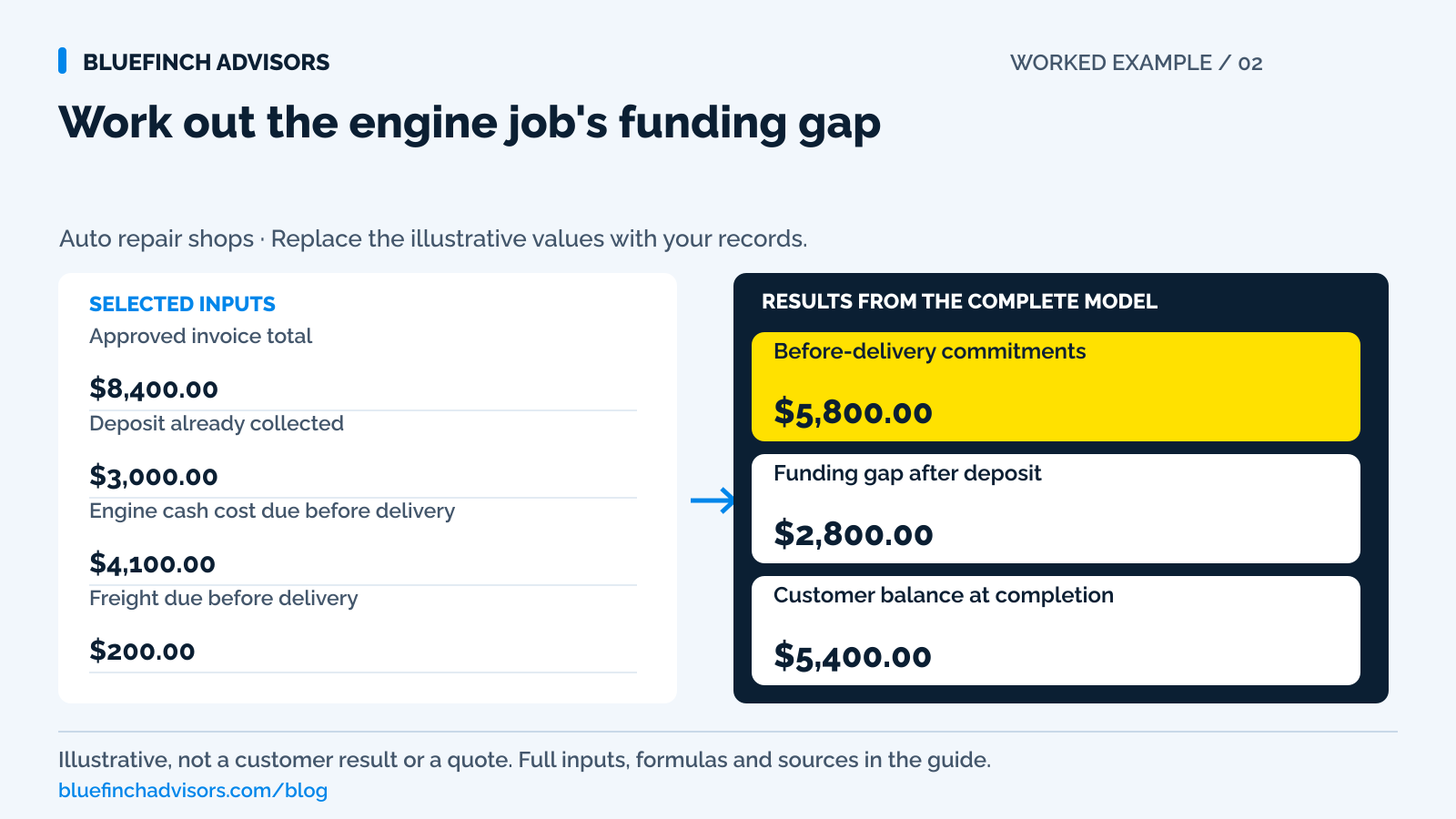
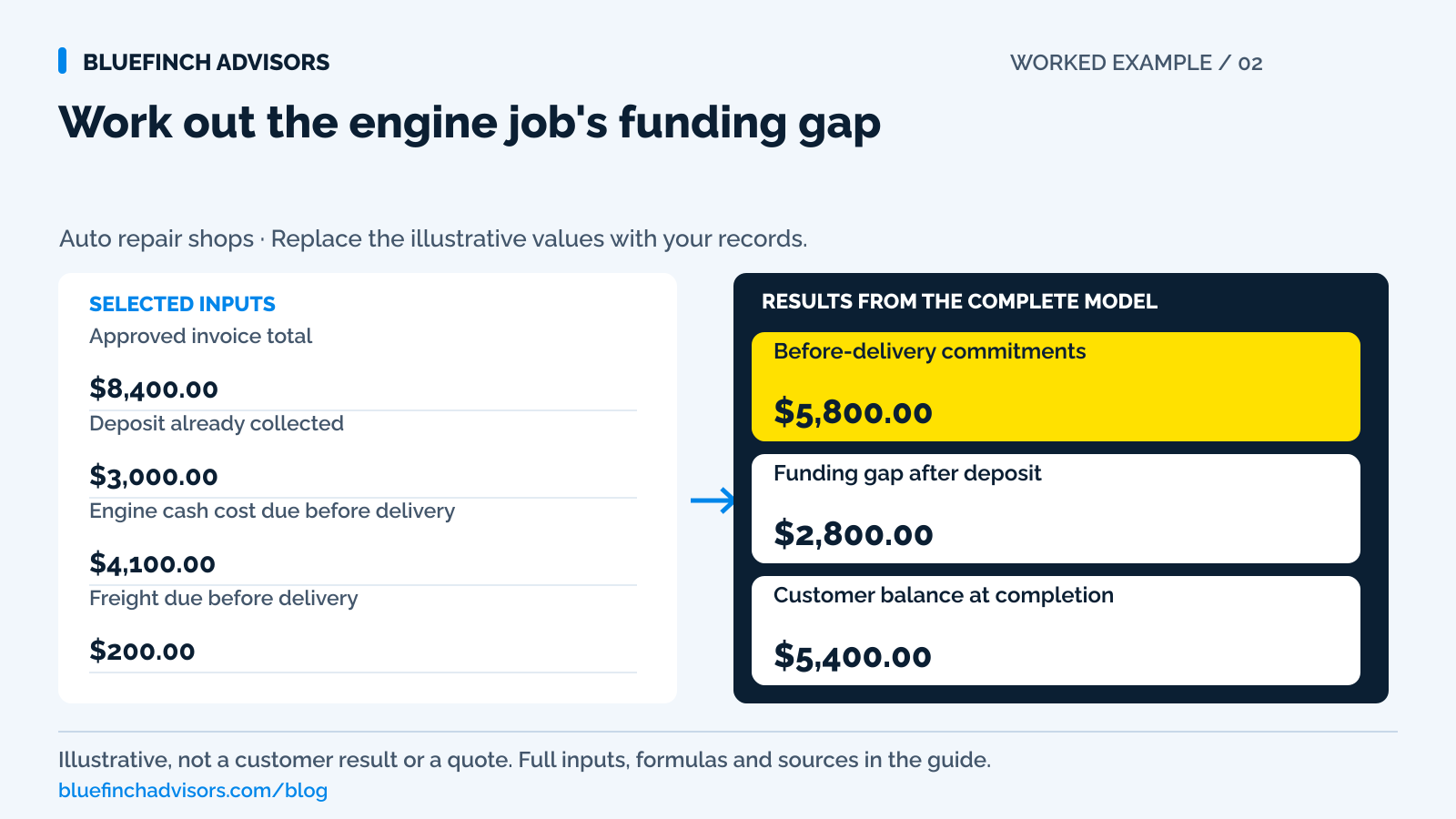
Illustrative example inputs
These starting values show how the math works. They are not industry averages, customer results or a quote.
| Input | Example value |
|---|---|
Approved invoice total Enter a consistent total, including applicable invoice charges. | $8,400.00 |
Deposit already collected Enter a captured payment, not an authorization-only hold. | $3,000.00 |
Engine cash cost due before delivery Count only supplier cash due before final payment. | $4,100.00 |
Freight due before delivery Enter the confirmed shipping cost due. | $200.00 |
Labor and sublet cash due before delivery Enter the cash due, not the retail labor price. | $1,500.00 |
Example results
| Measure | Result |
|---|---|
Before-delivery commitments Cash the shop expects to pay before collecting the balance. | $5,800.00 |
Funding gap after deposit A positive result needs shop funding; a negative result means the deposit exceeds these costs. | $2,800.00 |
Customer balance at completion Later authorized changes and credits can change this balance. | $5,400.00 |
Calculation detail
| Measure | Result |
|---|---|
| Engine commitment | $4,100.00 |
| Freight commitment | $200.00 |
| Other cash commitments | $1,500.00 |
| Collected deposit credit | $3,000.00 |
Model assumptions
- Defaults are examples, not recommended deposit amounts.
- Use the same price basis for the invoice and deposit. This tool doesn't calculate tax, refunds, core charges or lawful cancellation charges.
- A captured deposit can still be delayed in funding or disputed later.
Read alongside these results
- Investigate a negative customer balance as an overpayment; it isn't an automatic instruction to refund.
- Check repair authorization, deposit terms, account limits and actual funding dates separately.
Download this worked example (CSV). Use the interactive version to export your own inputs and results.
Download infographic (PNG) · Download vector (SVG) · Link to the source and methodology

The short version
- Track repair approval, card authorization, captured payment and available cash separately.
- Check when the engine, freight and other work must be paid before delivery.
- Explain the commitments and cancellation terms behind a deposit. A percentage alone doesn't explain the policy.
An $8,400 engine replacement can require several thousand dollars before the vehicle is ready for pickup. Ordering the engine, paying freight, and scheduling removal all create commitments. A large card approval at the counter does not tell the owner whether those commitments are funded or whether the customer has approved the exact engine and scope.
Before placing the order, compare the job's commitments with the collected deposit. You'll see how much the shop must advance and what the customer will still owe. Use that review to discuss the payment schedule, not to choose a lawful deposit policy, approve financing or replace the repair estimate.
Use with this guide
Set up the deposit request
Connect a payment link to the approved repair and remaining balance.
Separate diagnosis from repair approval
Use a staged authorization approach when teardown precedes the final scope.
Keep the approval file
Retain the estimate versions, customer approvals, invoice, and payment receipts.
Repair card authorizations: manage a parts-delay expiry
Manage repair card holds when parts delays outlast an authorization. Track capture deadlines, customer permission and the actual collection status.
Browse the complete auto repair guides and worksheets.
Specify the engine before asking for payment
The approved estimate should identify the work and the engine being supplied. New, remanufactured, and used assemblies can have different prices, availability, return restrictions, and warranty terms. State what the quoted job includes, which supporting components are covered, and which discoveries require another approval. A payment link labeled engine deposit is poor evidence if the customer believed it reserved a different assembly.
The FTC advises customers to obtain a written estimate and understand replacement parts and repair warranties. California's BAR guidance supplies a more detailed, state-specific example of documenting parts and customer authorization. Other states have their own requirements. Use the appropriate local process, and attach the customer's approval to the same repair order as the payment schedule. A processor's approval code cannot fill that role.
Sources for this section: FTC: Auto Repair Basics · California BAR: Write It Right
Record when each cost becomes payable
Ask the supplier when the engine charge becomes due, whether freight is prepaid, and what happens if the shipment is canceled, damaged, or rejected. Confirm any core obligation separately. An engine advertised at $4,100 may require additional funds that the price alone does not reveal. Use actual supplier terms, not a standard shop-wide deposit percentage, to identify the exposure before pickup.
Then list the labor and outside work expected to be paid before the final customer payment arrives. The worksheet uses cash obligations, not the entire retail labor charge. If the supplier gives terms extending beyond delivery, exclude that amount from the before-delivery column and document its later due date. If the job slips a week and another payroll occurs first, update the cash plan even when the authorized selling price remains unchanged.
| Commitment | Question to confirm | Cash-planning treatment |
|---|---|---|
| Engine supplier | When is payment due? | Include only obligations due before final collection |
| Freight | Prepaid, billed later, or refundable? | Use the actual shipping commitment |
| Labor and sublet | What must be paid before delivery? | Use cash cost, not retail labor sales |
A $3,000 deposit leaves a $2,800 gap
In the illustrative job, the approved invoice total is $8,400 and the captured deposit is $3,000. The engine requires $4,100, freight requires $200, and labor or sublet obligations payable before delivery total $1,500. The shop has $5,800 of before-delivery commitments. Subtracting the deposit leaves $2,800 to fund from its own cash or another agreed payment milestone.
The final customer balance is a different calculation: $8,400 minus $3,000 equals $5,400. Increasing the deposit to $4,000 would reduce the immediate gap to $1,800 and the final balance to $4,400, but it would not change the job's price or create another $1,000 of profit. Only propose that change before the customer agrees to the payment schedule, with the written terms and provider requirements checked.
Check whether a deposit was captured, not just authorized
Ask the payment provider whether the transaction is authorization-only, captured, pending settlement, or funded. Stripe's manual-capture documentation illustrates why the distinction matters: card authorizations have expiration windows, and money is released if capture does not occur in time. The applicable window depends on the network and transaction type. An engine shipping delay can easily outlast the assumptions behind an authorization-only workflow.
Do not promise that a hold will remain available until an uncertain completion date. Use a supported deposit or staged-payment process with the customer's consent and the account's permitted transaction types. For the cash worksheet, use a captured deposit as the starting credit, then separately check when those funds will be available. If the supplier must be paid today and funding is expected Monday, the bank still needs enough cash to bridge that interval.
Sources for this section: Stripe: Place a hold on a payment method
Check the large-ticket payment process before the customer arrives
A shop that usually processes oil changes should tell its provider about a materially different ticket size and expected volume. Ask which transaction channel is approved, what supporting invoice documents might be needed, and whom to contact if the payment is held for review. This is a coordination step, not a guarantee of approval. The card issuer and processor may still decline or review a particular payment.
Do not divide a charge to disguise its size or bypass a limit. If the customer genuinely needs two cards or a deposit followed by a later balance, document that arrangement and use the supported workflow. Keep each charge tied to the job, amount, and consent. A declined payment needs a clear status check before another attempt, because an uncertain first attempt and a quick retry can leave the customer worried about duplicate holds.
Sources for this section: Stripe: Place a hold on a payment method
Update the estimate and payment plan when the job changes
An additional component, changed engine source, or delayed delivery can change both the estimate and the cash commitments. Save the revised estimate and approval before the extra work proceeds under the applicable rules. Show the old deposit as an existing credit. State the new total, any next payment, and the remaining balance in the same message so the customer does not have to reconstruct the arithmetic from several texts.
Cancellation is another change, not a reason to invent a fee after the fact. Review what was authorized, what was purchased, what can actually be returned, and the applicable agreement and law. A supplier's charge to the shop does not automatically establish what the customer owes. If a refund is due, use the original transaction route and check provider fees and status. Stripe, for example, says its original processing fees are not returned with a refund.
Sources for this section: California BAR: Write It Right · Stripe: Refund and cancel payments
Confirm the remaining balance before pickup
Before pickup, compare the completed invoice with every approved revision, deposit, additional collection, and credit. Send the remaining amount and available payment methods while the customer still has time to plan. If the shop uses an approved dual-price program, make its prices and tender treatment clear at the relevant authorization and payment stages. Do not introduce an unexpected payment adjustment after the repair is complete.
Keep the cash-exposure worksheet with the job review, not as a substitute for the invoice. At completion, compare planned supplier and labor commitments with what actually became payable. A difference can improve the next engine-job estimate or reveal a missed freight charge. For the next large repair, pull the supplier terms first, enter the before-delivery obligations, and decide whether the proposed schedule leaves a gap the shop is willing and able to carry.
Sources for this section: FTC: Auto Repair Basics
Questions business owners ask
Does a deposit covering the engine also cover the job?
Not necessarily. Freight, labor, outside work, and timing may create cash needs before delivery. Include only obligations that actually become payable before final collection.
What if the calculated funding gap is negative?
The entered deposit exceeds the entered before-delivery cash commitments. That is not proof of profit or permission to keep the deposit if the job changes.
Can the shop rely on a card authorization for a long backorder?
Only within the provider's supported authorization and capture rules. Confirm the actual expiration and a permitted alternative; do not assume a hold lasts until the engine arrives.
Primary sources
BlueFinch last reviewed these sources on October 2, 2026. Payment rules and state requirements can change.
- FTC: Auto Repair Basics
- California BAR: Write It Right
- Stripe: Place a hold on a payment method
- Stripe: Refund and cancel payments
Use this page for general business information. It is not legal, tax, or accounting advice.