Check a paid PPF-kit shipping batch
Keep the cost of fulfilling ready orders separate from payments on orders not yet ready to ship.
Use the interactive tool without signing up. It runs in your browser: enter your numbers, save a comparison, download results or print a working copy. Your numbers are not sent to BlueFinch.
Illustrative example inputs
These starting values show how the math works. They are not industry averages, customer results or a quote.
| Input | Example value |
|---|---|
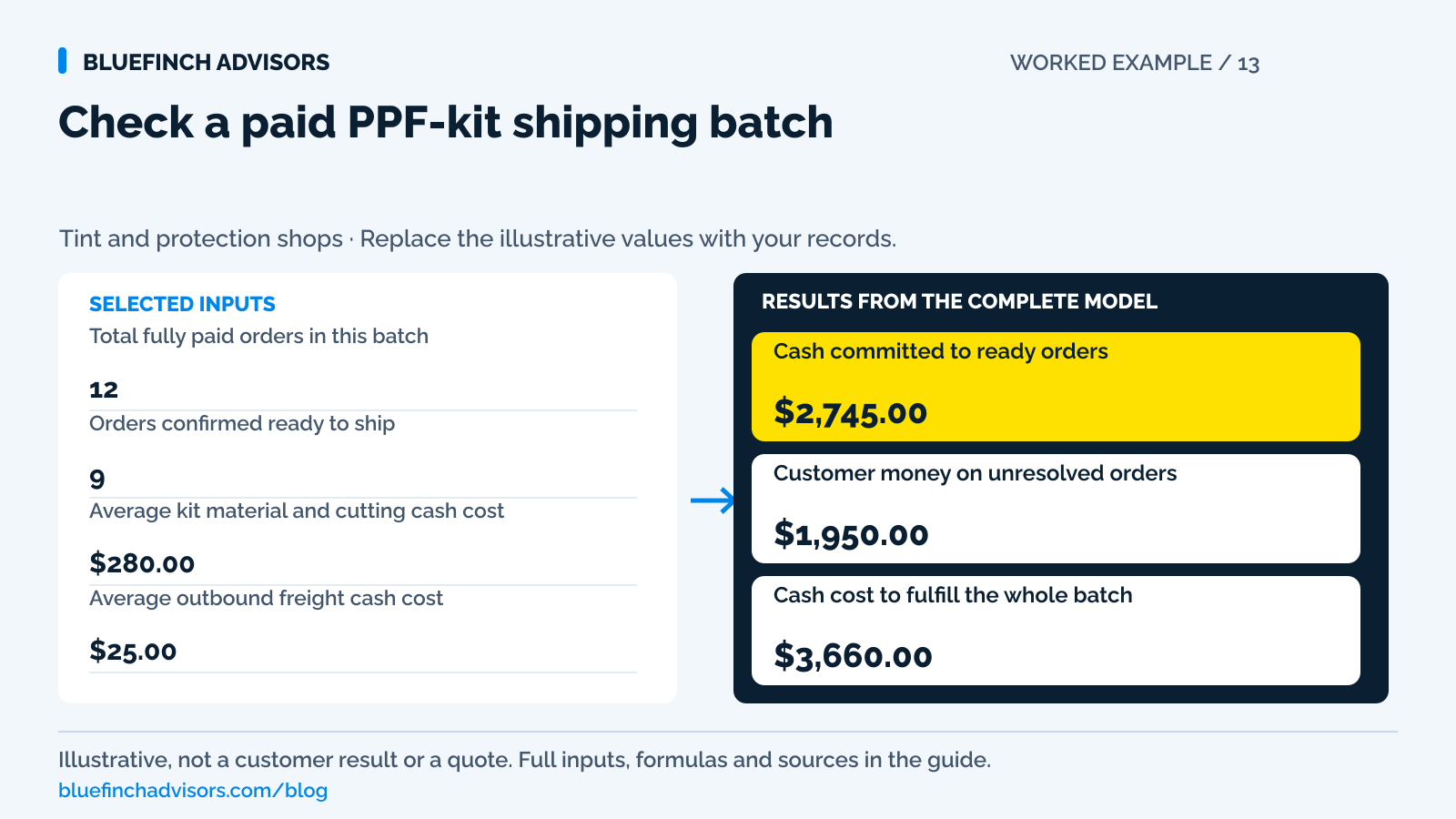
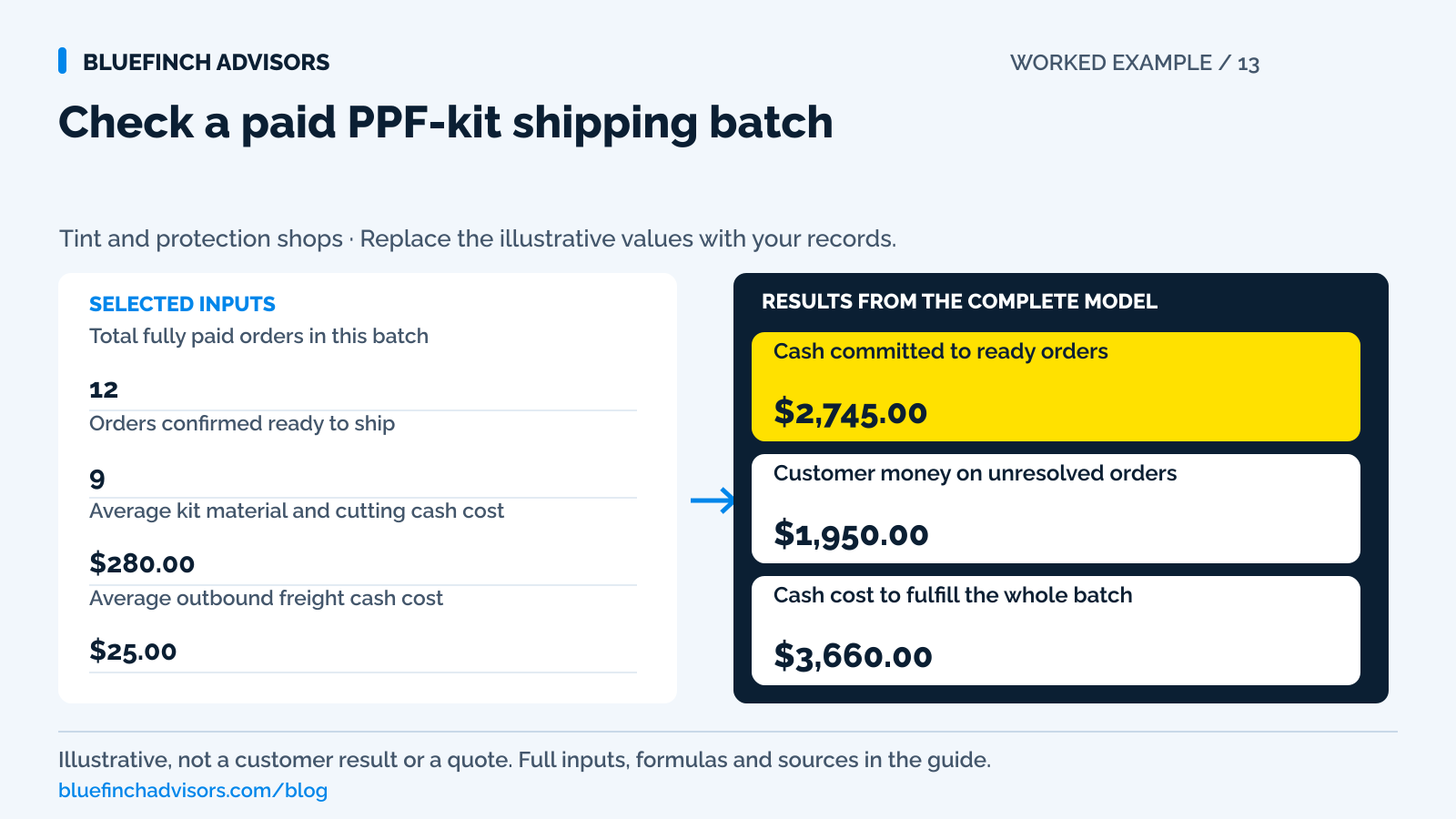
Total fully paid orders in this batch Whole orders at the same illustrative average values. | 12 |
Orders confirmed ready to ship Payment, fitment, address, stock, and shipping promise have been reviewed. | 9 |
Average kit material and cutting cash cost Incremental fulfillment cash cost, not selling price. | $280.00 |
Average outbound freight cash cost Use the actual service planned for this batch. | $25.00 |
Average customer amount already paid One selected before-tax payment-price basis, excluding completed refunds. | $650.00 |
Example results
| Measure | Result |
|---|---|
Cash committed to ready orders Ready count times average kit and freight cost. | $2,745.00 |
Customer money on unresolved orders A fulfillment or refund obligation, not a predicted loss. | $1,950.00 |
Cash cost to fulfill the whole batch Assumes every order later becomes ready at the same costs. | $3,660.00 |
Calculation detail
| Measure | Result |
|---|---|
| Unresolved order count | 3 |
| Gross paid batch amount | $7,800.00 |
Model assumptions
- Starting values are examples, not market benchmarks or payment quotes.
- Use one currency and a consistent before-tax basis. Work out taxes and program-specific adjustments separately.
Read alongside these results
- Enter whole order counts and keep ready orders no greater than total paid orders.
- Average values simplify a uniform batch. Review expensive, custom, split-payment, or differently priced orders individually.
Download this worked example (CSV). Use the interactive version to export your own inputs and results.
Download infographic (PNG) · Download vector (SVG) · Link to the source and methodology

The short version
- Check payment status, fitment approval and shipping readiness separately.
- Keep money received for unshipped orders visible rather than calling it all completed revenue.
- For a shipping delay, update the fulfillment plan and customer response instead of charging again.
A tint or PPF shop that ships precut kits has a different collection problem from a shop handing a finished vehicle back to its owner. The buyer may be remote, the vehicle details may be incomplete, and the delivery address may change after payment. A green paid label is useful, but it does not answer whether the right kit is going to the agreed recipient on the promised schedule.
Use this release check for a small batch of fully paid orders. The calculator separates cash needed to fulfill ready orders from payments on unresolved ones. It doesn't score fraud or judge customers. It shows what still needs resolving before you commit material and freight.
Use with this guide
Review remote payment controls
Distinguish supported remote collection from ordinary in-person payment.
Build a traceable evidence file
Keep the approved product, payment, and delivery records together.
Test the online payment channel
Verify that remote prices and receipts match the approved program.
Customer-supplied PPF kits: separate scope and collections
Write a clear labor scope for a customer-supplied PPF kit. Use the approval sheet to connect material readiness, revised work and the accepted collection.
Browse the complete window tint guides and worksheets.
A paid order still needs an approved kit and shipping instruction
Record the vehicle year, make, model, trim, body configuration, coverage, and relevant fitment details in the customer's approved order. Link the cut-file or kit reference used by production. The person packing should not infer a bumper variant from a payment description. If a customer changes the vehicle after paying, revise the order and price before cutting or shipping. That change may affect both fitment and what a later dispute record needs to show.
Confirm the recipient, delivery address, contact details, and promised shipment timing through the supported order process. Treat an address change as a reason to review the record, not automatic proof of fraud. Stripe's dispute-prevention guidance identifies address changes and unusual expedited shipping as factors that can merit review. Staff should follow a documented review path rather than either ignoring every mismatch or accusing a legitimate customer based on one signal.
Sources for this section: Stripe: payment policies, shipping records, and dispute prevention
Confirm when you can ship, even for custom-cut kits
For covered merchandise orders, the FTC's Mail, Internet, or Telephone Order Merchandise Rule requires a reasonable basis for the promised shipping time. Its guidance also explains the default timing when no shipping statement is made and the consent or refund steps when a seller cannot ship as promised. Apply the actual rule and transaction facts; do not assume that collecting payment, calling an item custom, or ordering film automatically resolves the obligation.
The operational record should show when the order became complete, what shipment statement the buyer received, and whether the shop can meet it. If fitment information is missing, request it promptly and keep the communication. If supply or production changes the shipment plan, use the required customer notice and response process rather than leaving the payment captured indefinitely. This guide does not determine legal coverage for a particular sale, but the owner should review that question before launching remote kit sales.
Sources for this section: FTC: Mail, Internet, or Telephone Order Merchandise Rule
Nine ready kits commit $2,745 while $1,950 remains tied to unresolved orders
The illustrative batch contains 12 fully paid orders at an average customer amount of $650. Nine are confirmed ready. Each uses $280 of kit material and cutting cash plus $25 outbound freight, or $305 to fulfill. Releasing the nine ready orders commits $2,745. Three orders remain unresolved, carrying $1,950 of customer payments. That $1,950 is an outstanding fulfillment or refund obligation, not an estimate that those orders are fraudulent.
Fulfilling all 12 at the same cost would require $3,660, while gross customer payments total $7,800. The difference is not net profit: payment fees, cutting overhead, support, packaging if omitted, returns, and other costs remain. If the batch contains very different kit prices or costs, review the orders individually or group comparable ones. The calculator's averages are a cash control, not a substitute for a reliable order ledger.
Show the selected price in the remote checkout itself
A customer paying remotely should see the actual amount and applicable terms before submitting payment. A sign at the installation counter cannot do that job for a shipped kit. If the shop offers dual pricing, verify that the remote flow supports its regular card and lower cash presentation and the actual accepted payment methods. Do not advertise a lower amount, then reveal a different card amount only after fitment approval or production has begun.
Surcharging is a separate program with its own requirements. Mastercard excludes debit and prepaid from its surcharge permissions, including when the credential is presented in a remote flow. Confirm the underlying funding type and approved configuration rather than treating every online payment as credit. ACH, wallets, and other alternatives are not universally free. Compare the written provider costs and customer experience without making an unsupported claim that one checkout method eliminates every merchant fee.
Sources for this section: Mastercard: merchant surcharge rules and debit exclusions · Visa: merchant fees, rules, and surcharge disclosure
Keep delivery evidence separate from fitment and product records
Keep the packing record, kit identifier, carrier reference, and delivery confirmation tied to the order. Stripe recommends trackable shipping and explains that dispute submissions may need screenshots because issuers do not follow links. A carrier event proves something about the shipment; it does not necessarily prove fitment, installation quality, or that a changed address was authorized. Preserve those other records separately instead of expecting tracking to answer every complaint.
When a package is reported missing or incorrect, retrieve the exact order and shipment before promising a remedy. A replacement and a refund can accidentally be initiated by different employees. Record who owns the customer response and which action was approved. If a manufacturer warranty question arises, use the specific product's terms. A shipped kit and a professionally installed product may not carry identical eligibility, so avoid copying installation warranty language onto a retail kit order.
Sources for this section: Stripe: payment policies, shipping records, and dispute prevention · XPEL: warranty claims, approval, and product-specific coverage
Assign a next action to each paid, unshipped order
Review paid unshipped orders by age and next action: awaiting customer detail, stock confirmation, risk review, shipment-date consent, or refund. Give each one a named owner. The ready count should increase only when the actual release conditions are met, not because production needs the batch to look complete. A negative unresolved count indicates bad inputs and must be corrected before the financial result is used.
If the order is canceled or cannot proceed, follow the provider's original-payment refund path and confirm its status. Stripe documents pending and failed refunds and limitations on returning money to another destination. Do not send an alternative payment merely because a customer requests a new account without following the provider process. The next practical step is to reconcile one paid batch from customer approval through cut file, shipment, delivery, and any refund so every dollar and package has an explained status.
Sources for this section: Stripe: refund destinations, partial refunds, and refund status
Questions business owners ask
Does a successful card payment mean an order is safe to ship?
It is one input, not the whole release decision. Confirm order details, fitment, address changes, provider review requirements, stock, and the shipping promise.
Is money on unresolved orders a predicted chargeback loss?
No. It is the amount collected for orders still needing fulfillment or another resolution. The calculator makes no fraud-rate or loss-probability assumption.
Can we use the batch tool for deposits instead of fully paid kits?
Not without changing the underlying records. This model assumes every included order is fully paid at the entered average. Track deposit-funded orders and their remaining balances separately.
Primary sources
BlueFinch last reviewed these sources on October 2, 2026. Payment rules and state requirements can change.
- Stripe: payment policies, shipping records, and dispute prevention
- FTC: Mail, Internet, or Telephone Order Merchandise Rule
- Mastercard: merchant surcharge rules and debit exclusions
- Visa: merchant fees, rules, and surcharge disclosure
- XPEL: warranty claims, approval, and product-specific coverage
- Stripe: refund destinations, partial refunds, and refund status
Use this page for general business information. It is not legal, tax, or accounting advice.