Check cash before the next supplier deadline
Use installments whose proceeds are available by the deadline to check the funding gap. Leave total booking value out.
Use the interactive tool without signing up. It runs in your browser: enter your numbers, save a comparison, download results or print a working copy. Your numbers are not sent to BlueFinch.
Illustrative example inputs
These starting values show how the math works. They are not industry averages, customer results or a quote.
| Input | Example value |
|---|---|
Guests in this collection cohort Guests in the entered gross-payment total, with net proceeds available by the cutoff. | 18 |
Cleared installments per guest Gross successful payments for this cohort divided by the guest count. Do not enter a net payout or available processor balance. | $700.00 |
Retained collection costs Actual costs on those collections, including relevant installment charges. | $420.00 |
Approved refunds due before deadline Amounts to fund in this window, not a speculative cancellation rate. | $1,400.00 |
Supplier cash committed by deadline Venue and other approved cash payments due by the cutoff. | $9,800.00 |
Other retreat cash due by deadline Travel, staffing, or other retreat-specific cash payments. | $1,300.00 |
Scheduled installments not yet cleared Displayed as uncollected, never added to present cash. | $9,000.00 |
Example results
| Measure | Result |
|---|---|
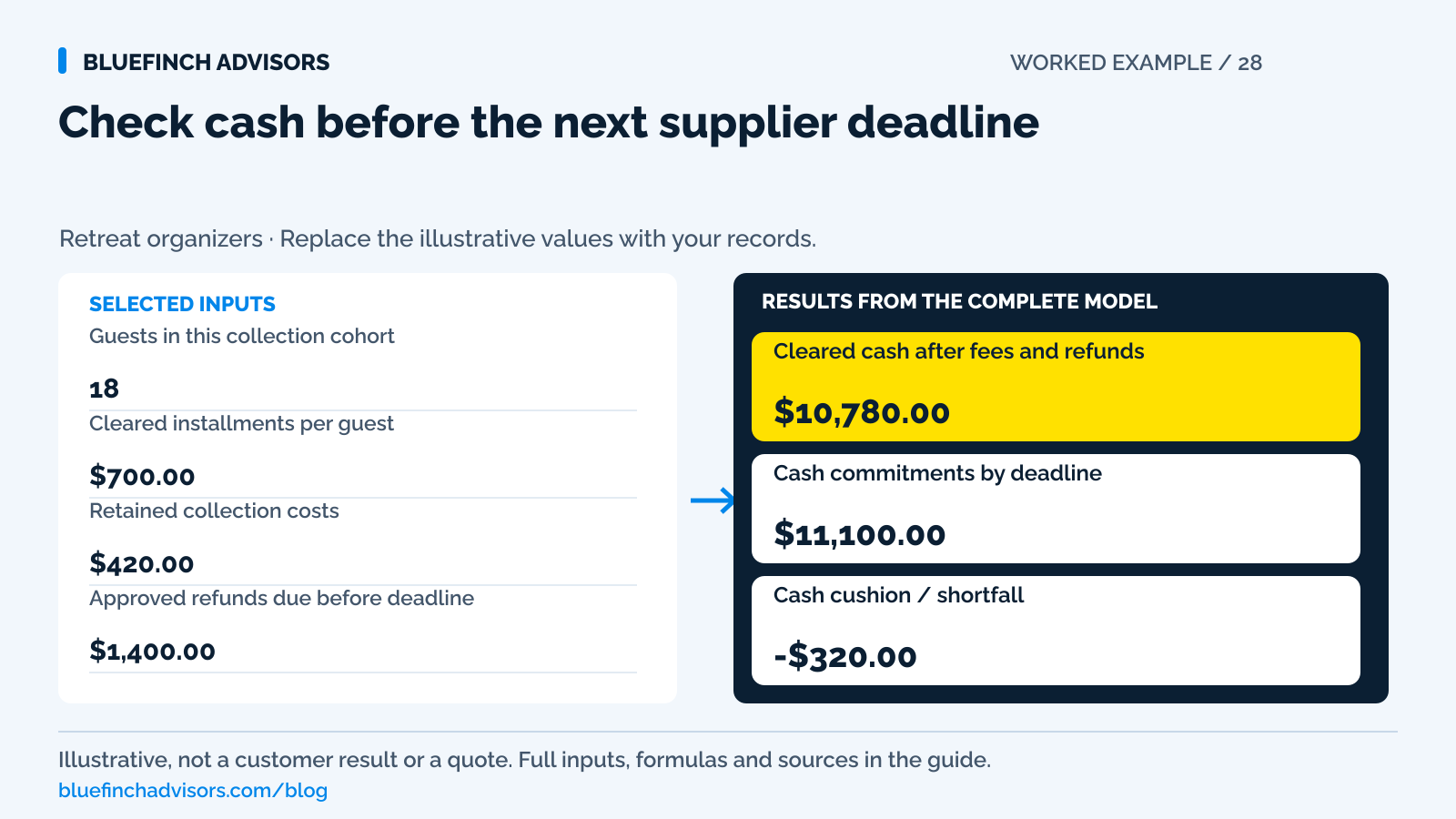
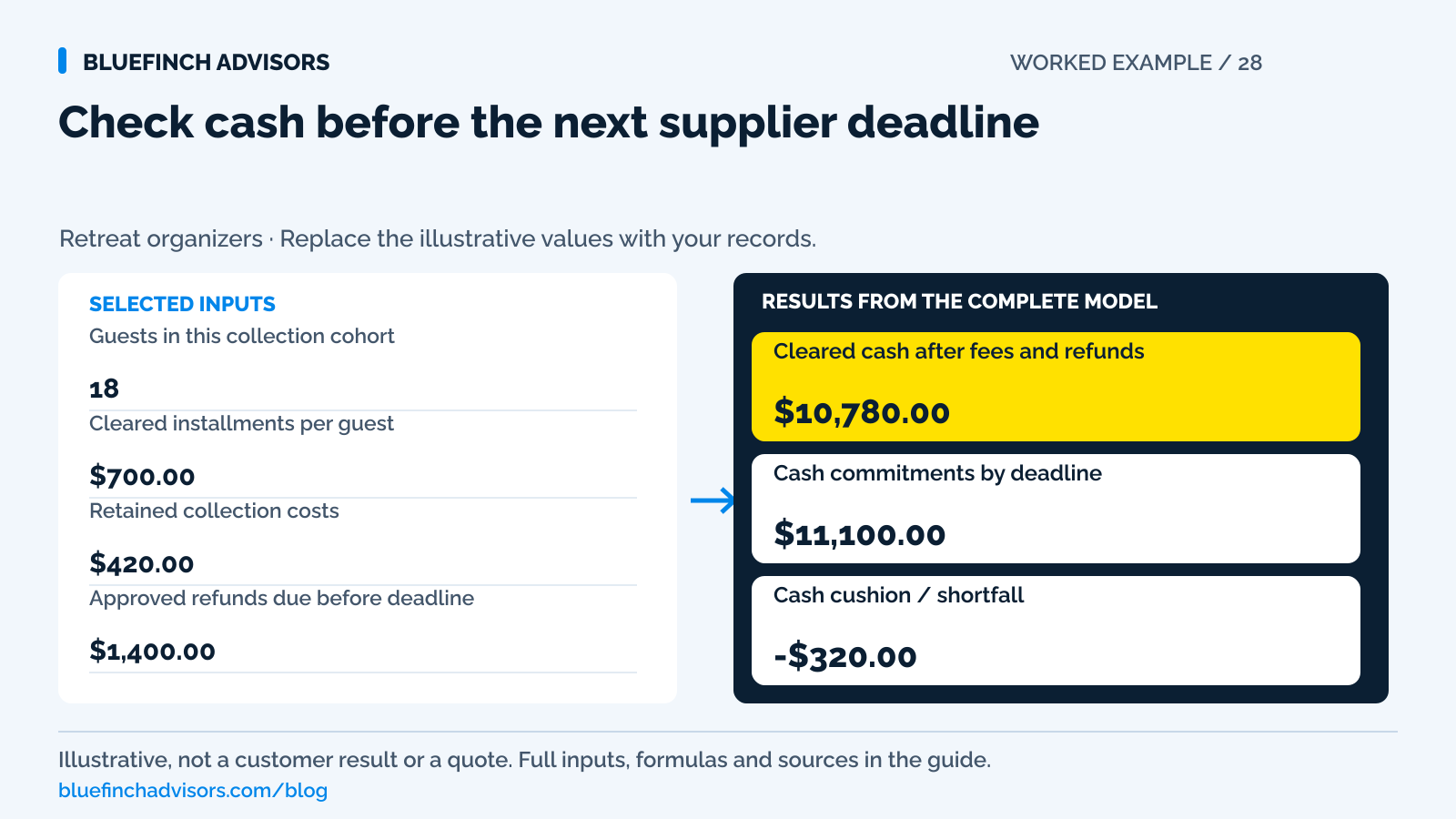
Cleared cash after fees and refunds Cash available from this cohort after the entered outflows. | $10,780.00 |
Cash commitments by deadline Supplier and other approved retreat cash requirements. | $11,100.00 |
Cash cushion / shortfall Positive is a cushion; negative is a funding shortfall. | -$320.00 |
Scheduled but uncollected installments Excluded from the cash cushion. | $9,000.00 |
Calculation detail
| Measure | Result |
|---|---|
| Gross cleared guest payments | $12,600.00 |
| Fees and approved refunds | $1,820.00 |
| Supplier payment requirement | $9,800.00 |
Model assumptions
- Fictional single-deadline model with equal cleared amounts per guest.
- Enter gross successful guest payments only when their net proceeds are available by the cutoff. The calculator subtracts entered costs and refunds separately. Exclude platform-held funds.
Read alongside these results
- A positive cushion is not retreat profit and does not eliminate later refund exposure.
- This model does not assume supplier refunds will arrive or authorize postponing guest refunds.
Download this worked example (CSV). Use the interactive version to export your own inputs and results.
Download infographic (PNG) · Download vector (SVG) · Link to the source and methodology


The short version
- Use available collections to fund today's venue payment, not promised installments.
- Track approved guest refunds separately from money you expect to recover from suppliers.
- Check that a new payment program preserves agreed installments and refund records.
The venue's next payment is due before several guests finish their installment plans. Bookings look healthy, yet the organizer may be short of cleared cash. A cancellation could create an additional refund while the venue keeps a payment under its own agreement. The guest and supplier schedules need to be read together.
The worksheet is a deadline-specific cash test. It does not set travel-law requirements, refund rights, supplier cancellation terms, or an appropriate financing arrangement. The retreat's scope, contracts, and any applicable seller-of-travel requirements need qualified review. All default amounts on this page are fictional.
Use with this guide
Wellness terms worksheet
Identify the approved guest payment and cancellation terms.
Event collection checklist
Test remote payments, receipts, and connectivity.
Milestone cash-flow planner
Map several retreat deadlines after checking the next one.
Browse the complete wellness center guides and worksheets.
Build one calendar from two sets of promises
Put guest installment due dates on the same calendar as venue deposits, catering payments, travel purchases, and staff commitments. Record the expected availability date of each collection, not just the date the card will be attempted. A failed or pending installment cannot be spent.
Next mark when supplier commitments become difficult or impossible to recover under the actual agreements. Those terms may differ from the terms offered to guests. Do not assume a guest's nonrefundable label means the organizer can retain every payment in every circumstance, or that a supplier will return money because the guest has a valid refund claim.
Use the calendar to choose a meaningful checkpoint: the next large supplier payment, a cancellation decision date, or departure. The calculator handles one checkpoint at a time. Running it at several dates reveals a cash shortfall that a total retreat budget can hide.
Define cleared money tightly
For this model, enter gross successful guest payments whose net proceeds are available to the organizer by the deadline. Fees and approved refunds have separate inputs, so do not use an already-net bank payout or available processor balance as the collection total. A booking confirmation, an installment schedule, or a processing-status payment is not enough. Stripe's balance documentation distinguishes transaction activity from when funds become available.
If a ticketing platform holds receipts until after the retreat, those funds cannot cover a venue payment due before departure unless a supported earlier payout is confirmed. Eventbrite's documentation describes its payout schedule and additional bank timing. Other platforms and accounts can differ, so use the actual setup.
Reconcile the guest list to successful payment references. If some guests paid $500 and others $900, add the gross qualifying payments and divide by the number of guests in that total. Enter that average as the cleared installments per guest, or split the model into equal-payment cohorts. Do not multiply all booked guests by the highest amount anyone has paid.
Sources for this section: Stripe: balance reporting and available versus pending funds · Eventbrite: payment processing, fees, and payout timing
Eighteen guests still leave a $320 shortfall
The fictional cohort has 18 guests with $700 of cleared installments each, totaling $12,600. Retained collection costs are $420, and $1,400 of approved guest refunds must be funded before the deadline. Cash available after those items is $10,780.
Supplier cash due is $9,800 and other retreat cash due is $1,300, a combined $11,100. The cushion is $10,780 less $11,100, or negative $320. The organizer needs to resolve that shortfall through an authorized funding or commitment decision before the deadline.
Another $9,000 of installments is scheduled but not cleared. The calculator shows it without adding it to available cash. If the net proceeds from another $2,000 of gross payments become available before the same deadline, add $2,000 to gross cleared collections, update any related payment costs, and reduce the uncollected schedule accordingly. Do not count that $2,000 in both places.
Monitor the next attempt without assuming success
Assign responsibility for upcoming bills, failed-payment follow-up, and guest communications. The organizer should know which installments are due before the supplier cutoff and which are due afterward. A reminder sent is an action. It is not a successful collection.
Any change to an installment amount or date should follow the guest's agreement and the provider's supported authorization process. Do not quietly increase a later charge to compensate for a shortfall elsewhere in the retreat budget. Keep the original schedule and the approved revision together.
If changing payment platforms during sales, verify credential portability and recurring schedules separately. Stripe's migration documentation treats payment-data movement and subscription instructions as different stages. A customer imported into the new system is not proof that the next installment will run for the correct amount on the correct date.
Sources for this section: Stripe: subscription migration stages
Keep the refund route usable through the final close
For each approved guest refund, retain the original payment references and the amount already returned. Installment plans can involve several transactions, so the refund may require more than one supported action. Do not exceed the original charge or use an unrelated payment route simply because the retreat has ended.
Stripe's refund documentation directs refunds to the original payment method and explains that available balance affects funding. A provider change or account closure should therefore include a historical-refund plan. Preserve access and exports needed to handle the actual outstanding obligations.
If the retreat uses Eventbrite, its platform rules require refunds when an event is canceled. The organizer's supplier losses do not remove that platform requirement. For another platform or private booking arrangement, review the applicable rules and agreements rather than importing Eventbrite's policy as a universal legal rule.
Sources for this section: Stripe: refund funding, destinations, and refund status · Eventbrite: setting and managing refund policies
Treat collection cost as part of the plan
Installments may create more transactions and more administration than a single payment. Use the actual retained cost of the chosen plan, including applicable per-payment, software, or platform fees. A financing provider's proceeds and refund obligations can require a different model from a merchant-run installment schedule.
If introducing dual pricing, confirm how both displayed prices and later installment authorizations are presented. Visa distinguishes a posted-price arrangement from adding a checkout surcharge, and debit and prepaid cards cannot receive a Visa surcharge. A wallet payment does not make the underlying card eligible credit.
The next action is to reconcile cleared guest funds today, then place the next supplier deadline beside the guest collection schedule. Ask the provider to demonstrate a failed installment, a partial refund, and an old-program refund before changing systems. A payment proposal is useful only if the retreat can still explain every guest balance.
Sources for this section: Visa: U.S. merchant surcharging and displayed-price distinctions
Questions business owners ask
Does a positive cushion mean the retreat is profitable?
No. It only covers the entered deadline. Later costs, overhead, refund exposure, and uncollected balances remain outside that result.
Can future installments be included if most guests usually pay?
Not in the present-cash calculation. Run a separately labeled forecast, then replace it with actual available collections as they arrive.
Can I offset guest refunds with expected supplier refunds?
Only count supplier recovery when its availability is verified for the same window. An expectation is not cash, and it does not decide the guest's rights.
Primary sources
BlueFinch last reviewed these sources on October 2, 2026. Payment rules and state requirements can change.
- Stripe: balance reporting and available versus pending funds
- Eventbrite: payment processing, fees, and payout timing
- Stripe: subscription migration stages
- Stripe: refund funding, destinations, and refund status
- Eventbrite: setting and managing refund policies
- Visa: U.S. merchant surcharging and displayed-price distinctions
Use this page for general business information. It is not legal, tax, or accounting advice.
Related resources
- 2026 Credit Card Processing Cost Report
- Wellness Center Payment Guide
- Wellness Center Credit Card Processing Calculator
- Wellness Package Cancellation and Expiration Policy Worksheet
- Mobile and Pop-Up Wellness Event Payment Checklist
- Chiropractic payment reconciliation: separate patient credit from payer adjustments