Find how much lost repair work would offset savings
Compare the complete monthly cost benefit with contribution from genuinely lost repairs that weren't replaced.
Use the interactive tool without signing up. It runs in your browser: enter your numbers, save a comparison, download results or print a working copy. Your numbers are not sent to BlueFinch.
Illustrative example inputs
These starting values show how the math works. They are not industry averages, customer results or a quote.
| Input | Example value |
|---|---|
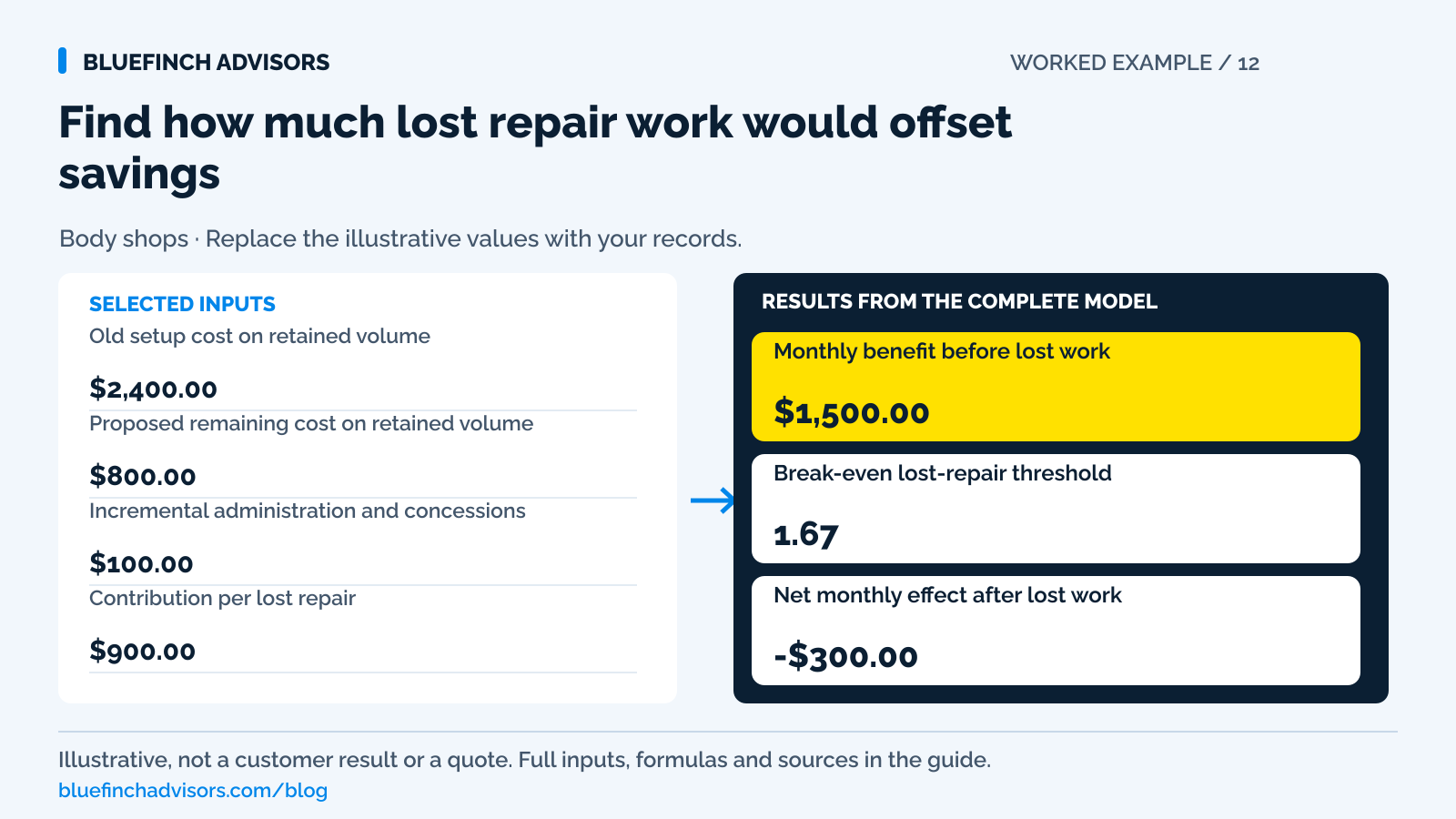
Old setup cost on retained volume Estimate the prior setup on the same retained payment volume and mix as the proposed cost. | $2,400.00 |
Proposed remaining cost on retained volume Include remaining debit, monthly, channel, and account costs relevant to this comparison. | $800.00 |
Incremental administration and concessions Only costs not already included above. | $100.00 |
Contribution per lost repair After avoidable job costs and old per-job payment expense; not gross revenue. | $900.00 |
Unreplaced payment-related lost repairs A scenario or documented estimate, not every decline after launch. | 2 |
Example results
| Measure | Result |
|---|---|
Monthly benefit before lost work Comparable cost reduction after incremental overhead. | $1,500.00 |
Break-even lost-repair threshold Threshold only; zero contribution returns Not available. | 1.67 |
Net monthly effect after lost work Negative means modeled lost contribution exceeds the cost benefit. | -$300.00 |
Calculation detail
| Measure | Result |
|---|---|
| Comparable processing cost reduction | $1,600.00 |
| Incremental administration and concessions | $100.00 |
| Lost contribution entered | $1,800.00 |
| Annualized same-scenario effect | -$3,600.00 |
Model assumptions
- All defaults are illustrative and do not predict customer behavior or savings.
- Old and proposed processing costs use the same retained volume to avoid counting fees avoided on lost jobs as program savings.
- Lost contribution is net of avoidable costs and any genuinely recovered contribution from replacement work.
Read alongside these results
- A negative benefit or threshold means the entered proposal fails the cost comparison before lost work.
- Annualization assumes the same monthly result repeats; it is not a forecast or savings guarantee.
- Verify the actual program, disclosures, card-type treatment, local requirements, and customer response separately.
Download this worked example (CSV). Use the interactive version to export your own inputs and results.
Download infographic (PNG) · Download vector (SVG) · Link to the source and methodology

The short version
- Compare full account costs using the same retained volume and payment mix.
- Value a lost repair by its contribution, not its entire selling price.
- Document whether payment pricing caused lost work. Don't start with an assumed loss percentage.
A proposed payment program saves $1,500 a month after remaining costs. The owner asks a sensible question: what if a few customers leave? The answer depends on the contribution those jobs would have produced and whether the shop can replace them. It cannot be answered by dividing savings by the full repair invoice.
Use the break-even threshold to plan a controlled review: how much unreplaced, payment-related lost work would erase the calculated benefit? The threshold doesn't predict customer losses, prove why someone declined or establish that a pricing program is permitted. Check those questions with separate evidence.
Use with this guide
Put processing beside contribution
Separate repair revenue from the money the shop retains after job costs.
Review the customer explanation
Check whether estimates and payment choices are clear before authorization.
Verify the baseline cost
Use a complete statement and the correct settled-card denominator.
Browse the complete auto body guides and worksheets.
Identify the pricing program before estimating its effect
Dual pricing presents an approved card price and another applicable price under the configured program. A cash discount and a surcharge have different presentation and rule requirements. Visa's guidance distinguishes discount offers from adding a card fee to a displayed lower price, and it excludes debit and prepaid from credit-card surcharging. Do not evaluate a proposal from the label alone; inspect the actual estimate, checkout, receipt, and refund behavior.
A zero merchant rate on eligible credit transactions does not eliminate monthly charges, debit costs, equipment or gateway charges, refunds, disputes, or other account-specific items. Build the comparison from a written proposal and actual statements. Do not use BlueFinch's 3.54% pre-conversion all-card client benchmark as if it were this shop's credit-only rate, a national average, or a guaranteed saving.
Sources for this section: Visa: U.S. merchant surcharge questions and answers
Compare the same retained volume on both sides
Estimate what the existing setup would cost on the payment volume the shop expects to retain, then estimate the proposed setup on that same volume and tender mix. This avoids calling the fees no longer paid on lost jobs a benefit of the new program. If customers shift from credit to debit, ACH, checks, or cash, include the actual cost and operational effect of those methods instead of assuming every alternative is free.
Add incremental administration and agreed concessions that are not already in the proposed account-cost total. Examples include additional reconciliation work or a documented price concession used to retain a job. Do not count ordinary office time twice, and do not treat a customer's request for an explanation as an automatically lost sale. Keep the cost assumptions visible so the owner can change them without rewriting the conclusion.
Sources for this section: Visa: U.S. merchant surcharge questions and answers
Use the contribution the lost job would have left
The relevant job value is revenue less costs that would be avoided if that job were not performed. Parts, materials, sublet work, and genuinely variable labor can matter. Allocated rent or a technician salary that remains payable may not disappear when one repair is lost. Use the shop's accounting view consistently, and include the old per-job processing expense when estimating the contribution the lost job would have produced under the prior setup.
The SBA's break-even explanation uses selling price less variable cost to calculate contribution and the unit threshold needed to cover costs. Here, the same contribution idea is applied to a payment-program change rather than the entire business. A customer-pay bumper job and a large collision repair can have different contributions, so use a representative value for the actual at-risk jobs or run separate scenarios.
Sources for this section: SBA: Break-even point
At $900 per repair, the second lost job reverses the benefit
Assume the old setup would cost $2,400 a month on the retained payment volume, while the proposed setup would cost $800 on that same volume. Incremental administration and concessions total $100. The modeled monthly benefit before lost work is $2,400 - $800 - $100 = $1,500. These inputs are illustrative and include the remaining costs relevant to the comparison.
If each genuinely lost and unreplaced repair would have contributed $900 after its avoidable costs, the threshold is $1,500 / $900 = 1.67 repairs. One lost repair leaves a $600 benefit. Two lose $1,800 of contribution and turn the monthly result into negative $300. The 1.67 figure is a threshold, not a forecast of fractional customers. In this scenario, the second whole lost repair is the point at which the modeled benefit becomes negative.
Ask why the customer declined without suggesting a reason
Record the estimate outcome and the customer's stated reason when available. Separate payment-price objections from scheduling, vehicle condition, coverage disagreement, total repair cost, another shop's availability, and no response. A decline after the program launches is not proof that the program caused it. Likewise, a customer who questions the price and then pays is not a lost repair.
Use a short neutral question such as, 'What kept you from moving forward with this repair?' Preserve the answer without embellishment. The FTC encourages customers to compare repair shops, estimates, and warranties, so price is only one plausible decision factor. For the worksheet, count only a defensible scenario of payment-related lost work and show an uncertainty range when the evidence does not support a precise number.
Sources for this section: FTC: Auto Repair Basics
Account for replacement work and concessions honestly
If a declined repair's slot is filled with equally profitable work that the shop otherwise could not have performed, the original job's full contribution is not necessarily lost. Measure the net effect of the replacement. If the replacement job has lower contribution or arrives too late to fill the capacity, only the recovered portion offsets the loss. Do not assume every open slot stays empty or every lost job is effortlessly replaced.
A price concession can preserve a job while reducing the benefit. Enter that cost separately if it is not already reflected in the retained-volume comparison. Avoid counting the same job as both fully lost and retained through a concession. When the mix is complex, total the net lost contribution outside the worksheet and convert it to an equivalent number of representative repairs, clearly labeled as a planning approximation.
Sources for this section: SBA: Break-even point
Set the review period before seeing the result
Choose a comparable period and preserve the baseline before launch. Record estimates offered, jobs approved, payment choices, documented objections, concessions, complete account costs, and any unreplaced lost contribution. Compare similar work and customer groups where possible. A seasonal change in collision volume or a change in insurer referrals can overwhelm a small payment-program signal.
Use the threshold as a decision aid, not a statistical claim. A small number of declines cannot reliably establish a causal effect, but a clear pattern of confused price disclosures deserves correction even before a formal conclusion is possible. Review actual customer-facing documents with the provider. If staff cannot explain the choice consistently or the terminal handles debit incorrectly, fix that operational problem rather than dismissing complaints because the fee estimate looks attractive.
Sources for this section: Visa: U.S. merchant surcharge questions and answers
Compare several loss scenarios before deciding
Run a low-loss case, a plausible case, and a higher-loss case using the shop's own contribution assumptions. If the proposed benefit disappears with one modest lost job, the decision is more sensitive than a large annual savings headline suggests. If it remains positive under a defensible higher-loss scenario, the owner has a clearer financial basis for proceeding, subject to correct implementation and customer treatment.
The next step is to reconcile one actual statement and a small set of relevant estimates, not invent a customer-loss rate. Verify the remaining account costs, calculate contribution for the jobs most likely to be affected, and document what customers actually said. Bring those facts to a BlueFinch account review. A useful recommendation should survive both the fee calculation and the owner's question about the work the shop might not retain.
Sources for this section: SBA: Break-even point
Questions business owners ask
Does a 1.67-repair threshold mean the shop will lose customers?
No. It is the mathematical break-even point under the entered assumptions. Customer response must be observed and cannot be inferred from the threshold.
Why not use the whole repair invoice as the lost value?
The shop avoids some costs when work is not performed. Contribution estimates the money the job would have left after those avoidable costs, using a consistent treatment of processing expense.
What if the savings before lost work are already negative?
The entered proposal is more costly even before any lost contribution. A negative threshold is not an allowance for losses; review the cost inputs and proposal first.
Primary sources
BlueFinch last reviewed these sources on October 2, 2026. Payment rules and state requirements can change.
Use this page for general business information. It is not legal, tax, or accounting advice.