Check the parts credit and cash needed for the refund
Compare expected and posted supplier credit, then use available recovery to estimate cash needed for the customer refund.
Use the interactive tool without signing up. It runs in your browser: enter your numbers, save a comparison, download results or print a working copy. Your numbers are not sent to BlueFinch.
Illustrative example inputs
These starting values show how the math works. They are not industry averages, customer results or a quote.
| Input | Example value |
|---|---|
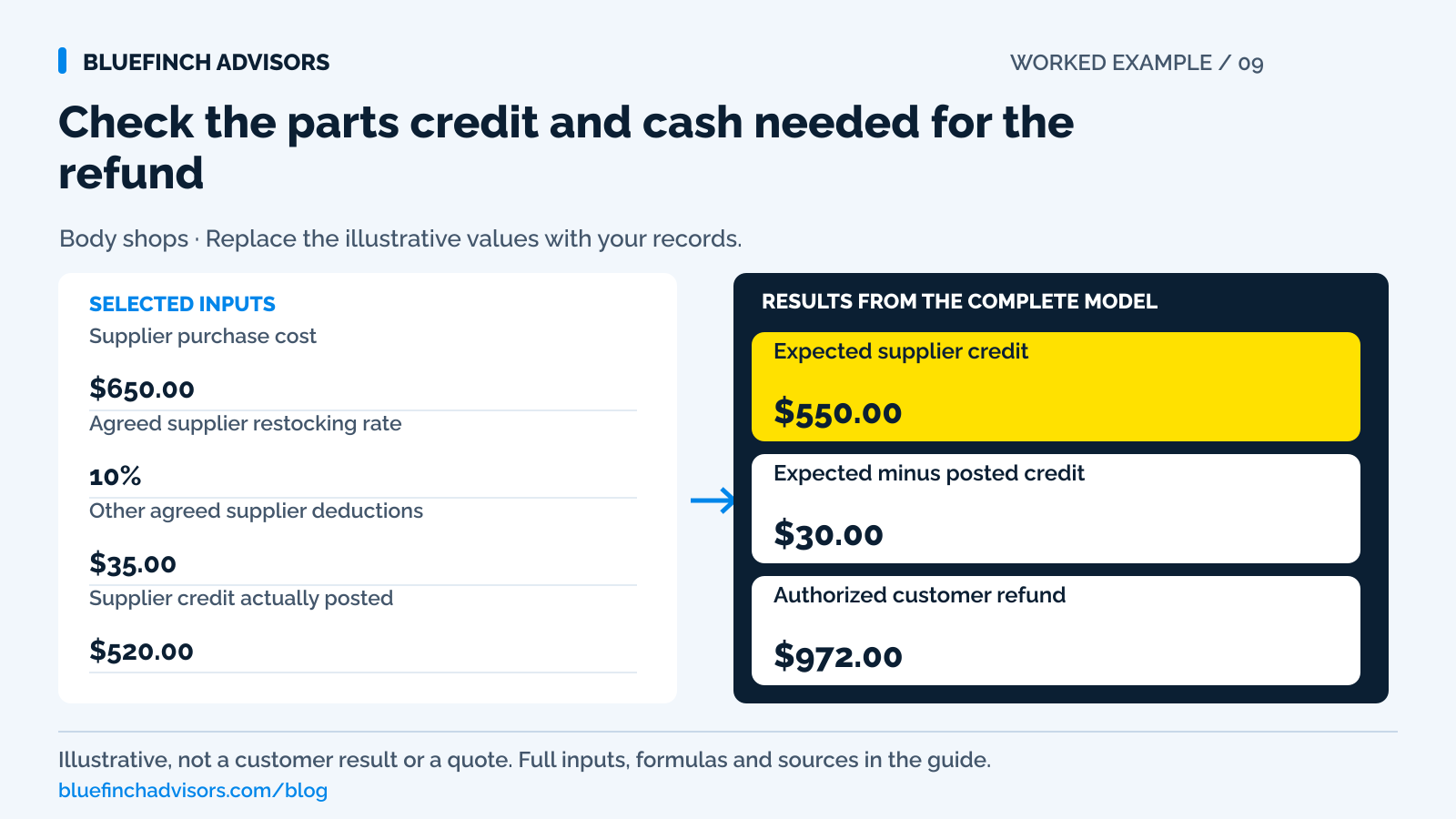
Supplier purchase cost Cost of the returned part, not the customer selling price. | $650.00 |
Agreed supplier restocking rate Illustrative rate; use the specific supplier agreement. | 10% |
Other agreed supplier deductions For example, confirmed return freight. | $35.00 |
Supplier credit actually posted Use the credit memo or posted refund. | $520.00 |
Supplier recovery usable in this cash window Enter zero if a future account credit cannot fund today's refund. | $520.00 |
Authorized customer line refund Amount determined from the invoice correction. | $900.00 |
Correctly determined tax refund This tool does not calculate tax. | $72.00 |
Example results
| Measure | Result |
|---|---|
Expected supplier credit Purchase cost less agreed deductions. | $550.00 |
Expected minus posted credit Positive means recovery is below the entered expectation. | $30.00 |
Authorized customer refund Invoice correction plus entered refundable tax. | $972.00 |
Immediate refund funding difference Cash required after recovery usable in the same window; not a profit measure. | $452.00 |
Calculation detail
| Measure | Result |
|---|---|
| Supplier restocking amount | $65.00 |
| Supplier credit posted | $520.00 |
| Supplier recovery usable now | $520.00 |
| Customer refund before tax | $900.00 |
Model assumptions
- All defaults are illustrative. The 10% supplier deduction is not a stated LKQ policy.
- Customer refund and supplier recovery are independently authorized amounts.
- Usable recovery can differ from posted credit because a credit memo is not necessarily immediate cash.
Read alongside these results
- A negative expected credit or recovery exceeding the relevant return needs review; signed results remain visible.
- Verify refund entitlement, tax, payer allocation, provider rules, and credit availability separately.
Download this worked example (CSV). Use the interactive version to export your own inputs and results.
Download infographic (PNG) · Download vector (SVG) · Link to the source and methodology

The short version
- Determine the customer refund separately from the supplier credit.
- Follow the return from authorization and pickup through supplier credit and statement application.
- Check the corrected customer invoice and original payment separately, using the correctly determined tax adjustment.
A $900 part is removed from a paid collision invoice. The supplier accepts the unused part, but its credit is smaller than the shop expected. Meanwhile, the customer is due an approved refund. Waiting for both amounts to match will not solve the problem because supplier cost and customer selling price were never the same number.
Keep the supplier return and customer correction as two linked records. This guide covers an unused replacement part, not a core exchange. The worksheet compares expected and posted supplier credits, adds the entered customer refund amounts and shows the shop's cash requirement using only supplier recovery available now.
Use with this guide
Review the refund file
Connect the approved correction with the original transaction and final refund status.
Correct the final repair record
Keep removed lines and payer adjustments visible in the delivery file.
Check partial-refund pricing
Confirm the configured program reverses the actual customer price correctly.
Collision parts price changes: reconcile approval and payment
Reconcile collision parts price changes before collecting a revised balance. Use the approval worksheet to connect the current estimate, payer and payment.
Body-shop refunds: investigate a rejected submission
Resolve a failed collision-shop refund from the provider status. Use the exception tracker before promising completion or sending a second payment.
Browse the complete auto body guides and worksheets.
Keep supplier-return terms separate from the customer correction
On the supplier side, identify the original purchase price, return authorization, permitted deductions, and expected credit destination. On the customer side, identify the authorized invoice change, the amount being refunded, any applicable tax adjustment, and who actually paid. The two records share a repair order and part reference, but they answer different questions. A wholesale credit cannot simply be substituted for the customer-facing adjustment.
If insurance paid the line, verify the payer and claim correction before returning money to the vehicle owner. If the customer paid for an optional upgrade, preserve that allocation. The FTC recommends a completed repair order listing work and parts, and BAR's California guidance details invoice and changed-work records. Use the appropriate local requirements to document what was removed and what the customer or payer was actually promised.
Sources for this section: FTC: Auto Repair Basics · California BAR: Write It Right
Check the supplier's terms while the part is still returnable
Record the delivery date, invoice number, part number, condition, packaging, and reason for return. Ask when the supplier must receive it, whether a return authorization is required, and whether freight or restocking costs apply. A return pickup scheduled before a deadline is not necessarily a return received before that deadline. Keep proof of handoff so a later missing-credit question has a concrete starting point.
LKQ's published policy, for example, calls for unaltered, resellable parts in original packaging with the invoice and describes time-based return restrictions and charges. That is a specific supplier policy, not a universal body-shop rule. The worksheet's 10% restocking assumption is illustrative and does not represent LKQ's published percentage. Replace it with the actual supplier agreement and do not assume painted, installed, damaged, or special-order items qualify.
Sources for this section: LKQ: Product return policy
Calculate what the supplier should credit before it posts
For a returnable part purchased at $650, assume the supplier has confirmed an illustrative 10% restocking charge and a $35 freight deduction. The expected credit is $650 - $65 - $35 = $550. Write that expected amount into the return log when the terms are confirmed. It becomes the check against the eventual credit memo, not a number reconstructed from memory when the statement arrives.
Suppose the supplier posts only $520. Expected minus posted is $30. Ask for the explanation with the original invoice, return authorization, and handoff record attached. The difference could be another agreed deduction, a partial credit, a quantity mismatch, or a mistake. Do not erase it by changing the original purchase amount. Resolve it and record the reason so the same missing-credit pattern does not recur unnoticed.
Sources for this section: LKQ: Product return policy
The approved customer refund is $972 in this example
Assume the removed customer line was $900 and the correctly determined refundable tax is $72. The authorized customer refund is $972. That does not change because the supplier posts $520 instead of $550. The customer adjustment follows the actual repair agreement, invoice correction, and applicable rules. A supplier's restocking charge is not automatically a charge the shop may pass to the customer after the fact.
If $520 of supplier credit is immediately usable as cash or an equivalent reduction of an amount otherwise payable now, the shop's near-term funding difference is $972 - $520 = $452. With the full expected $550 credit, it would be $422. This is a cash comparison, not a profit calculation. If the credit can only offset a future supplier bill, no cash arrives today and the shop may need the full $972 to fund the refund now.
Sources for this section: California BAR: Write It Right
Check how and when the supplier credit becomes usable
A credit memo might reduce a future account statement, reverse a supplier-card charge, or produce a separate payment. Those outcomes do not have the same cash date. Record the credit's destination and application, not just its issue date. If the supplier says a memo was issued, verify that it appears on the correct account and is applied once to the correct invoice or open balance.
For cash planning, enter only the supplier amount that is genuinely available to offset the refund during the selected window. Keep later credits in the return log but outside today's available funding. The worksheet includes a separate posted-credit input for the supplier variance and a usable-now input for cash timing. That prevents a book credit from making the bank position look stronger than it is.
| Supplier outcome | Evidence | Cash implication |
|---|---|---|
| Credit memo on account | Memo and statement application | May help only when the next bill is due |
| Refund to supplier card | Original transaction reversal | Check posting and availability |
| Separate payment | Payment and bank reference | Use the actual availability date |
Refund through the original payment record
After the invoice correction is approved, locate the original customer payment and any earlier partial refunds. Follow the provider's supported reversal process. Stripe's documentation states that refunds go to the original payment method and that the original processing fee is not returned. Those are Stripe's terms; review the actual account's refund and fee rules rather than assuming every provider handles them identically.
Record the refund amount, reason, transaction reference, and status, then check that it completes. A submitted refund is not the same as a completed one, and a failed refund should not remain a permanent credit on the cash ledger without follow-up. If the customer has also disputed the payment, coordinate the resolution through the provider before issuing another reimbursement. Preserve one clear trail for the approved correction.
Sources for this section: Stripe: Refund and cancel payments
Reverse the actual customer price, not a guessed percentage
If the original customer payment used an approved dual-price or surcharge arrangement, ask how a partial line refund should reverse the related pricing amount. The correct action depends on the program, receipt, tender, and applicable rules. Do not copy the supplier's restocking percentage into the customer refund, and do not use a network surcharge cap as a universal refund formula for a different pricing model.
Test a partial refund with the provider before staff encounter a large canceled part. Compare the corrected invoice, the processor refund, and the remaining amount paid. Debit and prepaid classification still matters; using a wallet or processing without a PIN does not turn debit into credit. The customer should receive a readable explanation of the corrected line and returned amount, not an unexplained adjustment labeled processing.
Sources for this section: Visa: U.S. merchant surcharge questions and answers
Resolve both the supplier credit and customer refund
A returned part can leave the building while its supplier credit remains missing for weeks. Likewise, a supplier credit can arrive while a customer refund remains pending. Give each side its own status and owner. Close the supplier side when the correct credit is posted and applied; close the customer side when the invoice and payment correction are complete. Keep any disputed deduction open instead of hiding it in a generic parts expense.
For the next parts statement, pull the open return log before paying the balance. Match returned quantities, expected credits, actual credits, and unapplied memos. Then check the associated repair orders for unresolved customer corrections. The useful result is not a larger spreadsheet. It is a shorter list of specific dollars still owed, with the right invoice, person, and follow-up date attached.
Sources for this section: LKQ: Product return policy · Stripe: Refund and cancel payments
Questions business owners ask
Does a $520 supplier credit limit the customer refund to $520?
No. Supplier purchase terms and the customer invoice correction are separate. Determine the customer adjustment from the actual agreement and applicable rules.
Should an unapplied supplier credit count as cash available today?
Only if it actually reduces a cash obligation in the same window. A credit against a later statement may not fund today's card refund.
Is this also a core-charge calculator?
No. It follows an unused replacement-part return and a customer invoice correction. Core exchanges have their own conditions and should be tracked separately.
Primary sources
BlueFinch last reviewed these sources on October 2, 2026. Payment rules and state requirements can change.
- LKQ: Product return policy
- FTC: Auto Repair Basics
- California BAR: Write It Right
- Stripe: Refund and cancel payments
- Visa: U.S. merchant surcharge questions and answers
Use this page for general business information. It is not legal, tax, or accounting advice.