Check the fleet PO and newly issued payment
Check both approval of the invoice and whether the issued payment covers the approved unpaid company balance.
Use the interactive tool without signing up. It runs in your browser: enter your numbers, save a comparison, download results or print a working copy. Your numbers are not sent to BlueFinch.
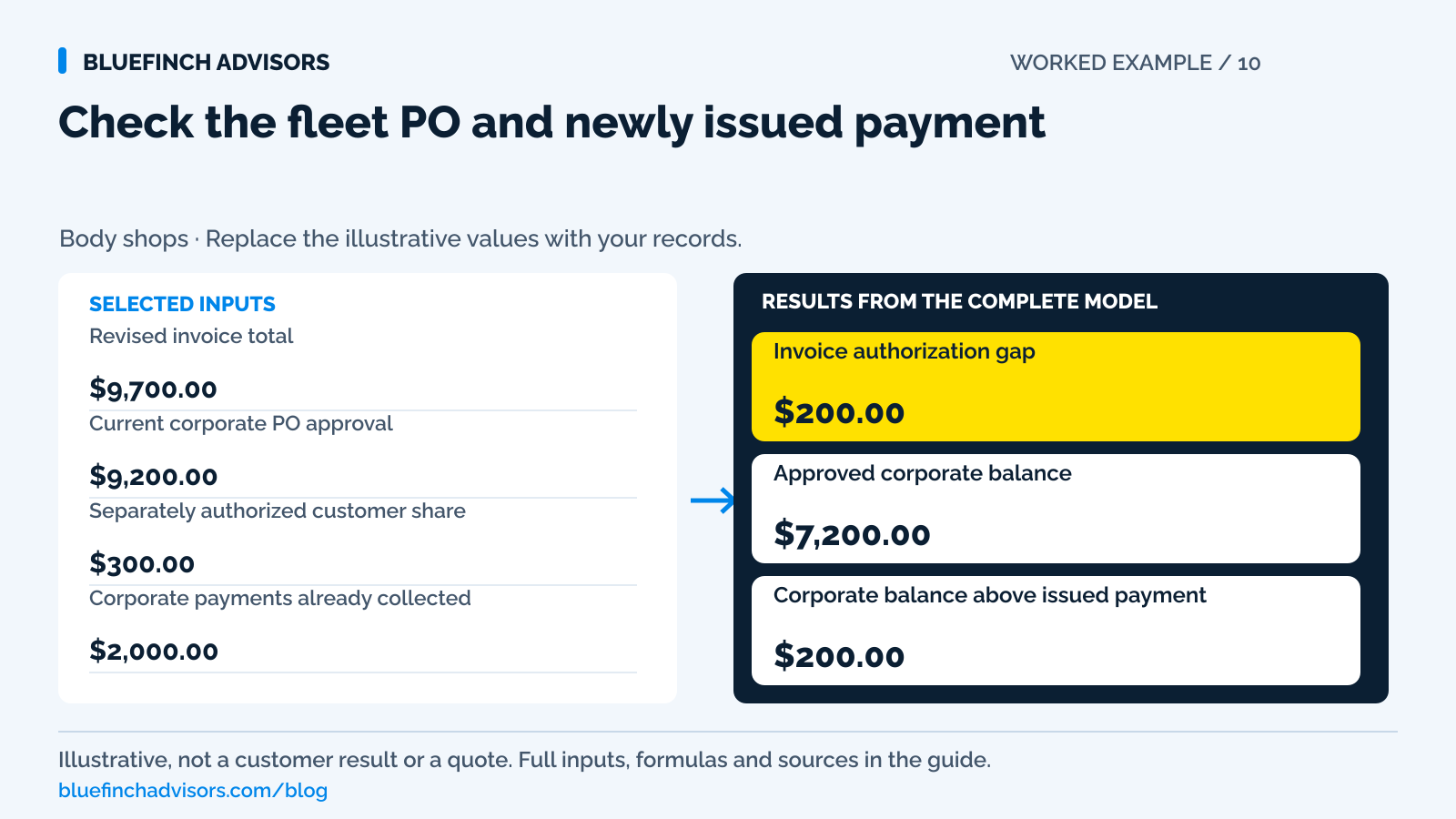
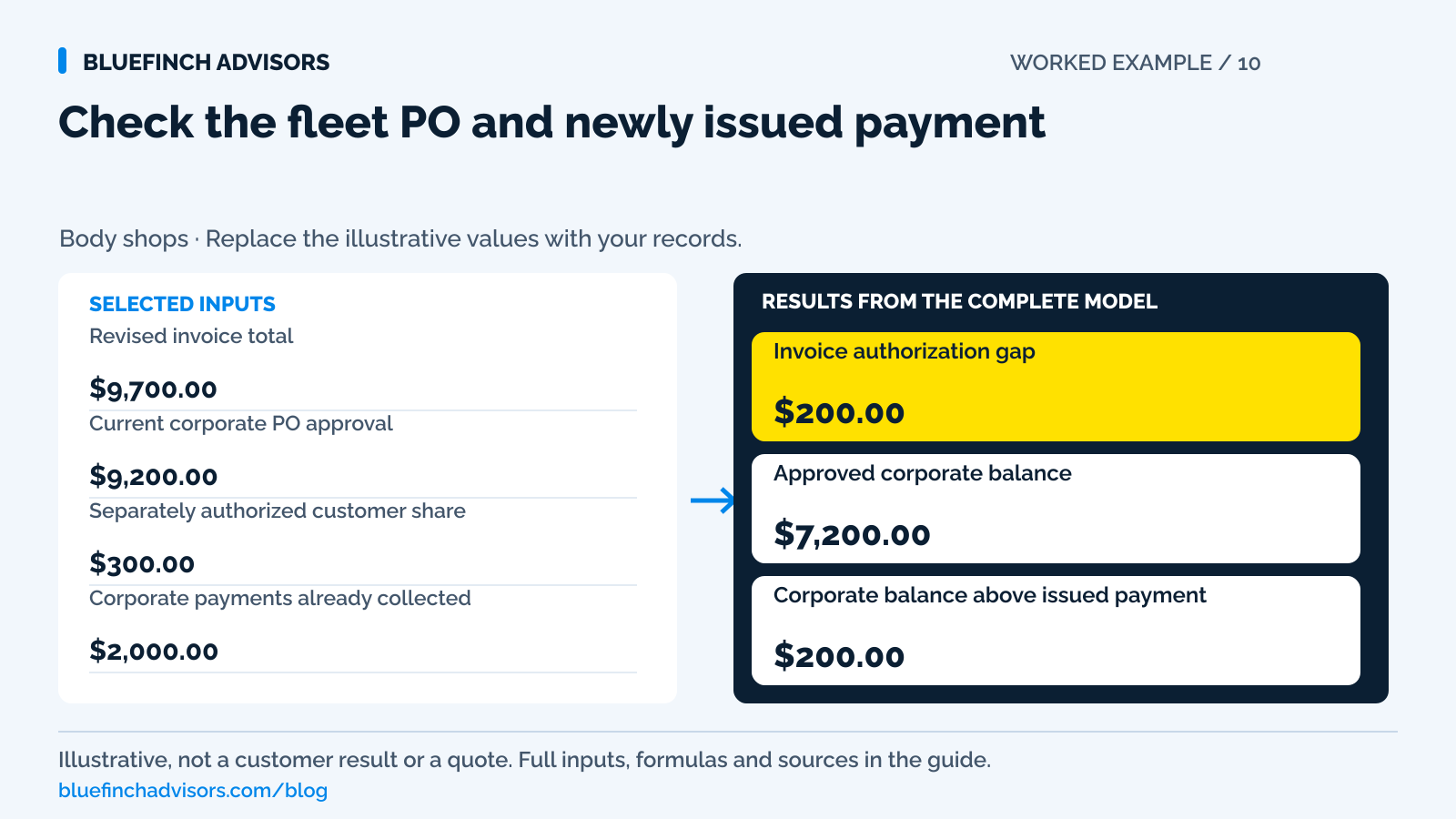
Illustrative example inputs
These starting values show how the math works. They are not industry averages, customer results or a quote.
| Input | Example value |
|---|---|
Revised invoice total Current approved invoice version on a consistent tax basis. | $9,700.00 |
Current corporate PO approval Total confirmed corporate responsibility. | $9,200.00 |
Separately authorized customer share Do not invent a driver-pay amount to close an approval gap. | $300.00 |
Corporate payments already collected Successful prior payments against this PO. | $2,000.00 |
Newly issued payment amount or card limit Confirmed amount executable through the new payment instruction. | $7,000.00 |
Customer share already collected Payments applied to the separately authorized customer amount. | $0.00 |
Example results
| Measure | Result |
|---|---|
Invoice authorization gap Positive indicates invoice dollars without an entered confirmed payer allocation. | $200.00 |
Approved corporate balance Corporate approval less actual prior corporate collections. | $7,200.00 |
Corporate balance above issued payment Positive means the new payment cannot cover the approved unpaid corporate amount. | $200.00 |
Calculation detail
| Measure | Result |
|---|---|
| Customer share remaining | $300.00 |
| Total invoice still uncollected | $7,700.00 |
| Confirmed allocation total | $9,500.00 |
| Issued but not yet collected | $7,000.00 |
Model assumptions
- All defaults are illustrative. PO and customer allocations are supported by actual approvals.
- An issued payment limit is not counted as money collected.
- A negative authorization gap means approval totals overlap or exceed the invoice; investigate it.
Read alongside these results
- Negative payer balances indicate credits or inconsistent entries; they are not hidden.
- This tool does not approve work, change fleet terms, authorize surcharges, or decide vehicle release.
Download this worked example (CSV). Use the interactive version to export your own inputs and results.
Download infographic (PNG) · Download vector (SVG) · Link to the source and methodology

The short version
- Record separate contacts for repair approval, the PO, payment and pickup.
- Check the PO's approved amount as well as its number when the invoice changes.
- Compare the issued payment with the approved unpaid company balance, not the full repair invoice.
The fleet driver is at the counter, the vehicle is ready, and the purchase order is on file. The office still cannot collect the invoice. The supplement exceeded the PO, the payment card covers less than the approved corporate balance, and the driver was never authorized to pay the difference personally.
Before delivery, confirm who approved the revised invoice, who owes it and whether the issued payment can cover the balance. This is a payment-and-authority check, separate from choosing ACH or cards for a fleet account.
Use with this guide
Build the fleet invoice packet
Use the existing fleet checklist for PO, unit, invoice, and payment-reference completeness.
Prepare the delivery handoff
Keep pickup authority and unresolved payer balances visible before delivery.
Test payer-specific balances
Check that software can preserve separate corporate and customer collections.
Browse the complete auto body guides and worksheets.
Identify who approves work, changes the PO, pays and collects
Record who can authorize repairs, who can increase the PO, who issues payment, and who may collect the vehicle. A local driver, fleet manager, claims administrator, and accounts-payable team can each hold one of those roles. The driver's presence at pickup does not establish authority to approve a supplement, change payment terms, or use a company card for an amount outside the program.
Ask for the payer's submission instructions when the job opens. Confirm the company account, unit or VIN reference, PO identifier, invoice format, tax presentation, and required attachments. Wheels' published vendor payment guide is a useful primary example: it requires a PO before payment submission and asks the vendor to verify identifying and invoice information. It is not a universal procedure for every fleet or every collision claim.
Sources for this section: Wheels: Vendor payment process for US repair orders
Check the PO amount again when the estimate changes
Store the current approved PO amount with its version and approval record. Do not treat the presence of a PO number as unlimited spending authority. A supplement can be technically necessary and correctly documented while still awaiting the fleet's commercial approval. Keep that unresolved amount visible before work or collection proceeds under the applicable agreement and repair rules.
California BAR's documentation guidance distinguishes authorization for the specific repair and changes to the authorized work. For shops outside California, apply the local requirements and the fleet agreement. The operational rule remains useful: a revision should carry an identifiable approver and amount. An estimator's email to accounts payable is a request until the authorized party responds; it is not itself an amended PO.
Sources for this section: California BAR: Write It Right
A $9,700 invoice has two different $200 problems
Assume the revised invoice is $9,700. The corporate PO approves $9,200, and a separate $300 customer or driver-pay amount has been properly authorized. Those amounts total $9,500, leaving a $200 invoice authorization gap. The shop must resolve that gap before pretending the whole invoice has a confirmed payer. It could be a missing PO amendment, a mistaken invoice, or another unresolved allocation.
The corporation has already paid $2,000, so its approved unpaid balance is $7,200. The newly issued card or payment instruction allows only $7,000. That creates a second $200 issue: the payment capacity is below the already approved corporate balance. Increasing the PO alone would not fix a card issued for the wrong amount. Conversely, obtaining a larger card would not prove the unallocated invoice charge was authorized.
Read the remittance before entering the card
Match the payment instruction to the correct shop, PO, invoice, and amount. Check whether any agreed discount has already reduced the issued payment, whether tax was entered on the required basis, and whether the payment is intended to settle the full balance or only a portion. Wheels' guide illustrates that invoice details and the amount available on a payment can require separate confirmation.
Do not raise a limited-use card amount to cover a supplement or add a processing charge without the payer's authorization and the applicable program rules. An approved dual-price arrangement at the retail counter does not automatically change a fleet contract. If the fleet route is a virtual card, evaluate its actual acceptance cost and written alternatives separately from the question of whether the invoice is authorized.
Sources for this section: Wheels: Vendor payment process for US repair orders · Visa: U.S. merchant surcharge questions and answers
Preserve payment evidence without copying credentials
Keep the remittance amount, masked card reference, PO, invoice, and successful transaction identifier. Use the provider's secure entry workflow for card credentials. PCI SSC prohibits keeping verification codes after authorization, even with permission. A payer's convenience instructions do not eliminate the shop's own responsibility to avoid storing those codes in repair-order notes, a general inbox archive, or a shared spreadsheet.
If the office needs to share payment status with the estimator, share the status and reference rather than the card details. The estimator needs to know whether $7,200 was approved and collected; they do not need the verification code used at checkout. Limit access to sensitive instructions and use the approved retention process so the payment handoff does not expand the number of places holding card information.
Sources for this section: PCI SSC: Card verification code storage
Resolve exceptions before the pickup appointment
Send the payment owner a concise exception note with the invoice version, PO amount, prior payment, outstanding corporate balance, and exact mismatch. In the example, identify the $200 authorization gap and the $200 payment-limit shortfall as separate issues. Attach the relevant approval and invoice, not an unfiltered repair file. Ask for a specific corrected amount or decision so the response can close the right exception.
Schedule the review before the driver is sent to collect the vehicle. The shop's release decision still depends on its agreement and applicable law; this tool does not determine a right to retain the vehicle. What it can prevent is a surprise at the counter. If an exception remains, tell the designated contacts which payment or authorization is unresolved and who is handling it.
Sources for this section: Wheels: Vendor payment process for US repair orders · California BAR: Write It Right
Check each payer's balance when closing the job
After the corporate payment succeeds, subtract it from the corporate balance and retain the separate customer-share status. If the company sends a duplicate remittance, do not automatically return it to the driver. Identify the original payer and route and follow the approved correction process. Stripe's refund guidance provides one provider example of why refunds normally stay tied to the original payment method.
Use the first completed job under each fleet account to verify the written handoff. Did the PO cover the final invoice? Did the issued payment match? Did the driver receive a clear receipt for any personal amount? Save the answers with the account instructions. The next fleet collision should start with a proven route and named contacts instead of rediscovering payment authority at delivery.
Sources for this section: Stripe: Refund and cancel payments
Questions business owners ask
Does a PO number authorize the entire final invoice?
Not necessarily. Check its approved amount, scope, version, and amendment process. A valid identifier can remain attached to an outdated limit.
Why calculate the card shortfall separately from the PO gap?
One is an authorization problem; the other is a payment-execution problem. The invoice can be approved while the issued payment is too small, or a card can be available for an amount not properly authorized.
Can a driver-pay amount be entered just to make the worksheet balance?
No. Enter only a separately supported customer responsibility. An unresolved corporate charge should stay unresolved until the right party approves or corrects it.
Primary sources
BlueFinch last reviewed these sources on October 2, 2026. Payment rules and state requirements can change.
- Wheels: Vendor payment process for US repair orders
- California BAR: Write It Right
- Visa: U.S. merchant surcharge questions and answers
- PCI SSC: Card verification code storage
- Stripe: Refund and cancel payments
Use this page for general business information. It is not legal, tax, or accounting advice.