Calculate the agreed workshop settlement
Use the agreed revenue base to calculate the guest's share, then show advances and studio-only costs separately.
Use the interactive tool without signing up. It runs in your browser: enter your numbers, save a comparison, download results or print a working copy. Your numbers are not sent to BlueFinch.
Illustrative example inputs
These starting values show how the math works. They are not industry averages, customer results or a quote.
| Input | Example value |
|---|---|
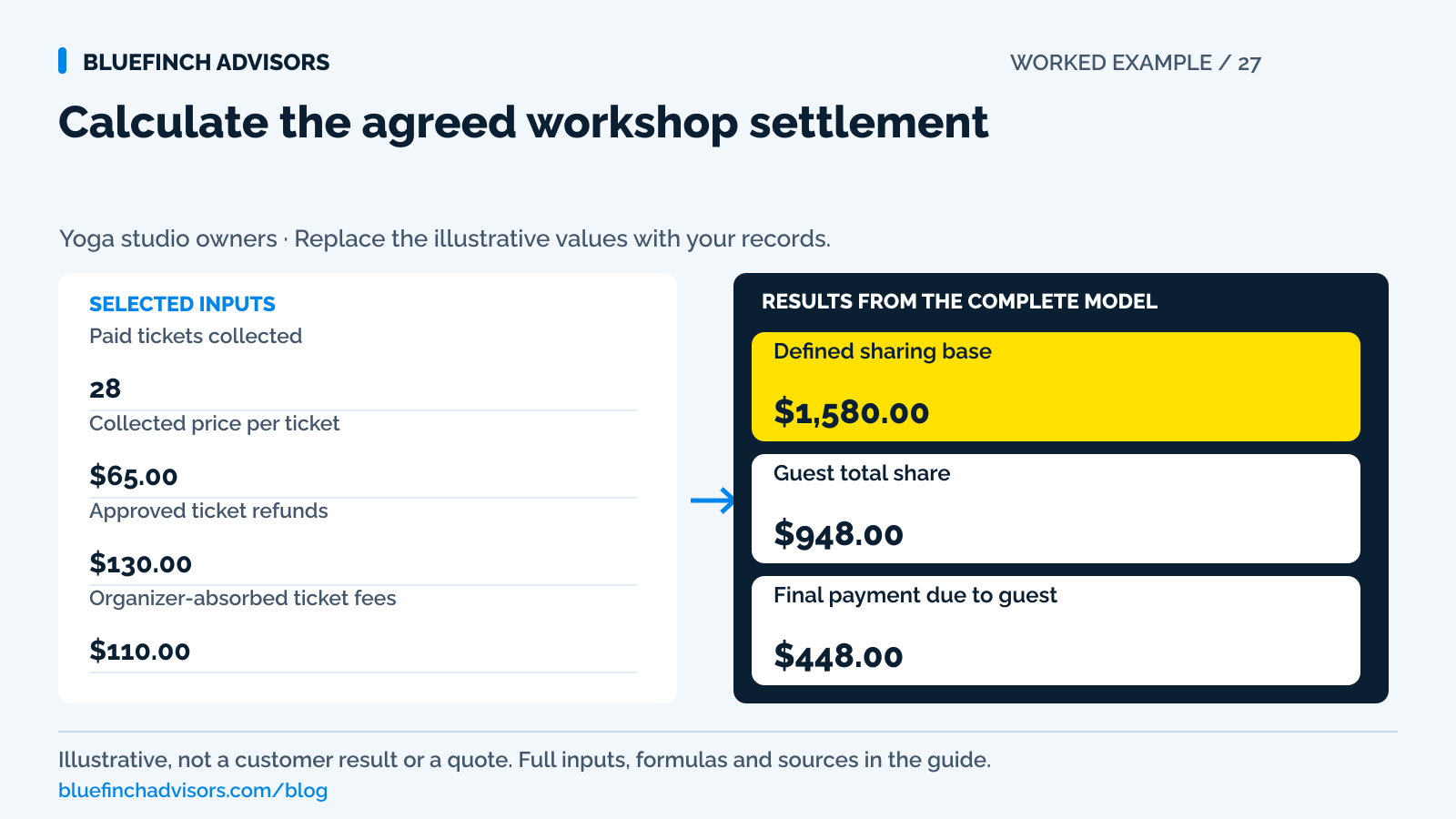
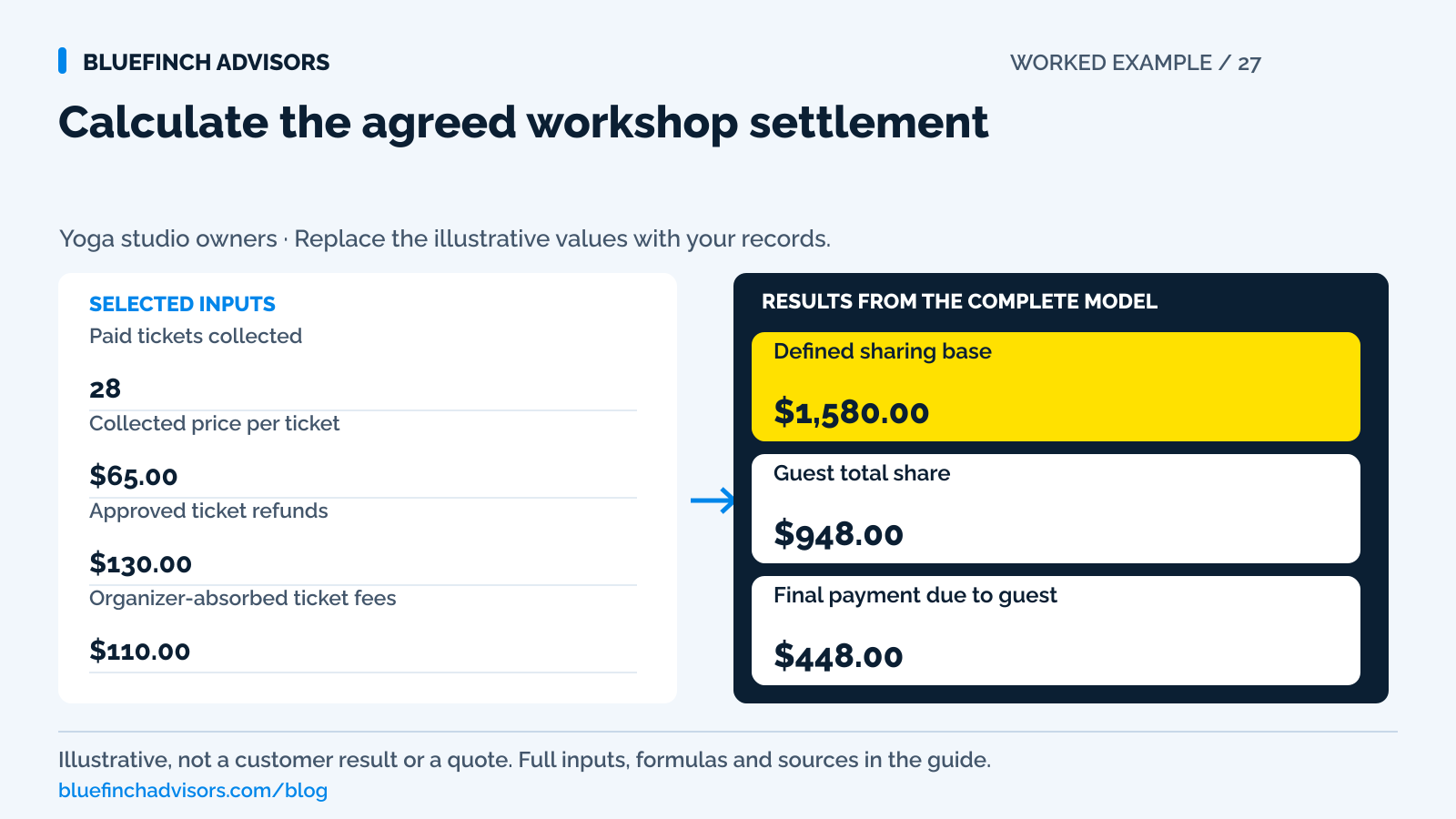
Paid tickets collected Tickets in the settled sales cohort before the separate refund input. | 28 |
Collected price per ticket One-price illustration. Use a weighted collected price if appropriate. | $65.00 |
Approved ticket refunds Refunds included in the agreed sharing-base calculation. | $130.00 |
Organizer-absorbed ticket fees Fees the agreement allows to reduce the sharing base. | $110.00 |
Guest share of defined base Agreed percentage, not an industry standard. | 60% |
Guest advance already paid Completed payment credited against the final settlement. | $500.00 |
Studio-only direct costs Costs borne by the studio after the agreed split. | $240.00 |
Example results
| Measure | Result |
|---|---|
Defined sharing base Collected ticket proceeds less the agreed deductions. | $1,580.00 |
Guest total share The guest's total under this illustrative agreement. | $948.00 |
Final payment due to guest A negative amount signals an advance exceeding the calculated share; review the agreement. | $448.00 |
Studio contribution after direct costs Before studio overhead and costs not entered. | $392.00 |
Calculation detail
| Measure | Result |
|---|---|
| Gross ticket collections | $1,820.00 |
| Agreed deductions | $240.00 |
| Guest advance | $500.00 |
Model assumptions
- Fictional net-share agreement, excluding taxes and merchandise.
- Refunds and fees reduce the sharing base only because this example explicitly assumes the parties agreed to that treatment.
Read alongside these results
- This tool does not decide compensation terms or worker status.
- A negative sharing base or overpaid advance needs review, not an automatic charge to the guest.
Download this worked example (CSV). Use the interactive version to export your own inputs and results.
Download infographic (PNG) · Download vector (SVG) · Link to the source and methodology


The short version
- Agree whether the percentage applies to gross sales or revenue after specified deductions.
- Apply an advance against the final payment, not against the guest's total earned share.
- Check platform fees separately from card surcharges; their rules differ.
The guest teacher and studio agree to split workshop revenue. After the event, they discover that one meant ticket face value and the other meant money left after refunds and fees. Neither the ticket count nor the bank deposit settles that disagreement.
Use a written settlement basis before publishing the event. The calculator illustrates one arrangement in which approved refunds and organizer-absorbed ticket fees are deducted before the guest percentage. It does not recommend that split, establish worker classification, or provide tax or employment advice. The parties must approve the actual agreement.
Use with this guide
Class break-even calculator
Review ordinary class economics separately from this guest settlement.
Event checkout checklist
Test ticket and door-payment records.
Wellness payment-cost audit
Verify the fees actually retained by the studio.
Yoga workshop cancellations: budget the refund decision
Budget a yoga workshop cancellation from approved ticket refunds and retained costs. Use the cash worksheet without treating a break-even estimate as refund policy.
Browse the complete wellness center guides and worksheets.
Replace the phrase split revenue with a formula
Write down the exact base: which ticket sales count, whether discounts reduce it, how refunds are treated, who absorbs platform fees, and whether merchandise or donations are included. Then state the guest percentage and any minimum guarantee, advance, or studio-only costs separately.
The example uses collected ticket proceeds less approved refunds and specified organizer-absorbed fees. A gross-share agreement would produce a different result. Neither method is automatically right. The important step is to make the chosen method understandable before the guest promotes the event or the studio pays an advance.
Keep a short sample calculation in the agreement. If the two parties can independently reproduce the same fictional settlement, the wording is probably clear enough to operate. If they disagree about the sample, resolve it before real customers pay.
Know which fees the organizer actually bears
Eventbrite distinguishes service fees and payment-processing fees, and lets organizers absorb certain ticketing fees or pass them to attendees under its setup. It also describes different treatment for onsite sales. Those details can change the organizer's proceeds even when the ticket face value is unchanged.
Use the event's actual fee report, not a percentage copied from another organizer's event. If buyers pay platform fees on top of the ticket price, do not deduct those same fees from the guest's base unless the agreement and actual money flow support that treatment. The settlement should not charge either side twice.
Discount codes and complimentary places need their own record. A free attendee consumes capacity but does not create collected ticket revenue. A discounted paid ticket contributes the amount actually collected under the chosen base. Do not multiply every attendee by the highest advertised ticket price.
Sources for this section: Eventbrite: ticketing fees and who pays them
The sample guest settlement is $448 after the advance
Twenty-eight paid tickets at $65 produce $1,820 of gross collections. The agreed base deducts $130 of refunds and $110 of organizer-absorbed fees. The sharing base is $1,580.
The guest's fictional 60% share is $948. A $500 advance was already paid, leaving $448 due at final settlement. The studio's 40% is $632. After $240 of studio-only direct costs, the studio retains $392 of contribution before overhead and other excluded expenses.
Do not subtract the advance again when measuring total event profit. It is part of the $948 guest share, not an additional $500 expense on top. The final payment answers a cash question. The total share answers the compensation-cost question.
Schedule the guest payment against a real funding source
The agreement should state when settlement is due and how refunds arriving after that date are handled. Do not promise payment from ticket receipts on a date when the platform has not yet released them. Eventbrite's documentation describes payouts after an event or on a chosen supported schedule, followed by bank processing time.
If the guest is to be paid before those proceeds arrive, identify the studio cash that will fund it. An advance can be a reasonable agreed arrangement, but it creates a cash commitment. A sold-out dashboard is not evidence that the funds are already spendable.
Keep the ticket report, refund detail, fee detail, platform payout, and guest settlement attached to the event reference. The bank deposit may not equal the sharing base if other adjustments or a different payout window are involved. Explain that bridge instead of changing the guest calculation to whatever happens to arrive.
Sources for this section: Eventbrite: payment processing, fees, and payout timing
Agree on refunds and cancellation before opening sales
Publish the attendee policy through the ticketing platform and make sure it matches the event agreement. Eventbrite requires refunds for canceled events under its rules and limits how an organizer can make a published policy more restrictive. Those platform requirements belong in the event planning conversation.
Decide who approves ordinary refund exceptions and how they affect the settlement. If the studio grants a goodwill refund after the guest has been paid, the agreement should address the financial treatment. Do not invent a deduction from the next event because the parties did not discuss the first one.
Separate an attendee refund from a guest cancellation or a change of venue. They may create different obligations and costs. This calculator only reflects the refund amount entered in the approved sharing base. It does not settle those contractual questions.
Sources for this section: Eventbrite: setting and managing refund policies
Keep ticket fees separate from a card-pricing program
A platform service fee is not automatically the same thing as a merchant credit-card surcharge. If the studio also sells seats at the door using dual pricing, confirm how the approved posted prices, ticket records, and guest-share base interact. Attendees should understand the total before they authorize payment.
Visa's guidance distinguishes displayed cash/card prices from adding a checkout fee and prohibits surcharging Visa debit and prepaid cards. Do not treat a wallet as proof of credit-card eligibility. Confirm the specific door-sales workflow with the acquirer and the ticketing provider rather than assuming their settings coordinate automatically.
The next action is to send the guest a sample settlement using the intended fee treatment and payout date. After agreement, run a test ticket purchase and refund through the actual system. Compare the exported records with the sample before opening a larger workshop series.
Sources for this section: Visa: U.S. merchant surcharging and displayed-price distinctions
Questions business owners ask
Is 60% a standard guest-teacher split?
No. It is a fictional input. The actual compensation arrangement must be negotiated and reviewed independently.
Should advances reduce the revenue-sharing base?
Not in this model. The advance reduces the remaining amount payable after the total share is calculated.
What if the guest has a minimum guarantee?
This tool does not model a guarantee. Add a separate approved comparison or use a model designed for that agreement rather than forcing it into the percentage input.
Primary sources
BlueFinch last reviewed these sources on October 2, 2026. Payment rules and state requirements can change.
- Eventbrite: ticketing fees and who pays them
- Eventbrite: payment processing, fees, and payout timing
- Eventbrite: setting and managing refund policies
- Visa: U.S. merchant surcharging and displayed-price distinctions
Use this page for general business information. It is not legal, tax, or accounting advice.